EUR
EUR
USD
English
Latviešu
Francais
English
Русский
Sign Up
Login
Auction
Best sellers
Upcomming auctions
Archive
Shop
Sell
Evaluation
Services
Expertise
Restoration
Antiq selection
Delivery
Contacts
Home
Shop
Show sold items
Show auction items
Available right now
Price
-
EUR
New items
Gifts
EXCLUSIVE
Catalogue categories
ALL ITEMS
Russian art
Objects of Vertu (19)
+
Objects of Vertu (19)
Paintings (640)
+
Paintings (605)
Watercolor (20)
Miniature (3)
Other (12)
Graphic arts (50)
+
Graphic arts (50)
Icons (38)
+
Icons (34)
Church utensils (4)
Frames and easels (43)
+
Frames (28)
Easels (3)
Photo frames (12)
Sculpture (61)
+
Bronze sculptures (33)
Stone sculptures (9)
Stone carving miniature (6)
Other (13)
Silver and metal (248)
+
Russian silver (105)
European silver (69)
Other (74)
Porcelain and ceramics (347)
+
Russian porcelain (23)
European porcelain (111)
Other (213)
Glass (52)
+
Crystal (5)
Glass (47)
Clocks and watches (26)
+
Mantel clocks (8)
Wall clocks (3)
Wrist watches (7)
Pocket watches (5)
Grandfather floor clocks (1)
Other (2)
Furniture (150)
+
Furniture sets (8)
Showcases (26)
Dressers (10)
Tables (33)
Sofas (3)
Armchairs and chairs (17)
Columns (5)
Mirrors (8)
Consoles (10)
Other (30)
Lighting (55)
+
Chandeliers (12)
Sconce (8)
Floor lamps (4)
Lamps (18)
Candlesticks and candelabra (12)
Other (1)
Interior objects (35)
+
Interior objects (35)
Fireplaces and stoves (16)
+
Fireplaces and stoves (6)
Accessories (9)
Other (1)
Carpets and tapestries (2)
+
Carpets (1)
Tapestries (1)
Jewelry (124)
+
Diamonds and precious stones (0)
Rings (50)
Bracelets (7)
Brooches and pendants (2)
Earrings (10)
Jewelry sets (4)
Chains and necklaces (11)
Amber (0)
Bijoux (1)
Other (39)
Weapons and мilitary (20)
+
Weapon (12)
Military (5)
Other (2)
Armour (1)
Orders and medals (4)
+
Orders and medals (3)
Signs and Tokens (0)
Other (1)
Coins and banknotes (17)
+
Coins (17)
Banknotes and Bonds (0)
Other (0)
Mechanics (15)
+
Music boxes (9)
Mechanisms and tools (4)
Models (0)
Other (2)
Print, postcards and other antique paper production (9)
+
Posters (3)
Maps (2)
Postcards (0)
Photos (0)
Other (4)
Books (5)
+
Literature (1)
History (1)
Military (0)
Science (1)
Children`s literature (0)
Other (2)
Garden and architecture (2)
+
Garden sculpture (0)
Fountain (0)
Garden furniture (0)
Architectural elements (2)
Other (0)
Modern Art (72)
+
Paintings (10)
Sculpture (18)
Objects (29)
Other (15)
Collectibles (15)
+
Collectibles (15)
Vintage and fashion (2)
+
Accessories (2)
Clothing (0)
Footwear (0)
Other (0)
Other (9)
+
Other (9)
Asian art
Styles
Louis-Philippe Carl X (11)
Academic art (3)
Antiquity (9)
Art Deco (63)
Art Nouveau (26)
Asian Art (12)
Baroque (26)
Biedermeier (10)
Boulle (4)
Chinoiserie (6)
Classicism (31)
Design of 50-60’s (10)
Design of 70’s (6)
Eclecticism (53)
Empire (29)
Empire - Consulate (1)
Gothic (1)
Gothic Revival (3)
Impressionism (22)
Judaica (2)
Jugendstil (10)
Louis XIII - Renaissance (2)
Louis XIV - Regency (1)
Louis XV (32)
Louis XVI (38)
Modern (107)
Modern Art (98)
Napoleon III (41)
Neo-baroque (5)
Neo-Baroque (10)
Neo-Russian (54)
Neoclassicism (38)
Neorenaissance (13)
Neorococo (37)
Oriental Art (5)
Other style (62)
Realism (51)
Renaissance (7)
Rococo (38)
Romanticism (30)
Vanguard (20)
Victorian Style (4)
Epoques
16th century (2)
17th century (4)
18th century (28)
19th century (331)
20th century (331)
21th century (269)
At the turn of 16th -17th century (1)
At the turn of 17th-18th century (1)
At the turn of 19th -20th century (201)
At the turn of the 15th - 16th century (4)
At the turn of the 18th -19th century (12)
Early 17th century (1)
Early 18th century (1)
Early 19th century (20)
Early 20th century (402)
Late 18th century (3)
Late 19th century (99)
Mid-17th century (14)
Mid-18th century (1)
Mid-19th century (38)
Mid-20th century (272)
The end of the 17th century (1)
The end of the 20th century (45)
19th century
Price (descending)
Price (ascending)
Date (ascending)
Date (descending)
1
2
3
4
...
6
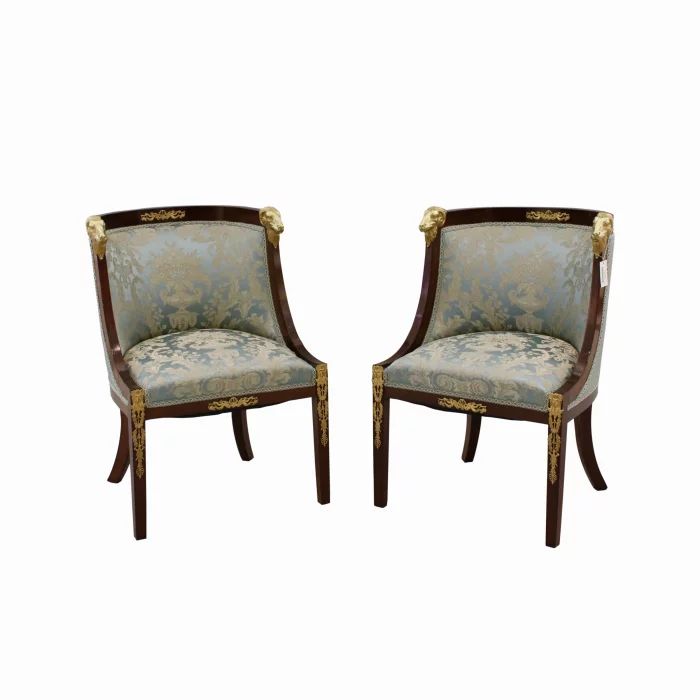
PAIR OF EMPIRE STYLE ARMCHAIRS FRANCE, FIRST QUARTER OF THE 19TH CENTURY
A distinguished pair of Empire period armchairs crafted from mahogany and adorned with gilt bronze mounts. The chairs form an elegant semi-cylindrical volume with straight, architecturally emphatic front legs and dynamically curved rear supports. The high sweeping arms merge seamlessly into the backrests and terminate in finely cast gilt bronze ram’s heads, serving as the principal symbolic and decorative accents. The primary ornamentation is concentrated on the façade: the legs and horizontal stretchers are enriched with delicately executed grotesques echoing the ram motif, as well as arabesques with trumpeting trophies, pearls, and shells. The warm, deep tone of the polished mahogany provides a refined contrast to the brilliance of the gilt bronze. The upholstery is executed in classical patterned textile with vegetal motifs, harmoniously complementing the строгая architectural clarity of the form.Dimensions: Height: 78 cm. Width: 53 cm.Condition: After professional full restoration. The structure has been stabilised, the mahogany carefully conserved, the gilt bronze mounts cleaned and secured, and the upholstery renewed with respect for the historical character of the pieces.Provenance: Private European collection.
Begins 03.05.2026
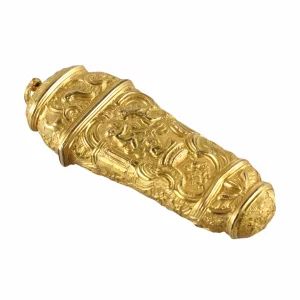
Necessaire. France 19th century.
Begins 03.05.2026 10:00:00
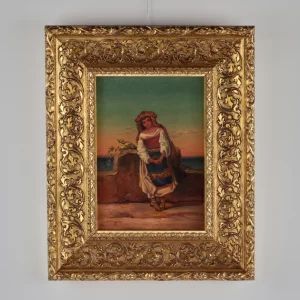
Painting Neopolitan.
420 EUR
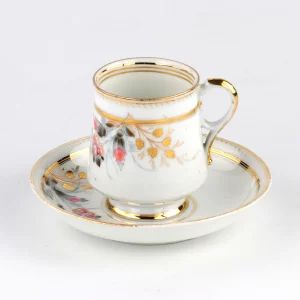
Tea pair from the Kuznetsov factory in Volkhov. 1880s.
Begins 02.05.2026 12:00:00
Photo frame
Begins 03.05.2026 10:00:00
Vase. Sevres.
Begins 03.05.2026 10:00:00
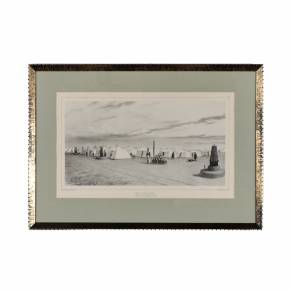
Lithograph Camp of the infantry in Voznesensk. 1837
150 EUR
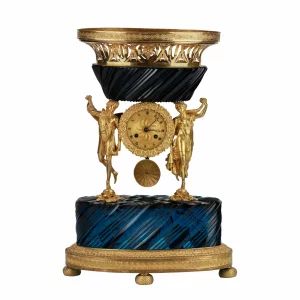
UNIQUE MANTEL CLOCK WITH SOLAR ALLEGORY. MODEL ATTRIBUTED TO CARLO ROSSI RUSSIAN EMPIRE, SAINT PETERSBURG, PERIOD OF NICHOLAS I, 1825-1855
Begins 02.05.2026 12:00:00
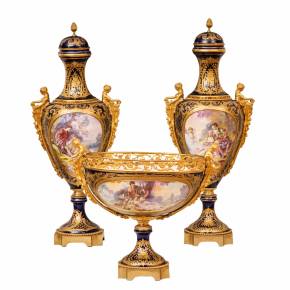
PORCELAIN GARNITURE. MANUFACTURE NATIONALE DE SÈVRES FRANCE, 1819
Begins 03.05.2026 10:00:00
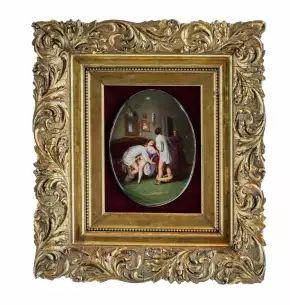
Porcelain slab Love Game, KPM Berlin, circa 1830
Begins 03.05.2026 10:00:00
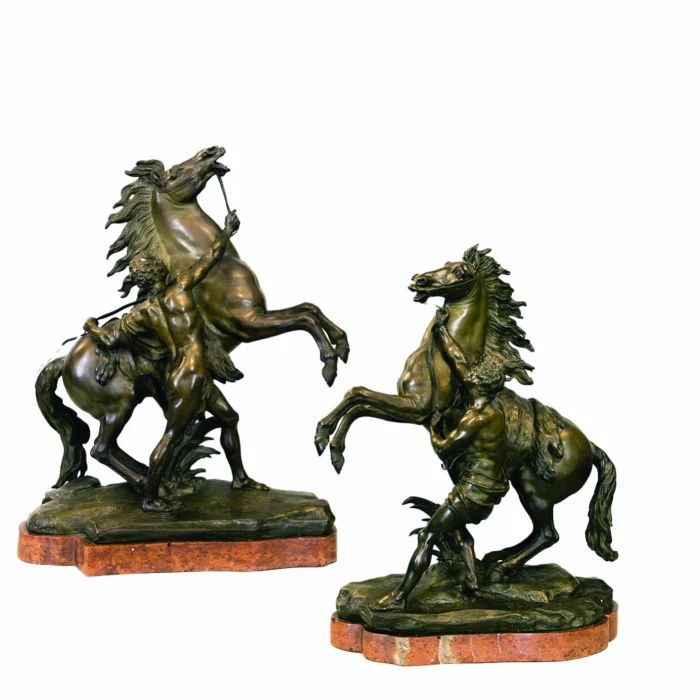
PAIR OF SCULPTURES “THE MARLY HORSES”, AFTER GUILLAUME COUSTOU THE ELDER (1677–1746) FRANCE, 19TH CENTURY
The pair of sculptural compositions known as “The Marly Horses”, also referred to as “The Horse Tamers”, represents a highly accomplished bronze interpretation of one of the most celebrated works of French court sculpture of the 18th century. The compositions derive from the original marble group created by Guillaume Coustou the Elder for the terrace of the royal château of Marly-le-Roi during the reign of Louis XV.The sculptures depict nude youths exerting great effort to restrain rearing horses. The dramatic tension of the scene is conveyed through the powerful contrast between the untamed energy of the animals and the academically precise treatment of human anatomy. The figures are conceived in complex spatial movement, creating a strong sense of continuous action and internal dynamism characteristic of the finest examples of French monumental sculpture.The bronzes are cast with exceptional attention to detail. The musculature of the human figures, the animated manes and strained necks of the horses, as well as the expressive gestures and corporeal plasticity, are all rendered with remarkable clarity. The surfaces retain a deep, even patina of a warm tone, enhancing the sculptural relief and the play of light and shadow. Each figure is mounted on a shaped marble base of harmonious coloration, lending the ensemble a distinctly ceremonial and interior-oriented presence.Material: Bronze; marble.Dimensions: Height – 66 cm; Width – 53 cm; Depth – 48 cm (each sculpture).Condition: Good.Provenance: Photo archive of a private collection. Formerly part of a private collection displayed in the Liechtenstein palaces, Stadtpalais Vienna and Schloss Vaduz, Liechtenstein, 1945.
Begins 03.05.2026
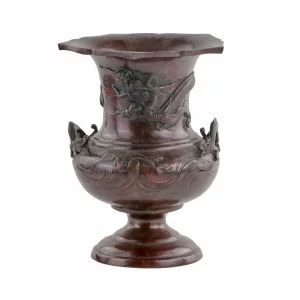
Bronze Chinese vase of the 19th century.
Begins 03.05.2026 10:00:00
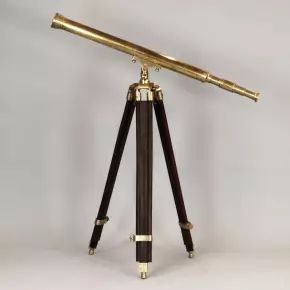
Telescope W & J. George Ltd, London
Begins 03.05.2026 10:00:00
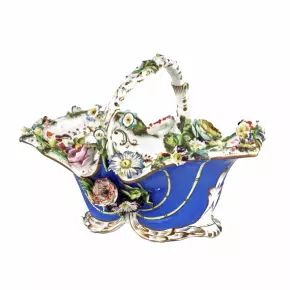
Porcelain basket with floral decor in Rococo style Europe, second half of the 19th century
Begins 03.05.2026 10:00:00
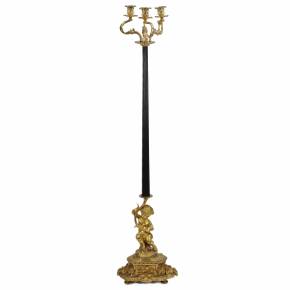
Bronze floor lamp with the figure of Putti. France. 19th century.
Begins 03.05.2026 10:00:00
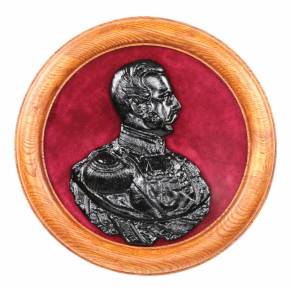
Panel with a cast-iron bas-relief of Emperor Alexander II.
Begins 02.05.2026 12:00:00
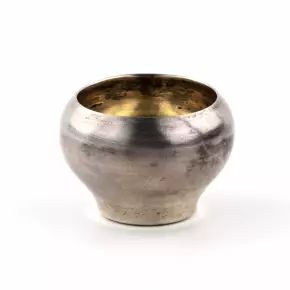
Russian silver salt shaker in the form of a cast-iron.
Begins 02.05.2026 12:00:00
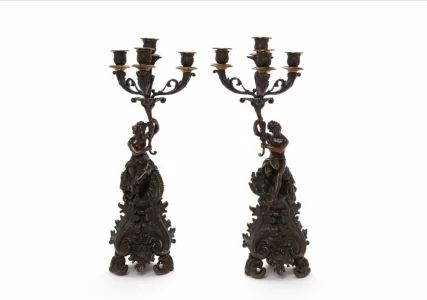
A pair of candelabra. Belle Epoque
Begins 03.05.2026 10:00:00
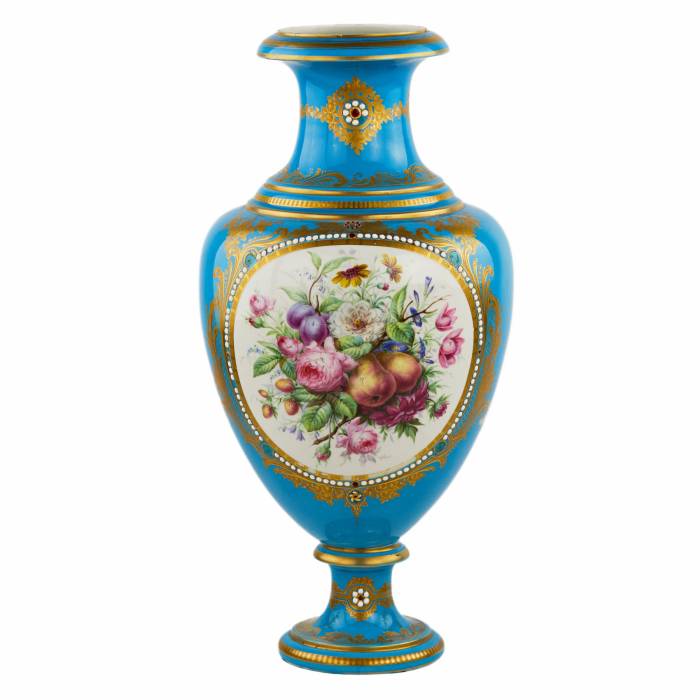
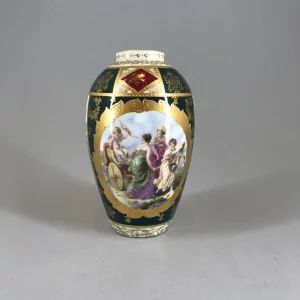
LARGE PORCELAIN VASE “THE BIRTH OF VENUS” FRANCE, MANUFACTURE NATIONALE DE SÈVRES, SECOND HALF OF THE 19TH CENTURY
A large ceremonial porcelain vase of amphora form, produced at the renowned Manufacture nationale de Sèvres. The shape is inspired by Renaissance prototypes, with carefully balanced proportions, a high neck, and a stable circular foot. The body is covered with a rich turquoise-blue glaze serving as a ground for refined polychrome painting and lavish gilt ornamentation, characteristic of the highest artistic production of Sèvres in the 19th century.The front is adorned with a large oval medallion depicting the mythological scene The Birth of Venus. The goddess is shown at the moment of her triumphant emergence from the sea in a shell, with a flowing red drapery, surrounded by putti and music-making nymphs. The movement of the waves, the play of wind, and the dynamic arrangement of figures emphasize the allegorical nature of the scene, symbolizing the triumphant power of love, harmony of nature, and ideal beauty. The composition draws upon Renaissance and academic traditions widely embraced by French art of the period.The reverse features a richly painted still life with an opulent bouquet of flowers, pears, and plums. This imagery, traditionally associated with abundance and fertility, forms a meaningful dialogue with the mythological subject on the front. The painting is framed by a gilt cartouche with a pearl border. The body is further enriched with elaborate gilt vegetal and classical ornamentation executed with exceptional precision.Marks:Hand-painted underglaze cobalt mark of the Manufacture nationale de Sèvres, featuring a working monogram and the letter “P”. Such letter marks formed part of the internal attribution system used by the artistic workshops and painting ateliers of the manufactory in the second half of the 19th century and are characteristic of ceremonial vases with painted medallions.Dimensions: Height: 42 cm; Width: 25 cm; Depth: 25 cm.Condition: Good. Even glaze, no cracks or chips. Minor signs of age and light wear to the gilding on raised areas. The painted decoration is well preserved, with no evidence of restoration.Provenance: Private European collection.
Begins 03.05.2026
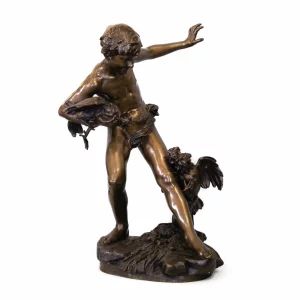
PAUL CHEVRE. BOY SEPARATING FIGHTING COCKS FRANCE / CANADA, LATE 19TH - EARLY 20TH CENTURY
Begins 03.05.2026 10:00:00
Fruit vase. Carl Thieme.
Begins 03.05.2026 10:00:00
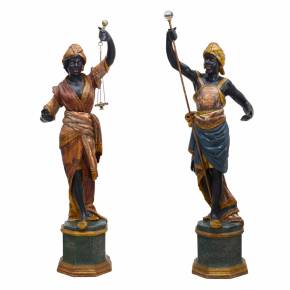
PAIR OF SCULPTURES “MOORISH PORTERS” FRANCE, 19TH CENTURY
Begins 03.05.2026 10:00:00
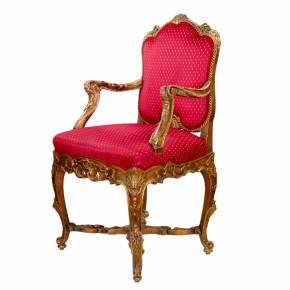
Magnificent, carved chair in the Rococo style of the 19th-20th centuries.
Begins 03.05.2026 10:00:00
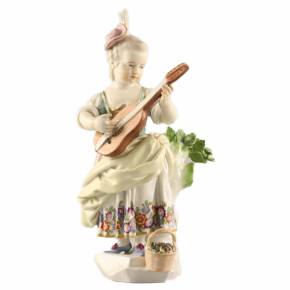
Girl with a lute. 19th century.
Begins 03.05.2026 10:00:00
Silver case with lighters
580 EUR
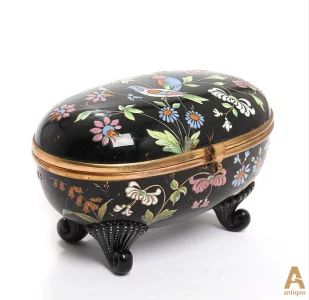
An elegant French jewelry box
Begins 03.05.2026 10:00:00
Muse
2670 EUR
1
2
3
4
...
6
Subscribe to our newsletter
Never miss new auctions
You have subscribed to our newsletter.
Subscribe
Your latest views
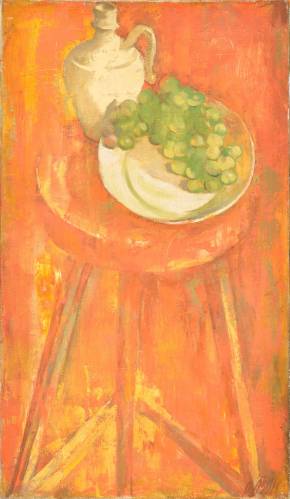
Still life with grapes
600 EUR
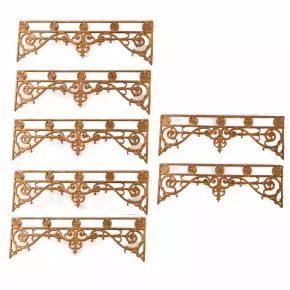
7 Cast Iron Window Bars
300 EUR
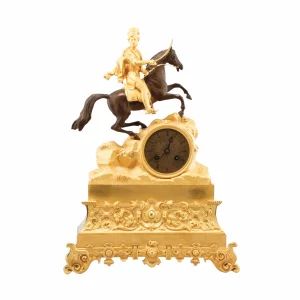
Mantel clock Cavalryman
Begins 03.05.2026 10:00:00
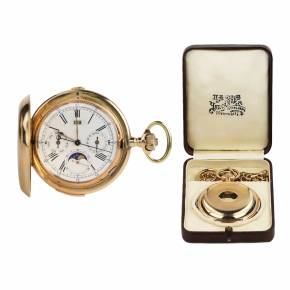
GOLD REPEATER POCKET WATCH BY LOUIS ARMAND SWITZERLAND, CIRCA 1900
Begins 02.05.2026 12:00:00
UNIQUE MANTEL CLOCK WITH SOLAR ALLEGORY. MODEL ATTRIBUTED TO CARLO ROSSI RUSSIAN EMPIRE, SAINT PETERSBURG, PERIOD OF NICHOLAS I, 1825-1855
Begins 02.05.2026 12:00:00
Dish for small items. Bogatyr Svyatogor. 1909.
Begins 02.05.2026 12:00:00
CRYSTAL JUG WITH SILVER, 13TH ARTEL RUSSIA, MOSCOW, EARLY 20TH CENTURY
Begins 02.05.2026 12:00:00
LADY’S NECESSAIRE IN BLOODSTONE AND GILT BRONZE. FRANCE, LOUIS XV PERIOD
Begins 03.05.2026 10:00:00
Engraving
Begins 03.05.2026 10:00:00
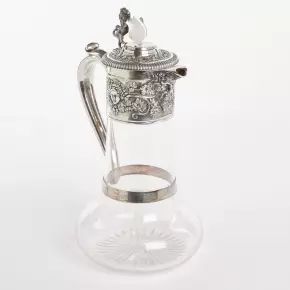
Silver wine jug with glass. Horace Woodward & Hugh Taylor, London 1893.
Begins 03.05.2026 10:00:00
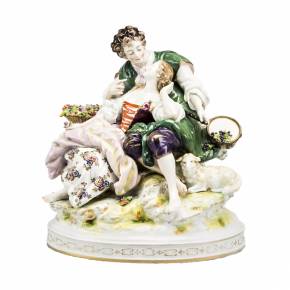
Porcelain group Romantic couple.
Begins 03.05.2026 10:00:00
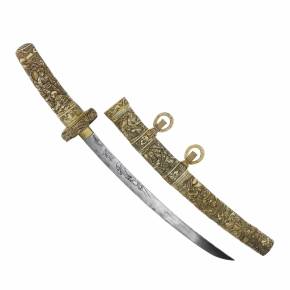
Japanese Wakizashi Sword in Carved Bone Sheath, Late Meiji Period (turn of the 19th–20th centuries)
Begins 03.05.2026 10:00:00
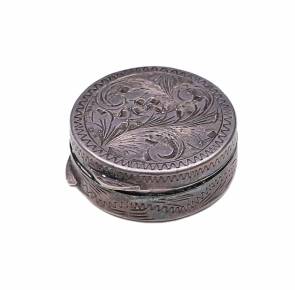
Silver snuffbox.
Begins 03.05.2026 10:00:00
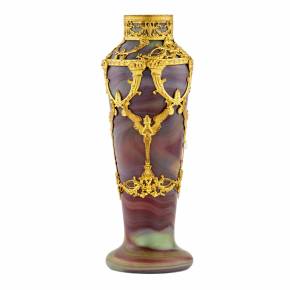
Decorative vase
Begins 03.05.2026 10:00:00
Telescope W & J. George Ltd, London
Begins 03.05.2026 10:00:00
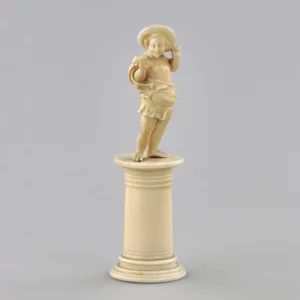
Carved ivory figurine of a boy with a bird 1800s.
Begins 03.05.2026 10:00:00
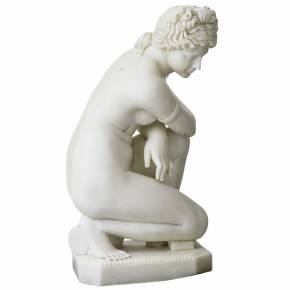
MARBLE SCULPTURE “THE BATHING VENUS” EUROPE, 19TH - EARLY 20TH CENTURY
Begins 03.05.2026 10:00:00
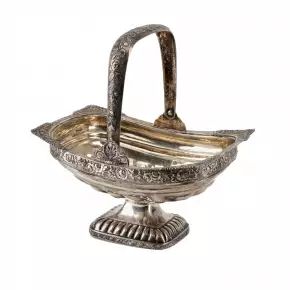
Russian silver candy bowl. St. Petersburg 1837
Begins 02.05.2026 12:00:00
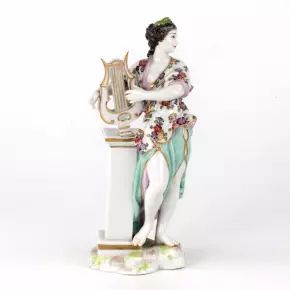
Girl with a lyre. DRESDEN
Begins 03.05.2026 10:00:00
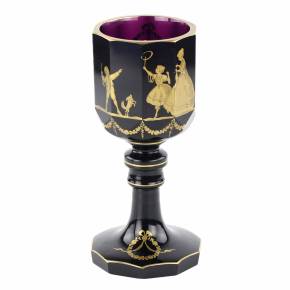
DECAGONAL GOBLET IN PURPLE CRYSTAL WITH GILT DECORATION ST PETERSBURG, 1810s IMPERIAL GLASS FACTORY
Begins 02.05.2026 12:00:00
Start hunt for treasures!
Individual
Legal entity
Enter a name (min 3 characters)
Enter a Last name (min 3 characters)
Enter the email
User already exist
Algeria (+213)
Andorra (+376)
Angola (+244)
Anguilla (+1264)
Antigua & Barbuda (+1268)
Argentina (+54)
Armenia (+374)
Aruba (+297)
Australia (+61)
Austria (+43)
Azerbaijan (+994)
Bahamas (+1242)
Bahrain (+973)
Bangladesh (+880)
Barbados (+1246)
Belarus (+375)
Belgium (+32)
Belize (+501)
Benin (+229)
Bermuda (+1441)
Bhutan (+975)
Bolivia (+591)
Bosnia Herzegovina (+387)
Botswana (+267)
Brazil (+55)
Brunei (+673)
Bulgaria (+359)
Burkina Faso (+226)
Burundi (+257)
Cambodia (+855)
Cameroon (+237)
Canada (+1)
Cape Verde Islands (+238)
Cayman Islands (+1345)
Central African Republic (+236)
Chile (+56)
China (+86)
Colombia (+57)
Comoros (+269)
Congo (+242)
Cook Islands (+682)
Costa Rica (+506)
Croatia (+385)
Cuba (+53)
Cyprus North (+90392)
Cyprus South (+357)
Czech Republic (+42)
Denmark (+45)
Djibouti (+253)
Dominica (+1809)
Dominican Republic (+1809)
Ecuador (+593)
Egypt (+20)
El Salvador (+503)
Equatorial Guinea (+240)
Eritrea (+291)
Estonia (+372)
Ethiopia (+251)
Falkland Islands (+500)
Faroe Islands (+298)
Fiji (+679)
Finland (+358)
France (+33)
French Guiana (+594)
French Polynesia (+689)
Gabon (+241)
Gambia (+220)
Georgia (+7880)
Germany (+49)
Ghana (+233)
Gibraltar (+350)
Greece (+30)
Greenland (+299)
Grenada (+1473)
Guadeloupe (+590)
Guam (+671)
Guatemala (+502)
Guinea (+224)
Guinea - Bissau (+245)
Guyana (+592)
Haiti (+509)
Honduras (+504)
Hong Kong (+852)
Hungary (+36)
Iceland (+354)
India (+91)
Indonesia (+62)
Iran (+98)
Iraq (+964)
Ireland (+353)
Israel (+972)
Italy (+39)
Jamaica (+1876)
Japan (+81)
Jordan (+962)
Kazakhstan (+7)
Kenya (+254)
Kiribati (+686)
Korea North (+850)
Korea South (+82)
Kuwait (+965)
Kyrgyzstan (+996)
Laos (+856)
Latvia (+371)
Lebanon (+961)
Lesotho (+266)
Liberia (+231)
Libya (+218)
Liechtenstein (+417)
Lithuania (+370)
Luxembourg (+352)
Macao (+853)
Macedonia (+389)
Madagascar (+261)
Malawi (+265)
Malaysia (+60)
Maldives (+960)
Mali (+223)
Malta (+356)
Marshall Islands (+692)
Martinique (+596)
Mauritania (+222)
Mayotte (+269)
Mexico (+52)
Micronesia (+691)
Moldova (+373)
Monaco (+377)
Mongolia (+976)
Montserrat (+1664)
Morocco (+212)
Mozambique (+258)
Myanmar (+95)
Namibia (+264)
Nauru (+674)
Nepal (+977)
Netherlands (+31)
New Caledonia (+687)
New Zealand (+64)
Nicaragua (+505)
Niger (+227)
Nigeria (+234)
Niue (+683)
Norfolk Islands (+672)
Northern Marianas (+670)
Norway (+47)
Oman (+968)
Palau (+680)
Panama (+507)
Papua New Guinea (+675)
Paraguay (+595)
Peru (+51)
Philippines (+63)
Poland (+48)
Portugal (+351)
Puerto Rico (+1787)
Qatar (+974)
Reunion (+262)
Romania (+40)
Russia (+7)
Rwanda (+250)
San Marino (+378)
Sao Tome & Principe (+239)
Saudi Arabia (+966)
Senegal (+221)
Serbia (+381)
Seychelles (+248)
Sierra Leone (+232)
Singapore (+65)
Slovak Republic (+421)
Slovenia (+386)
Solomon Islands (+677)
Somalia (+252)
South Africa (+27)
Spain (+34)
Sri Lanka (+94)
St. Helena (+290)
St. Kitts (+1869)
St. Lucia (+1758)
Sudan (+249)
Suriname (+597)
Swaziland (+268)
Sweden (+46)
Switzerland (+41)
Syria (+963)
Taiwan (+886)
Tajikstan (+7)
Thailand (+66)
Togo (+228)
Tonga (+676)
Trinidad & Tobago (+1868)
Tunisia (+216)
Turkey (+90)
Turkmenistan (+7)
Turkmenistan (+993)
Turks & Caicos Islands (+1649)
Tuvalu (+688)
Uganda (+256)
UK (+44)
Ukraine (+380)
United Arab Emirates (+971)
Uruguay (+598)
USA (+1)
Uzbekistan (+7)
Vanuatu (+678)
Vatican City (+379)
Venezuela (+58)
Vietnam (+84)
Virgin Islands - British (+1284)
Virgin Islands - US (+1340)
Wallis & Futuna (+681)
Yemen (North)(+969)
Yemen (South)(+967)
Zambia (+260)
Zimbabwe (+263)
Enter the phone number
Minimum password length must be at least 6 characters
Enter a name of your company (min 3 characters)
Enter registration number (min 3 characters)
Enter the email
User already exist
Enter the phone number
Minimum password length must be at least 6 characters
I am a buyer
I am a seller
or log in with
Sign up for our weekly newsletter
I reviewed and agree
user agreement
,
«Privacy Policy»
i agree with Antiqon Terms and conditions
Register
Already have an account?
Log In
Enter your email and password for authorization
Enter the email
The number of attempts has been used uo, repeat after 2 hours
Minimum password length must be at least 6 characters
Invalid email or password
or log in with
Login
Forgot password?
Don't have an account?
register