Price
- EUR
Catalogue categories

Porcelain and ceramics

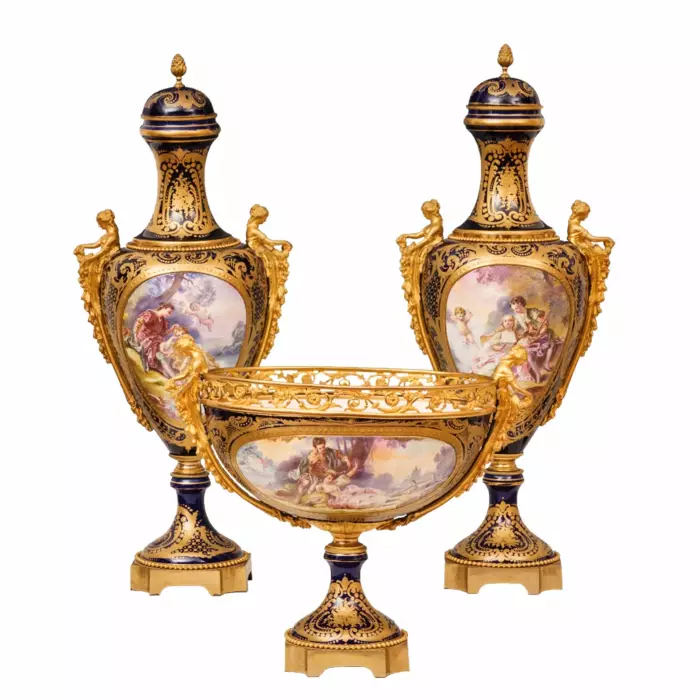
LARGE VASE WITH BRONZE MOUNTS AND PAINTED DECORATION “THE TRIUMPH OF VENUS” FRANCE, SECOND HALF OF THE 19TH CENTURY
A monumental vase combining gilt bronze and painted porcelain, representing a striking example of French decorative art of the Second Empire and the Historicist period. The oval bowl with a rich emerald-green ground is adorned with a central painted composition depicting the allegorical scene “The Triumph of Venus”, executed in the spirit of 18th century academic mythological painting. On the reverse appears an exquisite floral bouquet rendered with refined naturalism and delicate chromatic nuances.The porcelain body is mounted within an elaborate architectural framework of finely chased gilt bronze with openwork Rocaille ornamentation. The handles curve in dynamic vegetal scrolls with mascarons and ornamental cartouches. The upper rim forms an airy gallery of scrolling foliage and stylised acanthus leaves. The base is conceived as a ceremonial pedestal with a baluster stem and a four-sided support, richly decorated with relief elements and symmetrical scrollwork.The artistic conception unites elements of Neo-Rococo and Neo-Baroque, characteristic of Parisian bronze workshops of the second half of the 19th century. Stylistic features and the quality of porcelain painting suggest a connection with the traditions of the Sèvres manufactory, renowned for producing grand decorative vases and mantel ornaments for aristocratic residences.Dimensions: height 38 cm; width 54 cm; depth 32 cm.Condition: Good. Gilding even and well preserved. Minor wear to the base. No deformations, cracks, restorations or traces of active use.
2300 EUR
Porcelain dish from the Kuznetsov factory with a scene of calling the hero Mikula Selyaninovich. Early 20th century
A large porcelain decorative plate with a genre scene made in the technique of polychrome painting, located in the mirror of the plate and a stylized Russian-style leaf ornament along the flat side of the dish. The picturesque painting of the plate is made by hand. On the relief edge of the side of the plate, gold and blue decorative stripes are applied. Such decorative decoration and a flat side give the plate the appearance of a genre picture, framed in a beautiful painted frame. The reverse side of the plate is decorated along its side with a golden cover and an inscription with the name of the painting plot. The genre scene in the center of the plate is made to the motive of the Russian epic Mikula Selyaninovich, as evidenced by the inscription on the bottom of the dish - the epic Mikula Selyaninovich. The episode of the summoning of Mikula Selyaninovich by the bogatyr Volga Svyatoslavich to collect taxes is depicted. Typical is the image of the epic hero not in elegant boots, but in simple peasant bast shoes. Some researchers of the Russian epic interpret this scene as a meeting of the hunter god with the plowman god. This interpretation is due to the fact that Mikula Selyaninovich in Russian culture personified the god of agriculture. In the lower left part of the genre picture is the signature of the artist-ceramist, presented in the form of a monogram consisting of Latin and Russian capital block letters DB (unknown artist of the Kuznetsov factory). The plate is part of a series of several similar plates decorated on the theme of the Russian folk epic (at least 9 pieces), made in the Russian style in the second half of the 19th century (1870-1880s) at the Tver faience factory of M.S. Kuznetsov. The Tver faience factory was acquired by M.S. Kuznetsov in 1870, which already under the first owner and founder of the factory (the Auerbach family) became famous in Russia for products in the pseudo-Russian style. A series of epic plates from the Tver factory may have been exhibited at the Polytechnic Exhibition of 1889. Production mark of the factory M.S. Kuznetsov in Tver in the form of a small state emblem - a double-headed eagle and the inscription M.S. Kuznetsov Tver province located on the tape. The printed stamp is filled with gold, which testifies to the special purpose of the subject. Russian Empire, Tver province. Factory of M.S. Kuznetsov. 1870-1889 years.Porcelain, hand-painted polychrome, gilding, golden cover. Collection safety. Diameter - 25.5 cm, weight - 668 gr.
2000 EUR
Subscribe to our newsletter
Never miss new auctions
Subscribe

Your latest views