EUR
EUR
USD
English
Latviešu
Francais
English
Русский
Sign Up
Login
Auction
Best sellers
Upcomming auctions
Archive
Shop
Sell
Evaluation
Services
Expertise
Restoration
Antiq selection
Delivery
Contacts
Home
Shop
Show sold items
Show auction items
Available right now
Price
-
EUR
New items
Gifts
EXCLUSIVE
Catalogue categories
ALL ITEMS
Russian art
Objects of Vertu (19)
+
Objects of Vertu (19)
Paintings (640)
+
Paintings (605)
Watercolor (20)
Miniature (3)
Other (12)
Graphic arts (50)
+
Graphic arts (50)
Icons (38)
+
Icons (34)
Church utensils (4)
Frames and easels (43)
+
Frames (28)
Easels (3)
Photo frames (12)
Sculpture (61)
+
Bronze sculptures (33)
Stone sculptures (9)
Stone carving miniature (6)
Other (13)
Silver and metal (255)
-
Russian silver (105)
European silver (74)
Other (76)
Porcelain and ceramics (349)
+
Russian porcelain (23)
European porcelain (114)
Other (212)
Glass (52)
+
Crystal (5)
Glass (47)
Clocks and watches (25)
+
Mantel clocks (7)
Wall clocks (3)
Wrist watches (7)
Pocket watches (5)
Grandfather floor clocks (1)
Other (2)
Furniture (147)
+
Furniture sets (8)
Showcases (25)
Dressers (10)
Tables (30)
Sofas (3)
Armchairs and chairs (17)
Columns (5)
Mirrors (8)
Consoles (10)
Other (31)
Lighting (52)
+
Chandeliers (11)
Sconce (8)
Floor lamps (4)
Lamps (16)
Candlesticks and candelabra (12)
Other (1)
Interior objects (35)
+
Interior objects (35)
Fireplaces and stoves (14)
+
Fireplaces and stoves (6)
Accessories (7)
Other (1)
Carpets and tapestries (2)
+
Carpets (1)
Tapestries (1)
Jewelry (124)
+
Diamonds and precious stones (0)
Rings (50)
Bracelets (7)
Brooches and pendants (2)
Earrings (10)
Jewelry sets (4)
Chains and necklaces (11)
Amber (0)
Bijoux (1)
Other (39)
Weapons and мilitary (20)
+
Weapon (12)
Military (5)
Other (2)
Armour (1)
Orders and medals (4)
+
Orders and medals (3)
Signs and Tokens (0)
Other (1)
Coins and banknotes (17)
+
Coins (17)
Banknotes and Bonds (0)
Other (0)
Mechanics (15)
+
Music boxes (9)
Mechanisms and tools (4)
Models (0)
Other (2)
Print, postcards and other antique paper production (9)
+
Posters (3)
Maps (2)
Postcards (0)
Photos (0)
Other (4)
Books (5)
+
Literature (1)
History (1)
Military (0)
Science (1)
Children`s literature (0)
Other (2)
Garden and architecture (2)
+
Garden sculpture (0)
Fountain (0)
Garden furniture (0)
Architectural elements (2)
Other (0)
Modern Art (72)
+
Paintings (10)
Sculpture (18)
Objects (29)
Other (15)
Collectibles (15)
+
Collectibles (15)
Vintage and fashion (2)
+
Accessories (2)
Clothing (0)
Footwear (0)
Other (0)
Other (10)
+
Other (10)
Asian art
Styles
Louis-Philippe Carl X (11)
Academic art (3)
Antiquity (9)
Art Deco (63)
Art Nouveau (27)
Asian Art (12)
Baroque (26)
Biedermeier (10)
Boulle (4)
Chinoiserie (6)
Classicism (31)
Design of 50-60’s (10)
Design of 70’s (5)
Eclecticism (55)
Empire (29)
Empire - Consulate (1)
Gothic Revival (3)
Impressionism (22)
Judaica (3)
Jugendstil (10)
Louis XIII - Renaissance (2)
Louis XIV - Regency (1)
Louis XV (31)
Louis XVI (38)
Modern (108)
Modern Art (98)
Napoleon III (40)
Neo-baroque (5)
Neo-Baroque (9)
Neo-Russian (54)
Neoclassicism (37)
Neorenaissance (13)
Neorococo (37)
Oriental Art (5)
Other style (62)
Realism (51)
Renaissance (7)
Rococo (36)
Romanticism (30)
Vanguard (20)
Victorian Style (4)
Epoques
16th century (2)
17th century (4)
18th century (28)
19th century (328)
20th century (334)
21th century (269)
At the turn of 16th -17th century (1)
At the turn of 17th-18th century (1)
At the turn of 19th -20th century (200)
At the turn of the 15th - 16th century (4)
At the turn of the 18th -19th century (12)
Early 17th century (1)
Early 18th century (1)
Early 19th century (20)
Early 20th century (404)
Late 18th century (3)
Late 19th century (101)
Mid-17th century (14)
Mid-18th century (1)
Mid-19th century (38)
Mid-20th century (270)
The end of the 17th century (1)
The end of the 20th century (45)
Silver and metal
Price (descending)
Price (ascending)
Date (ascending)
Date (descending)
...
6
7
8
9
10
11
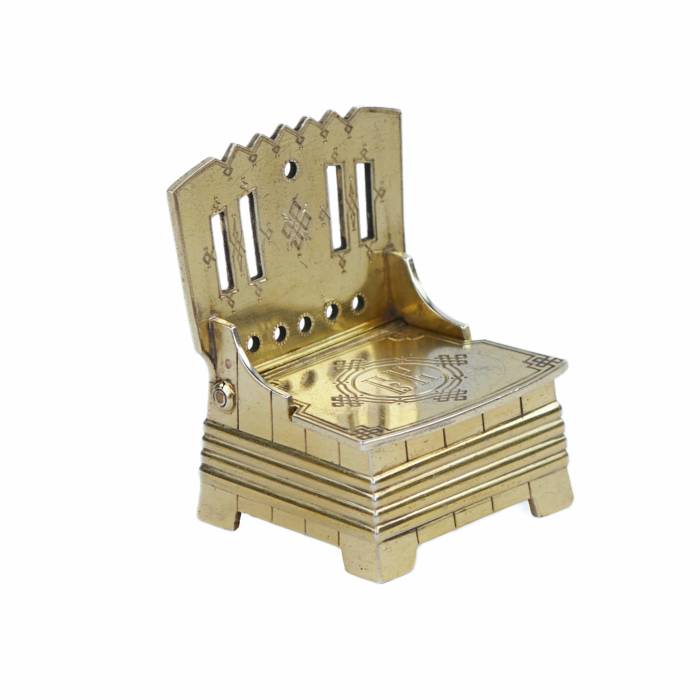
SALT CELLAR IN THE FORM OF A THRONE BY THE SAZIKOV FIRM RUSSIA, SAINT PETERSBURG, SECOND HALF OF THE 19TH CENTURY
An elegant silver salt cellar executed by the renowned Saint Petersburg firm Sazikov represents a characteristic example of Russian artistic silver of the Historicism period. The object is conceived in the form of a miniature throne with a high shaped back, a stepped base, and a hinged front panel opening to reveal the inner compartment for salt. Such interpretation of a utilitarian object as a throne-like architectural form imparts a ceremonial, almost reliquary character and reflects the стремление of Russian silversmiths of the second half of the 19th century to create works imbued with a pronounced national-historical imagery.The surface is decorated with fine engraving and chased geometric and cross-shaped ornaments associated with the decorative system of the Russian style. The upper section of the back features vertical openwork apertures framed by строгие ornamental motifs.The combination of architectural composition, archaizing ornament and expressive plasticity makes this salt cellar a vivid example of the Russian national-romantic line in decorative arts. Such objects were created not only as tableware but also as камерные artistic images intended for a cultivated collector and for an environment receptive to ideas of historical memory and the aesthetics of Old Russia.Marks: Under the double-headed eagle - “Sazikov”; assay mark “84”; Saint Petersburg city mark - anchor.Dimensions: Height: 5 cm.Weight: 81 g.Condition: Good. Gilding even. Minor surface wear and light traces of use consistent with age. Structure preserved.Provenance: Private collection.
Begins 02.05.2026
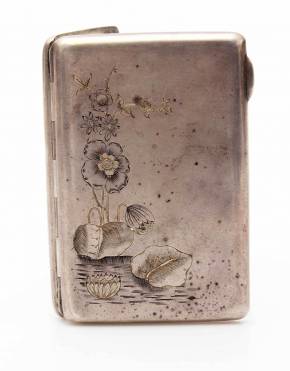
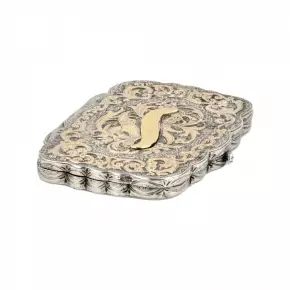
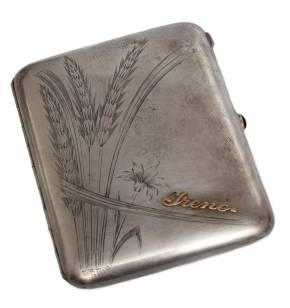
Silver cigarette case
400 EUR
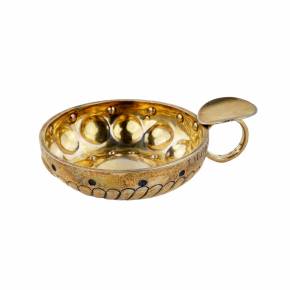
Tastevin or sommelier`s bowl. Pierre Hippolyte Fournerot, Paris 1833-1857
Begins 03.05.2026 10:00:00
Silver case
340 EUR
Silver spatula
430 EUR
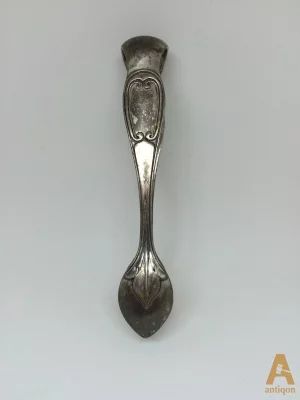
Silver sugar tongs. Warchawa
Begins 03.05.2026 10:00:00
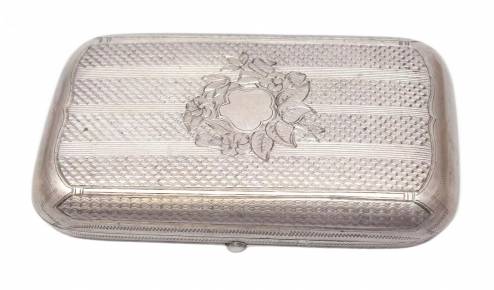
Rectangular silver cigarette case
Begins 03.05.2026 10:00:00
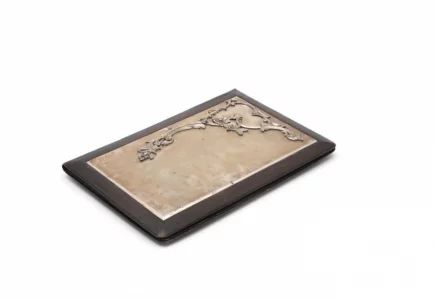
Leather portfolio with silver overlay. Russia, 1908-1917.
Begins 02.05.2026 12:00:00
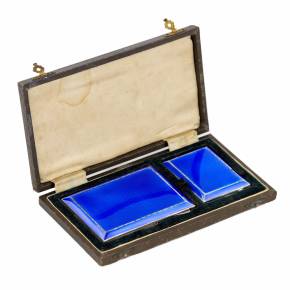
English smoking set of cigarette case and matchbox made of silver and enamel.
Begins 03.05.2026 10:00:00
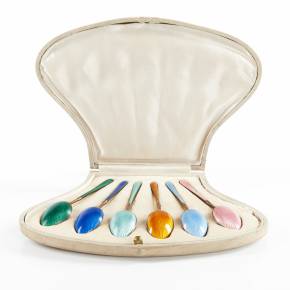
Set of six silver spoons with guilloche enamel, in the original box.
Begins 03.05.2026 10:00:00
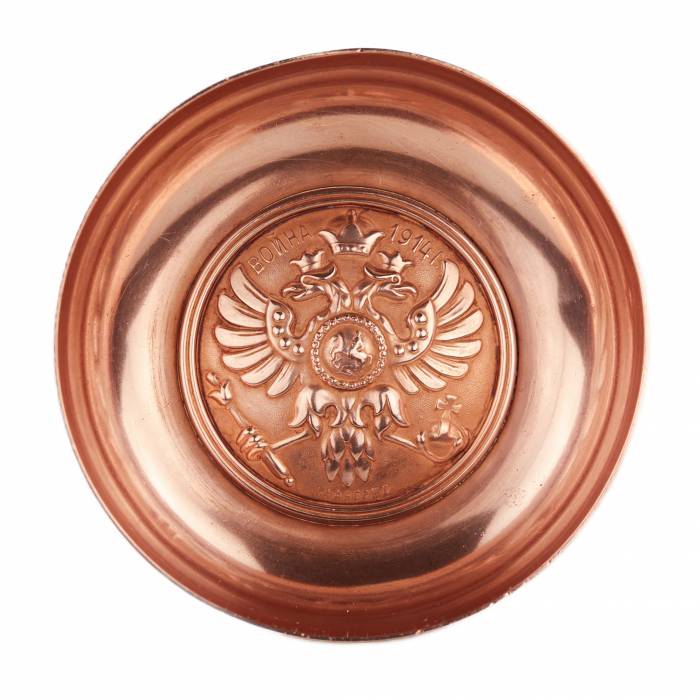
ASH TRAY “WAR 1914” BY THE FABERGÉ FIRM RUSSIA, 1914–1915
A small circular copper ashtray, executed in stamped technique, featuring a relief depiction of the double-headed eagle - the state emblem of the Russian Empire. The central medallion presents a finely modelled composition with a crowned eagle holding a sceptre and orb, emphasizing the official and symbolic character of the object.Along the perimeter of the medallion are the inscriptions “WAR 1914” and “K. FABERGÉ”, indicating the commemorative purpose of the piece and its association with the name of the Imperial Court supplier. The typographic composition is harmoniously integrated into the relief, enhancing the decorative impact of the object.The form of the ashtray is restrained and functional: a shallow bowl with a gently profiled rim and a concentric layout that draws attention to the central motif. The warm tone of the copper accentuates the depth of the relief and lends the object a distinctive visual presence. The use of stamping technique reflects serial production, characteristic of utilitarian and commemorative items produced during wartime.Objects of this type belong to a group of commemorative and functional items produced during the First World War, when the firm of Carl Fabergé, alongside its renowned jeweled creations, also manufactured objects in base metals intended for the army and for charitable purposes.Marks: Relief inscriptions “WAR 1914” and “K. FABERGÉ”Dimensions: Height: 2.5 cm; Diameter: 11 cmCondition: Good. Minor surface wear, even patina, no deformations
Begins 02.05.2026
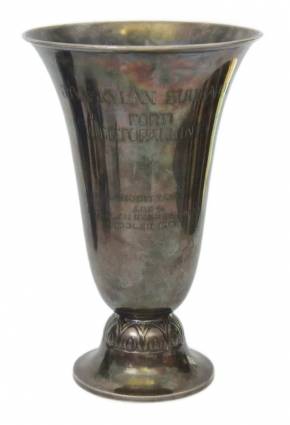
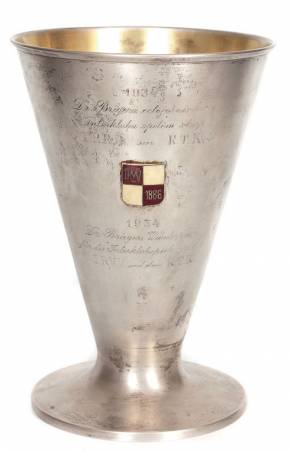
Silver award cup with engraving
590 EUR
RESERVED
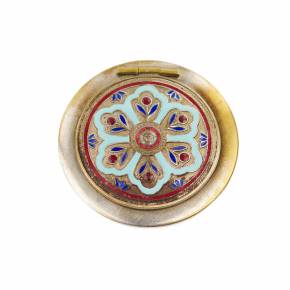
A lady`s mirror, decorated with an enamel pattern. 20th century.
Begins 03.05.2026 10:00:00
Silver plated metal utensil
390 EUR
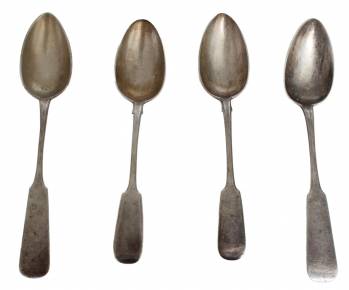
Silver spoons (4 pcs.)
350 EUR
RESERVED
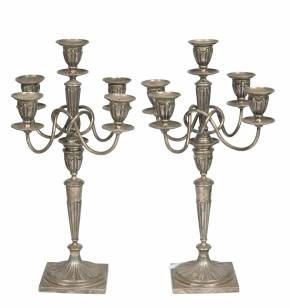
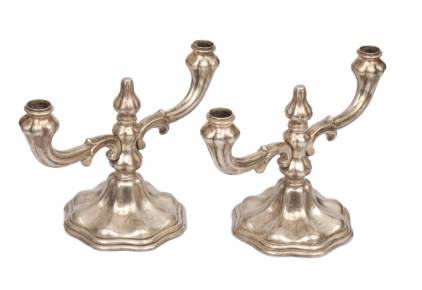
Silver candlesticks 2 pcs.
3740 EUR
RESERVED
Doctor Kruger traveling cup for club matches between IRRB RTK
1140 EUR
RESERVED
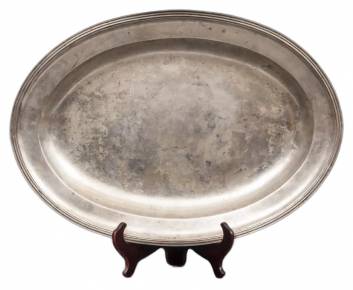
Silver tray
2860 EUR
RESERVED
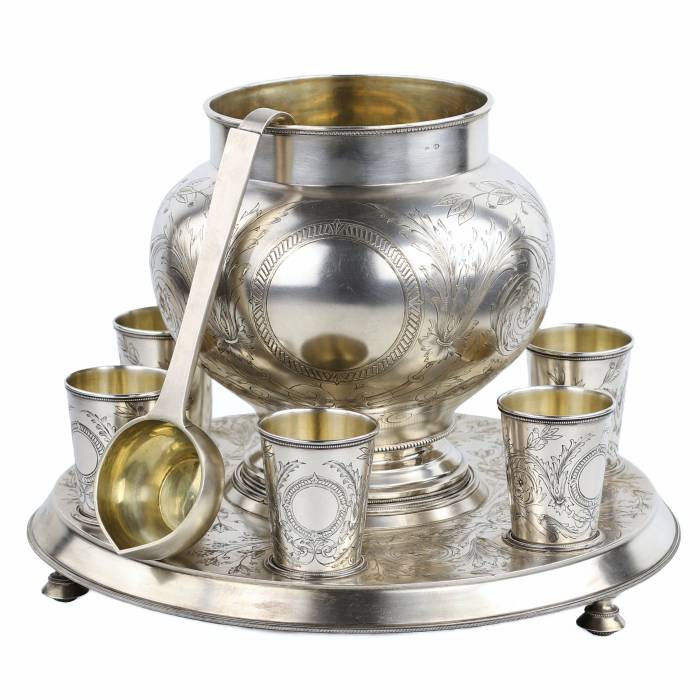
Russian gift silver punch set. A. Ivanov factory. Moscow 1895
Luxurious gift silver punch set made in 1895 at the Ivanov Andrian Terentevich factory, consisting of a bowl, a tray on legs, five cups and a ladle, is an example of high jewelry art of the late 19th - early 20th centuries, made in the style of Russian romanticism. All items in the set are decorated with the finest engraving with plant motifs, complemented by medallions with a geometric pattern along the edges. The inner surfaces of each element of the set are covered with gilding, which emphasizes their refined decorativeness and luxury. Hallmarks: initials in two letters AI Ivanov Andrian Terentevich - owner of a factory of silver tableware and other products, founded in 1893, known until 1917, numbers 84 corresponding to the silver sample, city hallmark of Moscow St. George the Victorious on a horse, hallmark of the assay master of Moscow - Artsybashev Anatoly Apollonovich - initials AA above the numbers 1895. Total weight is 2300 grams. Historical background: Ivanov Andrian Terentievich is an outstanding master of silversmithing and the owner of a factory founded in 1893. The production became famous for the high quality of its products and artistic execution. In 1897, 15 people worked at the factory: 8 men and 7 teenagers. The annual production volume was 8,000 rubles. Ivanov`s works are presented in the collection of the State Historical Museum in Moscow (GIM), which confirms their artistic and historical value.
Begins 02.05.2026
Silver utensil with lid
1270 EUR
Silver candlesticks, 2 pcs.
640 EUR
RESERVED
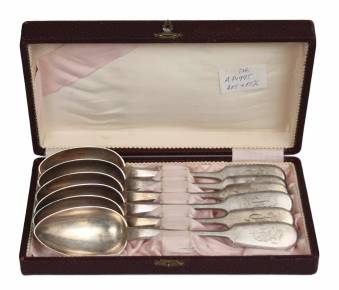
Silver tablespoons (6 pcs.)
530 EUR
RESERVED
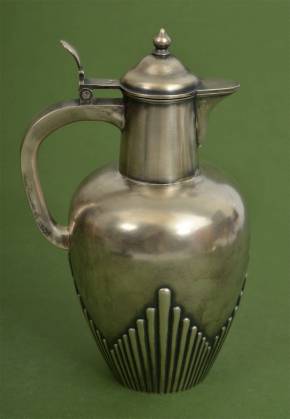
Silver water pitcher
800 EUR
RESERVED
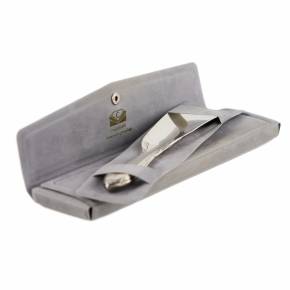
Original silver shoehorn in its own case. 20th century.
Begins 03.05.2026 10:00:00
Silver case
560 EUR
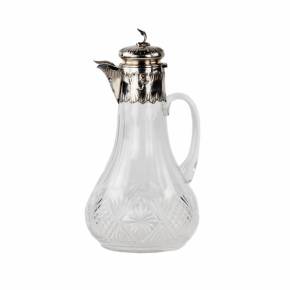
French crystal jug with silver.
Begins 03.05.2026 10:00:00
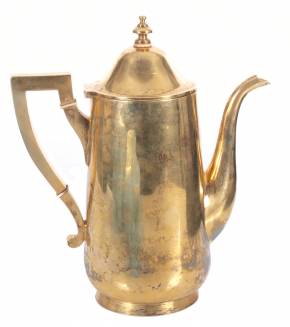
Gilded silver coffee pot
920 EUR
RESERVED
...
6
7
8
9
10
11
Subscribe to our newsletter
Never miss new auctions
You have subscribed to our newsletter.
Subscribe
Your latest views
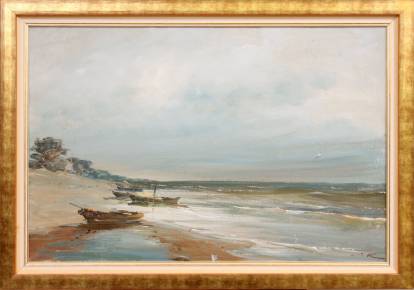
Boats on the coast
490 EUR
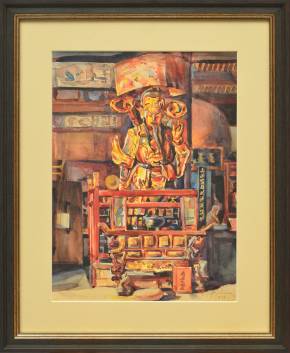
God of war
640 EUR
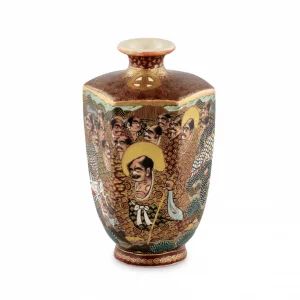
Small Japanese vase Satsuma
Begins 03.05.2026 10:00:00
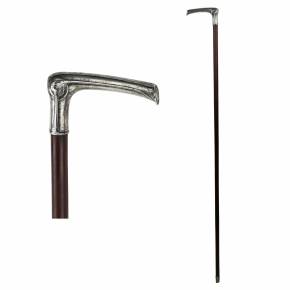
Walking cane with a silver handle.
Begins 02.05.2026 12:00:00
Val St. Lambert Crystal fruit bowl
540 EUR
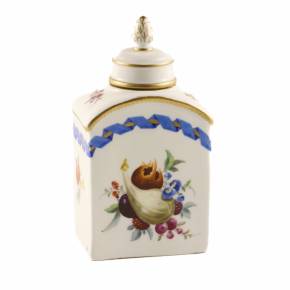
Tea caddy. Meissen.
Begins 03.05.2026 10:00:00
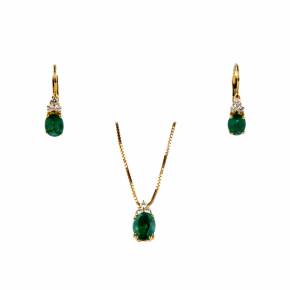
Giorgio Visconti. 18K gold pendant and earrings with emeralds and diamonds.
Begins 03.05.2026 10:00:00
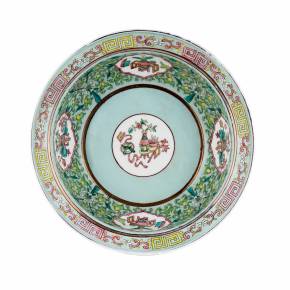
Chinese dish from the Gardner factory.
Begins 02.05.2026 12:00:00
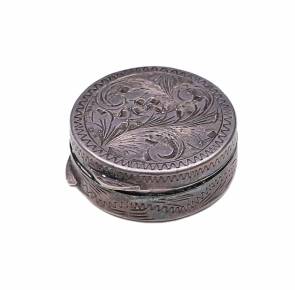
Silver snuffbox.
Begins 03.05.2026 10:00:00
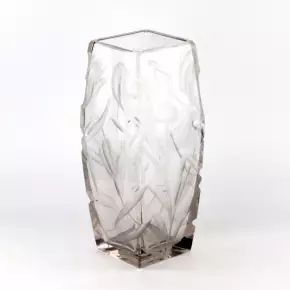
Large, heavy, crystal vase with luxurious irises.
Begins 03.05.2026 10:00:00
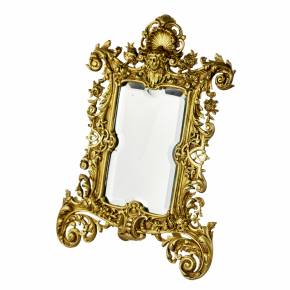
Table mirror.
Begins 03.05.2026 10:00:00
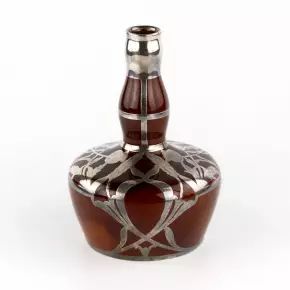
An elegant porcelain vase in a silver Braid in the Art Nouveau style. Crown Staffordshire.
Begins 03.05.2026 10:00:00
Landscape with horses
9560 EUR
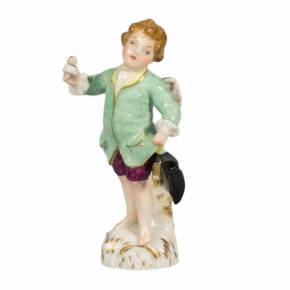
Figure Cherub on a date. KPM.
Begins 03.05.2026 10:00:00
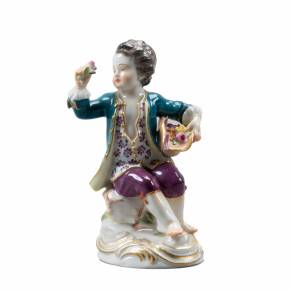
Boy with flowers. Meissen.
Begins 03.05.2026 10:00:00
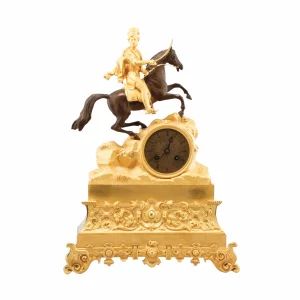
Mantel clock Cavalryman
Begins 03.05.2026 10:00:00
Silver card holder
Begins 03.05.2026 10:00:00
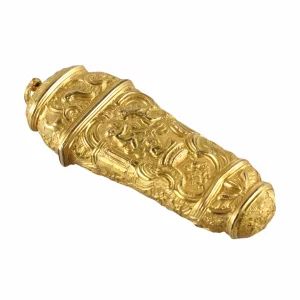
Necessaire. France 19th century.
Begins 03.05.2026 10:00:00
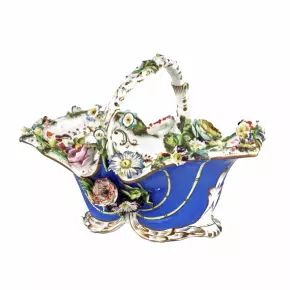
Porcelain basket with floral decor in Rococo style Europe, second half of the 19th century
Begins 03.05.2026 10:00:00
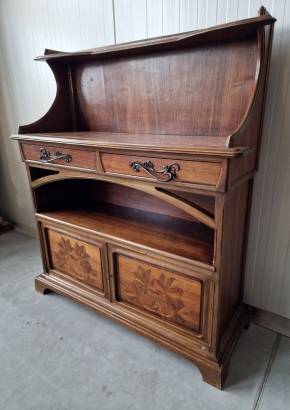
Art Nouveau cabinet
1640 EUR
Start hunt for treasures!
Individual
Legal entity
Enter a name (min 3 characters)
Enter a Last name (min 3 characters)
Enter the email
User already exist
Algeria (+213)
Andorra (+376)
Angola (+244)
Anguilla (+1264)
Antigua & Barbuda (+1268)
Argentina (+54)
Armenia (+374)
Aruba (+297)
Australia (+61)
Austria (+43)
Azerbaijan (+994)
Bahamas (+1242)
Bahrain (+973)
Bangladesh (+880)
Barbados (+1246)
Belarus (+375)
Belgium (+32)
Belize (+501)
Benin (+229)
Bermuda (+1441)
Bhutan (+975)
Bolivia (+591)
Bosnia Herzegovina (+387)
Botswana (+267)
Brazil (+55)
Brunei (+673)
Bulgaria (+359)
Burkina Faso (+226)
Burundi (+257)
Cambodia (+855)
Cameroon (+237)
Canada (+1)
Cape Verde Islands (+238)
Cayman Islands (+1345)
Central African Republic (+236)
Chile (+56)
China (+86)
Colombia (+57)
Comoros (+269)
Congo (+242)
Cook Islands (+682)
Costa Rica (+506)
Croatia (+385)
Cuba (+53)
Cyprus North (+90392)
Cyprus South (+357)
Czech Republic (+42)
Denmark (+45)
Djibouti (+253)
Dominica (+1809)
Dominican Republic (+1809)
Ecuador (+593)
Egypt (+20)
El Salvador (+503)
Equatorial Guinea (+240)
Eritrea (+291)
Estonia (+372)
Ethiopia (+251)
Falkland Islands (+500)
Faroe Islands (+298)
Fiji (+679)
Finland (+358)
France (+33)
French Guiana (+594)
French Polynesia (+689)
Gabon (+241)
Gambia (+220)
Georgia (+7880)
Germany (+49)
Ghana (+233)
Gibraltar (+350)
Greece (+30)
Greenland (+299)
Grenada (+1473)
Guadeloupe (+590)
Guam (+671)
Guatemala (+502)
Guinea (+224)
Guinea - Bissau (+245)
Guyana (+592)
Haiti (+509)
Honduras (+504)
Hong Kong (+852)
Hungary (+36)
Iceland (+354)
India (+91)
Indonesia (+62)
Iran (+98)
Iraq (+964)
Ireland (+353)
Israel (+972)
Italy (+39)
Jamaica (+1876)
Japan (+81)
Jordan (+962)
Kazakhstan (+7)
Kenya (+254)
Kiribati (+686)
Korea North (+850)
Korea South (+82)
Kuwait (+965)
Kyrgyzstan (+996)
Laos (+856)
Latvia (+371)
Lebanon (+961)
Lesotho (+266)
Liberia (+231)
Libya (+218)
Liechtenstein (+417)
Lithuania (+370)
Luxembourg (+352)
Macao (+853)
Macedonia (+389)
Madagascar (+261)
Malawi (+265)
Malaysia (+60)
Maldives (+960)
Mali (+223)
Malta (+356)
Marshall Islands (+692)
Martinique (+596)
Mauritania (+222)
Mayotte (+269)
Mexico (+52)
Micronesia (+691)
Moldova (+373)
Monaco (+377)
Mongolia (+976)
Montserrat (+1664)
Morocco (+212)
Mozambique (+258)
Myanmar (+95)
Namibia (+264)
Nauru (+674)
Nepal (+977)
Netherlands (+31)
New Caledonia (+687)
New Zealand (+64)
Nicaragua (+505)
Niger (+227)
Nigeria (+234)
Niue (+683)
Norfolk Islands (+672)
Northern Marianas (+670)
Norway (+47)
Oman (+968)
Palau (+680)
Panama (+507)
Papua New Guinea (+675)
Paraguay (+595)
Peru (+51)
Philippines (+63)
Poland (+48)
Portugal (+351)
Puerto Rico (+1787)
Qatar (+974)
Reunion (+262)
Romania (+40)
Russia (+7)
Rwanda (+250)
San Marino (+378)
Sao Tome & Principe (+239)
Saudi Arabia (+966)
Senegal (+221)
Serbia (+381)
Seychelles (+248)
Sierra Leone (+232)
Singapore (+65)
Slovak Republic (+421)
Slovenia (+386)
Solomon Islands (+677)
Somalia (+252)
South Africa (+27)
Spain (+34)
Sri Lanka (+94)
St. Helena (+290)
St. Kitts (+1869)
St. Lucia (+1758)
Sudan (+249)
Suriname (+597)
Swaziland (+268)
Sweden (+46)
Switzerland (+41)
Syria (+963)
Taiwan (+886)
Tajikstan (+7)
Thailand (+66)
Togo (+228)
Tonga (+676)
Trinidad & Tobago (+1868)
Tunisia (+216)
Turkey (+90)
Turkmenistan (+7)
Turkmenistan (+993)
Turks & Caicos Islands (+1649)
Tuvalu (+688)
Uganda (+256)
UK (+44)
Ukraine (+380)
United Arab Emirates (+971)
Uruguay (+598)
USA (+1)
Uzbekistan (+7)
Vanuatu (+678)
Vatican City (+379)
Venezuela (+58)
Vietnam (+84)
Virgin Islands - British (+1284)
Virgin Islands - US (+1340)
Wallis & Futuna (+681)
Yemen (North)(+969)
Yemen (South)(+967)
Zambia (+260)
Zimbabwe (+263)
Enter the phone number
Minimum password length must be at least 6 characters
Enter a name of your company (min 3 characters)
Enter registration number (min 3 characters)
Enter the email
User already exist
Enter the phone number
Minimum password length must be at least 6 characters
I am a buyer
I am a seller
or log in with
Sign up for our weekly newsletter
I reviewed and agree
user agreement
,
«Privacy Policy»
i agree with Antiqon Terms and conditions
Register
Already have an account?
Log In
Enter your email and password for authorization
Enter the email
The number of attempts has been used uo, repeat after 2 hours
Minimum password length must be at least 6 characters
Invalid email or password
or log in with
Login
Forgot password?
Don't have an account?
register