USD
EUR
USD
English
Latviešu
Francais
English
Русский
Sign Up
Login
Auction
Best sellers
Upcomming auctions
Archive
Shop
Sell
Evaluation
Services
Expertise
Restoration
Antiq selection
Delivery
Contacts
Home
Shop
Modern Art
Paintings
Show sold items
Show auction items
Available right now
Price
-
USD
New items
Gifts
EXCLUSIVE
Catalogue categories
ALL ITEMS
Russian art
Objects of Vertu (19)
+
Objects of Vertu (19)
Paintings (640)
+
Paintings (605)
Watercolor (20)
Miniature (3)
Other (12)
Graphic arts (50)
+
Graphic arts (50)
Icons (38)
+
Icons (34)
Church utensils (4)
Frames and easels (43)
+
Frames (28)
Easels (3)
Photo frames (12)
Sculpture (61)
+
Bronze sculptures (33)
Stone sculptures (9)
Stone carving miniature (6)
Other (13)
Silver and metal (255)
+
Russian silver (105)
European silver (74)
Other (76)
Porcelain and ceramics (349)
+
Russian porcelain (23)
European porcelain (114)
Other (212)
Glass (52)
+
Crystal (5)
Glass (47)
Clocks and watches (25)
+
Mantel clocks (7)
Wall clocks (3)
Wrist watches (7)
Pocket watches (5)
Grandfather floor clocks (1)
Other (2)
Furniture (147)
+
Furniture sets (8)
Showcases (25)
Dressers (10)
Tables (30)
Sofas (3)
Armchairs and chairs (17)
Columns (5)
Mirrors (8)
Consoles (10)
Other (31)
Lighting (52)
+
Chandeliers (11)
Sconce (8)
Floor lamps (4)
Lamps (16)
Candlesticks and candelabra (12)
Other (1)
Interior objects (34)
+
Interior objects (34)
Fireplaces and stoves (14)
+
Fireplaces and stoves (6)
Accessories (7)
Other (1)
Carpets and tapestries (2)
+
Carpets (1)
Tapestries (1)
Jewelry (124)
+
Diamonds and precious stones (0)
Rings (50)
Bracelets (7)
Brooches and pendants (2)
Earrings (10)
Jewelry sets (4)
Chains and necklaces (11)
Amber (0)
Bijoux (1)
Other (39)
Weapons and мilitary (20)
+
Weapon (12)
Military (5)
Other (2)
Armour (1)
Orders and medals (4)
+
Orders and medals (3)
Signs and Tokens (0)
Other (1)
Coins and banknotes (17)
+
Coins (17)
Banknotes and Bonds (0)
Other (0)
Mechanics (15)
+
Music boxes (9)
Mechanisms and tools (4)
Models (0)
Other (2)
Print, postcards and other antique paper production (9)
+
Posters (3)
Maps (2)
Postcards (0)
Photos (0)
Other (4)
Books (5)
+
Literature (1)
History (1)
Military (0)
Science (1)
Children`s literature (0)
Other (2)
Garden and architecture (2)
+
Garden sculpture (0)
Fountain (0)
Garden furniture (0)
Architectural elements (2)
Other (0)
Modern Art (72)
+
Paintings (10)
Sculpture (18)
Objects (29)
Other (15)
Collectibles (15)
+
Collectibles (15)
Vintage and fashion (2)
+
Accessories (2)
Clothing (0)
Footwear (0)
Other (0)
Other (10)
+
Other (10)
Asian art
Styles
Louis-Philippe Carl X (11)
Academic art (3)
Antiquity (9)
Art Deco (62)
Art Nouveau (27)
Asian Art (12)
Baroque (26)
Biedermeier (10)
Boulle (4)
Chinoiserie (6)
Classicism (31)
Design of 50-60’s (10)
Design of 70’s (5)
Eclecticism (55)
Empire (29)
Empire - Consulate (1)
Gothic Revival (3)
Impressionism (22)
Judaica (3)
Jugendstil (10)
Louis XIII - Renaissance (2)
Louis XIV - Regency (1)
Louis XV (31)
Louis XVI (38)
Modern (108)
Modern Art (98)
Napoleon III (40)
Neo-baroque (5)
Neo-Baroque (9)
Neo-Russian (54)
Neoclassicism (37)
Neorenaissance (13)
Neorococo (37)
Oriental Art (5)
Other style (62)
Realism (51)
Renaissance (7)
Rococo (36)
Romanticism (30)
Vanguard (20)
Victorian Style (4)
Epoques
16th century (2)
17th century (4)
18th century (28)
19th century (328)
20th century (334)
21th century (269)
At the turn of 16th -17th century (1)
At the turn of 17th-18th century (1)
At the turn of 19th -20th century (200)
At the turn of the 15th - 16th century (4)
At the turn of the 18th -19th century (12)
Early 17th century (1)
Early 18th century (1)
Early 19th century (20)
Early 20th century (404)
Late 18th century (3)
Late 19th century (101)
Mid-17th century (14)
Mid-18th century (1)
Mid-19th century (38)
Mid-20th century (269)
The end of the 17th century (1)
The end of the 20th century (45)
Price (descending)
Price (ascending)
Date (ascending)
Date (descending)
...
35
36
37
38
39
40
41
...
87
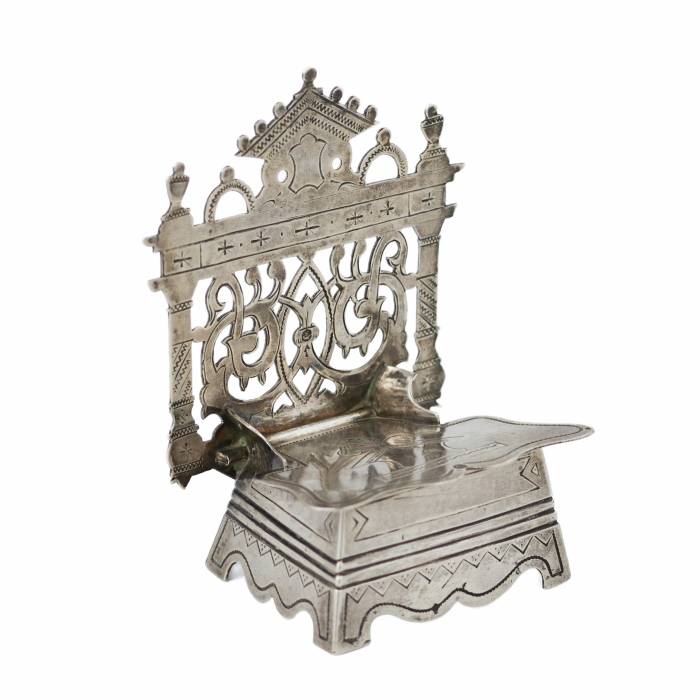
SILVER SALT CELLAR IN THE FORM OF A THRONE WITH AN OPENWORK BACK RUSSIA, KOSTROMA, 1880s–1890s
An elegant silver salt cellar executed in the form of a miniature throne with a high architectural back, representing a characteristic example of Russian decorative and applied art of the late 19th century. The composition is based on architectural and furniture motifs, emphasised by the clear geometry of the body, stepped base and richly developed ornamental decoration.The openwork back is designed as a symmetrical structure with pierced vegetal and geometric ornament organised around a central diamond-shaped motif. The upper section is crowned with a stylised pediment featuring balusters and a crenellated frieze, recalling forms of Old Russian architecture. The side supports are decorated with fine chasing and ornamental bands, reinforcing the architectural character of the object.The rectangular body with profiled walls is adorned with linear and zigzag engraved decoration. The base is solid and contoured, providing both stability and visual completeness. The interior of the bowl is fully gilded, a traditional measure used to protect silver from the corrosive effects of salt while simultaneously enhancing the ceremonial appearance of the piece. The hinged lid is functionally and compositionally integrated with the back, preserving the overall harmony of the design.Material: Silver, 84 standard, gilt interior.Hallmarks: Maker’s mark of an unidentified master “AB” in a rectangular cartouche; Kostroma town assay mark depicting the city coat of arms – a galley sailing on a river; To the left, the silver standard “84”, characteristic of the Kostroma assay office of the 1880s–1890s; Additional assay marks.Dimensions: Height: 7.5 cm; Width: 6 cm; Depth: 5 cm.Condition: Good. Even natural patina to the silver. Gilding to the interior well preserved. Minor signs of age and use consistent with the period. No deformations or restorations observed.Provenance: Private collection.
00 ч 16 min
French porcelain set
679 USD
Chinese painted porcelain vase
749 USD
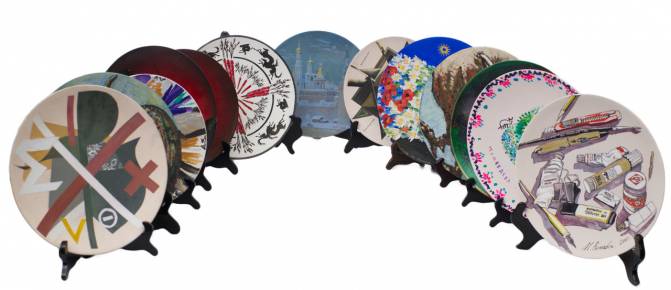
A collection of 13 painted plates by famous Russian painters
12487 USD
Decorative plate Tautumeita
469 USD
Porcelain figurine Ballerina
785 USD
Porcelain figure Flute player
1405 USD
Painted porcelain vase
679 USD
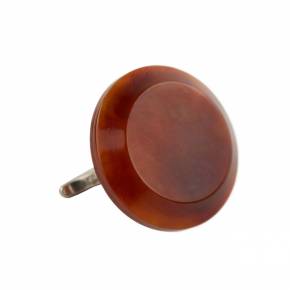
Original three-finger ring made of silver and carnelian.
Begins 03.05.2026 10:00:00
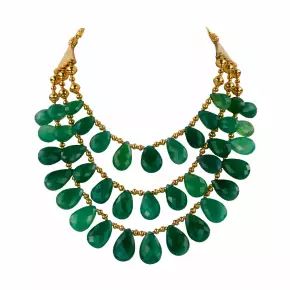
Chrysoprase necklace.
445 USD
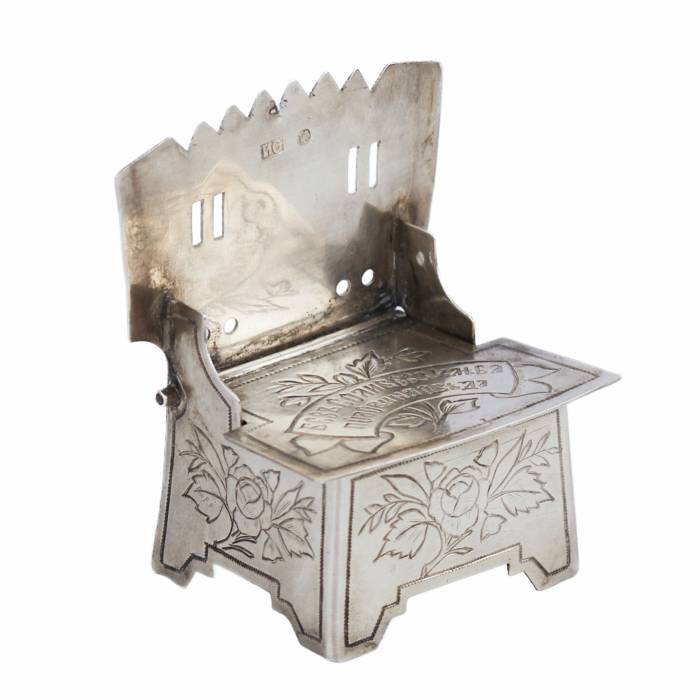
SILVER SALT CELLAR IN THE FORM OF A CHAIR, IVAN DMITRIEVICH SALTYKOV MOSCOW, RUSSIA, 1882–1898
A rare silver salt cellar in the form of a miniature chair, executed in the Moscow workshop of Ivan Dmitrievich Saltykov in the late 19th century, represents an expressive example of Moscow silver of the Late Historicism period. The composition is conceived as a stylized chair with a high shaped back, pierced “windows,” a hinged front panel, and a rectangular compartment for salt. The architectural interpretation of the object refers to forms of traditional Russian wooden architecture, giving the piece a distinct national character.The surface is decorated with fine engraving featuring stylized floral motifs framed within linear borders. The back is finished with a crenellated top and pierced elements inspired by carved wooden peasant architecture. The inner side of the lid is adorned with an oval medallion depicting a rooster, reinforcing the symbolism of the domestic hearth and prosperity.The hinged panel bears the engraved proverb: “Without salt and bread, half a meal,” giving the object a strong cultural and symbolic meaning characteristic of Moscow silverware of the late 19th century. The quality of execution, ornamental program, and construction allow the piece to be attributed to the circle of Moscow workshops of the late 19th century, focused on the development of the National Style in decorative arts.Marks: Maker’s mark “I.S.” - Ivan Dmitrievich Saltykov; Russian silver hallmark “84” with Moscow coat of arms (St. George) in an oval shield, 1882–1898.Dimensions: Height: 6.5 cm; Width: 5.5 cm; Depth: 4.5 cm.Weight: 53 g.Condition: Good. Natural patina, signs of use, minor surface scratches and wear. Structure intact, hinge functioning properly.
00 ч 14 min
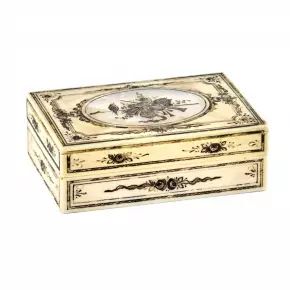
Ivory box with mother-of-pearl inlay.
Begins 03.05.2026 10:00:00
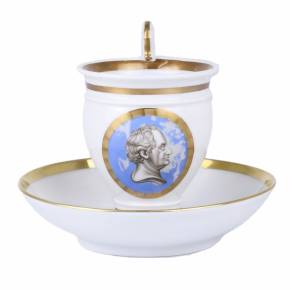
Porcelain coffee pair
Begins 03.05.2026 10:00:00
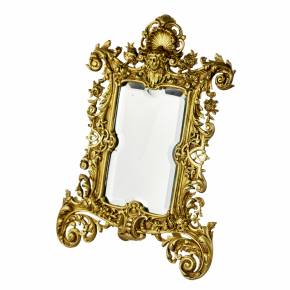
Table mirror.
Begins 03.05.2026 10:00:00
Painted Meissen porcelain decorative plate
457 USD
Porcelain figure National son with national daughter
785 USD
Art Deco ceramic figure Woman with a dog
574 USD
Porcelain figurine Ballerina
1206 USD
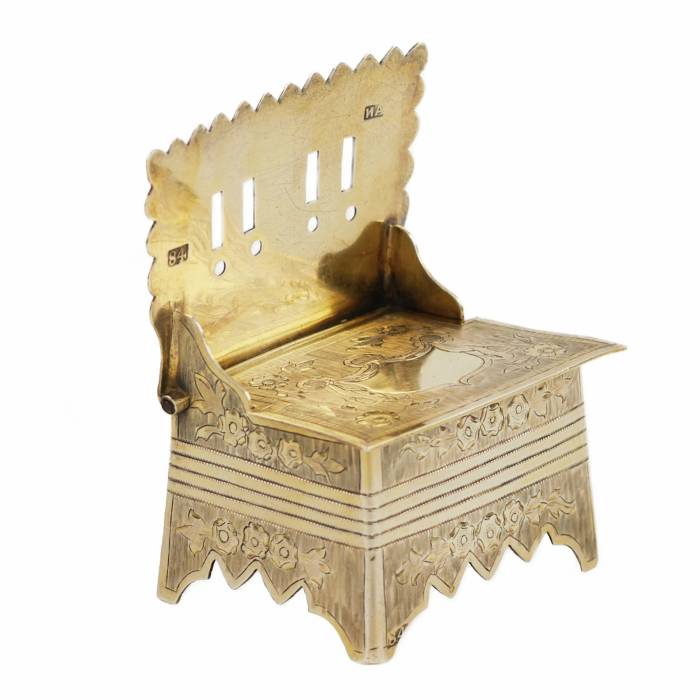
SILVER SALT CELLAR IN THE FORM OF A THRONE WITH ENGRAVED DECORATION RUSSIA, MOSCOW, 1870
An elegant silver salt cellar executed in the form of a miniature throne, representing a characteristic example of Moscow artistic silver of the second half of the 19th century. The composition is conceived as a ceremonial seat with a high shaped back, pierced openings, and a hinged front panel providing access to the interior.The sculptural design is distinguished by architectural clarity and decorative richness. The surface is adorned with fine engraved ornamentation featuring stylized floral motifs, garlands, and a central cartouche. The lower section is decorated with rhythmic horizontal bands and a serrated frieze, reinforcing its resemblance to carved wooden prototypes.The interior is gilded, creating a refined contrast with the matte and engraved exterior surfaces. The composition combines utilitarian function with symbolic representation, characteristic of table objects in the merchant and noble households of 19th century Russia.Marks: Maker’s mark “IA” in a rectangular cartouche, attributed to Ivan Alekseev; Moscow assay mark with initials “V.S.” above a line and the date “1870” - assay inspector Viktor Savinkov; Standard mark “84”; Moscow city mark depicting Saint George slaying the dragon.Dimensions: Height: 8 cm; Width: 6.5 cm; Depth: 5 cm.Weight: 88 g.Condition: Good. Partial wear to gilding, with light surface marks consistent with age and use.Provenance: Private collection.
00 ч 12 min
Crystal vase
527 USD
Crystal vase with silver finish
527 USD
Ceramic interior item Knight in the tower
562 USD
Porcelain figure Chess game
562 USD
Pocelain figure Buddha
398 USD
Ceramic vase
398 USD
Porcelain plate Marilyn Monroe
562 USD
Austrian Art Nouveau vase with lions
1487 USD
...
35
36
37
38
39
40
41
...
87
Subscribe to our newsletter
Never miss new auctions
You have subscribed to our newsletter.
Subscribe
Your latest views
Porcelain figure Lacplesis
527 USD
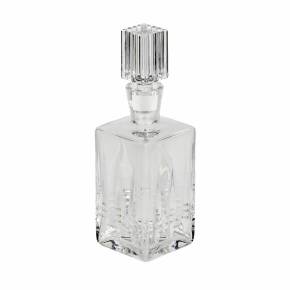
Crystal decanter in Art Deco style.
Begins 03.05.2026 10:00:00
Biscuit figurine Angel
749 USD
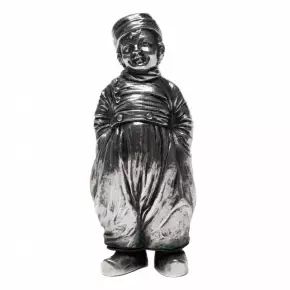
Polish silver salt cellar Porter.
Begins 03.05.2026 10:00:00
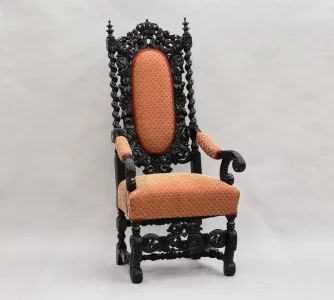
Baroque armchair 18th century
Begins 03.05.2026 10:00:00
Crystal fruit bowl with silver finish
632 USD
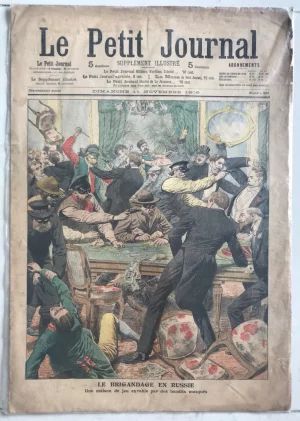
"Le Petit Journal 1906"
94 USD
Twilight in Paris
469 USD
A. Lanin. Artist. Monotype. 1966.
1405 USD
Table mirror.
Begins 03.05.2026 10:00:00
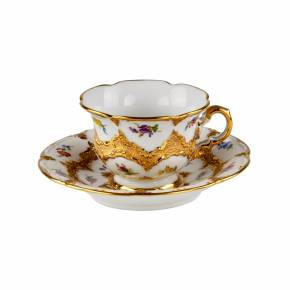
Cup with saucer Meissen
Begins 03.05.2026 10:00:00
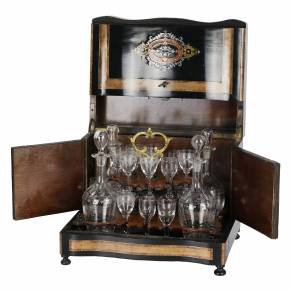
Liqueur Bar (Cave à liqueur)
Begins 03.05.2026 10:00:00
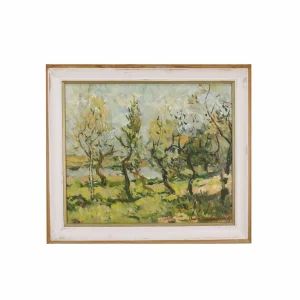
Painting "Landscape" Timergaleev
1697 USD
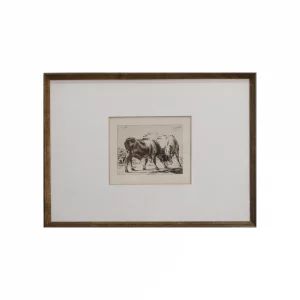
Engraving "Bulls"
Begins 03.05.2026 10:00:00
Mantra-aba
609 USD
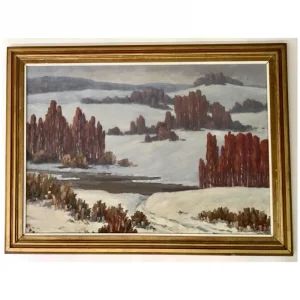
Painting "Winter"
94 USD
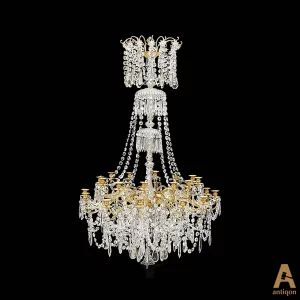
Chandelier for 25 candles. 19th century.
Bidding is completed
RESERVED
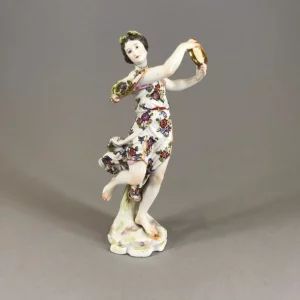
Girl with a tambourine. OSWALD LORENZ
Begins 03.05.2026 10:00:00
Decorative porcelain plate
527 USD
Old Riga
199 USD
Start hunt for treasures!
Individual
Legal entity
Enter a name (min 3 characters)
Enter a Last name (min 3 characters)
Enter the email
User already exist
Algeria (+213)
Andorra (+376)
Angola (+244)
Anguilla (+1264)
Antigua & Barbuda (+1268)
Argentina (+54)
Armenia (+374)
Aruba (+297)
Australia (+61)
Austria (+43)
Azerbaijan (+994)
Bahamas (+1242)
Bahrain (+973)
Bangladesh (+880)
Barbados (+1246)
Belarus (+375)
Belgium (+32)
Belize (+501)
Benin (+229)
Bermuda (+1441)
Bhutan (+975)
Bolivia (+591)
Bosnia Herzegovina (+387)
Botswana (+267)
Brazil (+55)
Brunei (+673)
Bulgaria (+359)
Burkina Faso (+226)
Burundi (+257)
Cambodia (+855)
Cameroon (+237)
Canada (+1)
Cape Verde Islands (+238)
Cayman Islands (+1345)
Central African Republic (+236)
Chile (+56)
China (+86)
Colombia (+57)
Comoros (+269)
Congo (+242)
Cook Islands (+682)
Costa Rica (+506)
Croatia (+385)
Cuba (+53)
Cyprus North (+90392)
Cyprus South (+357)
Czech Republic (+42)
Denmark (+45)
Djibouti (+253)
Dominica (+1809)
Dominican Republic (+1809)
Ecuador (+593)
Egypt (+20)
El Salvador (+503)
Equatorial Guinea (+240)
Eritrea (+291)
Estonia (+372)
Ethiopia (+251)
Falkland Islands (+500)
Faroe Islands (+298)
Fiji (+679)
Finland (+358)
France (+33)
French Guiana (+594)
French Polynesia (+689)
Gabon (+241)
Gambia (+220)
Georgia (+7880)
Germany (+49)
Ghana (+233)
Gibraltar (+350)
Greece (+30)
Greenland (+299)
Grenada (+1473)
Guadeloupe (+590)
Guam (+671)
Guatemala (+502)
Guinea (+224)
Guinea - Bissau (+245)
Guyana (+592)
Haiti (+509)
Honduras (+504)
Hong Kong (+852)
Hungary (+36)
Iceland (+354)
India (+91)
Indonesia (+62)
Iran (+98)
Iraq (+964)
Ireland (+353)
Israel (+972)
Italy (+39)
Jamaica (+1876)
Japan (+81)
Jordan (+962)
Kazakhstan (+7)
Kenya (+254)
Kiribati (+686)
Korea North (+850)
Korea South (+82)
Kuwait (+965)
Kyrgyzstan (+996)
Laos (+856)
Latvia (+371)
Lebanon (+961)
Lesotho (+266)
Liberia (+231)
Libya (+218)
Liechtenstein (+417)
Lithuania (+370)
Luxembourg (+352)
Macao (+853)
Macedonia (+389)
Madagascar (+261)
Malawi (+265)
Malaysia (+60)
Maldives (+960)
Mali (+223)
Malta (+356)
Marshall Islands (+692)
Martinique (+596)
Mauritania (+222)
Mayotte (+269)
Mexico (+52)
Micronesia (+691)
Moldova (+373)
Monaco (+377)
Mongolia (+976)
Montserrat (+1664)
Morocco (+212)
Mozambique (+258)
Myanmar (+95)
Namibia (+264)
Nauru (+674)
Nepal (+977)
Netherlands (+31)
New Caledonia (+687)
New Zealand (+64)
Nicaragua (+505)
Niger (+227)
Nigeria (+234)
Niue (+683)
Norfolk Islands (+672)
Northern Marianas (+670)
Norway (+47)
Oman (+968)
Palau (+680)
Panama (+507)
Papua New Guinea (+675)
Paraguay (+595)
Peru (+51)
Philippines (+63)
Poland (+48)
Portugal (+351)
Puerto Rico (+1787)
Qatar (+974)
Reunion (+262)
Romania (+40)
Russia (+7)
Rwanda (+250)
San Marino (+378)
Sao Tome & Principe (+239)
Saudi Arabia (+966)
Senegal (+221)
Serbia (+381)
Seychelles (+248)
Sierra Leone (+232)
Singapore (+65)
Slovak Republic (+421)
Slovenia (+386)
Solomon Islands (+677)
Somalia (+252)
South Africa (+27)
Spain (+34)
Sri Lanka (+94)
St. Helena (+290)
St. Kitts (+1869)
St. Lucia (+1758)
Sudan (+249)
Suriname (+597)
Swaziland (+268)
Sweden (+46)
Switzerland (+41)
Syria (+963)
Taiwan (+886)
Tajikstan (+7)
Thailand (+66)
Togo (+228)
Tonga (+676)
Trinidad & Tobago (+1868)
Tunisia (+216)
Turkey (+90)
Turkmenistan (+7)
Turkmenistan (+993)
Turks & Caicos Islands (+1649)
Tuvalu (+688)
Uganda (+256)
UK (+44)
Ukraine (+380)
United Arab Emirates (+971)
Uruguay (+598)
USA (+1)
Uzbekistan (+7)
Vanuatu (+678)
Vatican City (+379)
Venezuela (+58)
Vietnam (+84)
Virgin Islands - British (+1284)
Virgin Islands - US (+1340)
Wallis & Futuna (+681)
Yemen (North)(+969)
Yemen (South)(+967)
Zambia (+260)
Zimbabwe (+263)
Enter the phone number
Minimum password length must be at least 6 characters
Enter a name of your company (min 3 characters)
Enter registration number (min 3 characters)
Enter the email
User already exist
Enter the phone number
Minimum password length must be at least 6 characters
I am a buyer
I am a seller
or log in with
Sign up for our weekly newsletter
I reviewed and agree
user agreement
,
«Privacy Policy»
i agree with Antiqon Terms and conditions
Register
Already have an account?
Log In
Enter your email and password for authorization
Enter the email
The number of attempts has been used uo, repeat after 2 hours
Minimum password length must be at least 6 characters
Invalid email or password
or log in with
Login
Forgot password?
Don't have an account?
register