Price
- USD
Catalogue categories

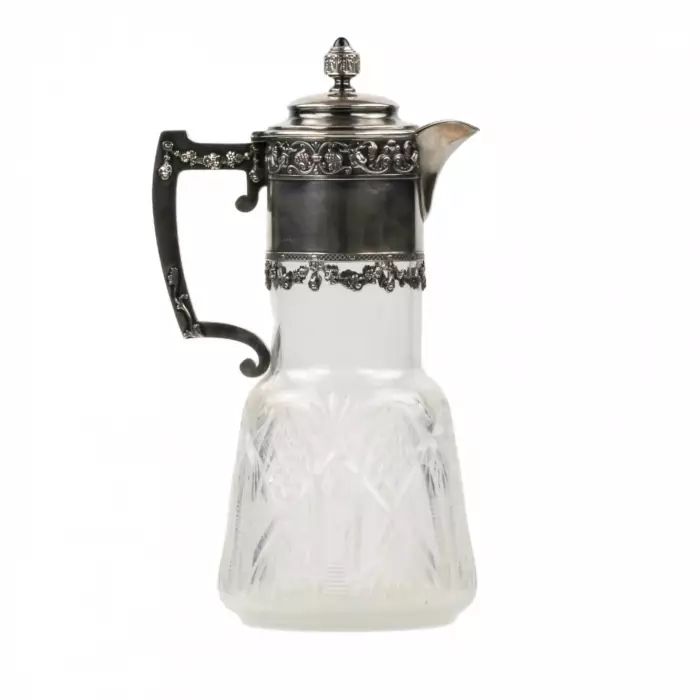
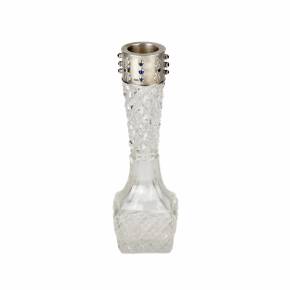
CRYSTAL JUG WITH SILVER, 13TH ARTEL RUSSIA, MOSCOW, EARLY 20TH CENTURY
An exquisite crystal jug with a silver mount represents a striking example of the high level achieved by Russian decorative and applied arts in the early 20th century. The object demonstrates a refined and deliberate reinterpretation of Western European historical styles, characteristic of Moscow silver workshops of the Late Historicism period. The composition combines classical restraint with decorative elegance, inspired by motifs of the Early French Renaissance.The proportionally expanded body of transparent crystal is adorned with deep diamond-cut and vegetal engraving, creating a rich play of light while emphasizing the functional purpose of the vessel. The silver collar of the neck is executed in a restrained manner and decorated with classical garlands seemingly suspended along the lower edge, lending the form architectural clarity and ceremonial dignity. A Renaissance-style ornamental band at the rim harmoniously complements the gently curved handle, whose subtly modern character reflects the stylistic transition of the era.A distinctive accent is provided by the garnet finial crowning the lid - an elegant detail symbolically associated with fertility, blossoming, and abundance, themes of particular significance within Renaissance tradition. This refined artistic gesture reinforces the association of the jug with formal table settings and celebratory beverages such as cherry juice, punch, or red wine. The jug is perceived not merely as a utilitarian object, but as an independent artistic focal point conceived for festive occasions.Hallmarks: State assay mark of the Moscow Assay Office for secondary elements and fittings, silver standard “84”, period 1908-1926; Maker’s mark “13A” (13th Artel); Inside the lid - repeated Moscow Assay Office mark and maker’s mark “13A”.Dimensions: Height: 29 cm, Width: 16 cm, Depth: 13 cmCondition: Good. The crystal shows no cracks or restorations. The silver elements retain an even time patina, without deformation.Provenance: Private collection.
Bidding is completed
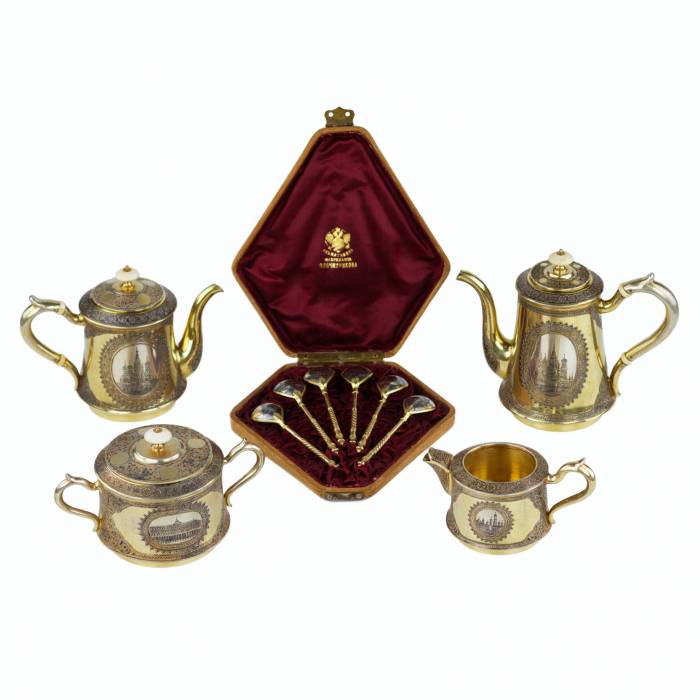
TEA AND COFFEE SET BY P. OVCHINNIKOV MOSCOW, LATE 19TH CENTURY
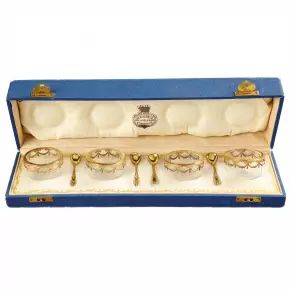
A magnificent gilded silver tea and coffee set created by the renowned Moscow firm of Pavel Ovchinnikov in the late 19th century, representing an outstanding example of Russian jewelry craftsmanship of the era. This refined ensemble, comprising a coffee pot, teapot, sugar bowl, cream jug, and a set of six spoons, embodies the essence of the Russian Revival style, combining national motifs, decorative richness, and exceptional technical execution.Each piece is adorned with medallions depicting views of the Moscow Kremlin, executed in niello, one of the most intricate and elegant decorative techniques in silverwork. The niello ornamentation frames architectural scenes with a sense of depth and precision, while the gilding lends a warm tone that enhances the contrast and sculptural clarity of the forms.The spoons feature miniature architectural scenes on the reverse, including St. Basil’s Cathedral, the Kremlin, the Ivan the Great Bell Tower, the Cathedral of Christ the Saviour, the towers of Kitay-gorod, and panoramic views of Red Square. Each image is executed with exquisite precision characteristic of Ovchinnikov’s finest work. The set is preserved in its original fitted case, embossed in gold with the inscription “FROM THE STORE OF THE MANUFACTURER P.A. OVCHINNIKOV” beneath the Russian Imperial coat of arms, indicating its sale through the Imperial Court Supplier’s official shop.Marks: Full and small maker’s marks of P. Ovchinnikov beneath a double-headed eagle, small mark “PO,” Moscow assay office mark with the stamp of Viktor Savinkov (active 1855–1888), dated 1872, state assay mark depicting St. George slaying the dragon, Russian 84 silver standard mark in a square shield with chamfered corners, later Latvian 875 mark with a girl’s head facing left (1922–1939) and the letter “A,” master’s mark “VS” for Vasily Semyonov.Dimensions: Coffee pot 24.5 × 12.6 × 24.0 cm, Sugar bowl 17.5 × 18.0 × 12.2 cm, Cream jug 11.8 × 8.2 × 9.6 cm, Spoons 10.5 × 2 cm.Weight: 1288 gMaterials: Silver 84 standard, gilding, niello, carving, casting, bone.Condition: Good collector’s condition. Partial wear to gilding and minor traces of age on niello consistent with use. Ornamentation remains sharp and detailed. Original case preserved with gold embossing and velvet interior.Provenance: Private European collection.
Bidding is completed
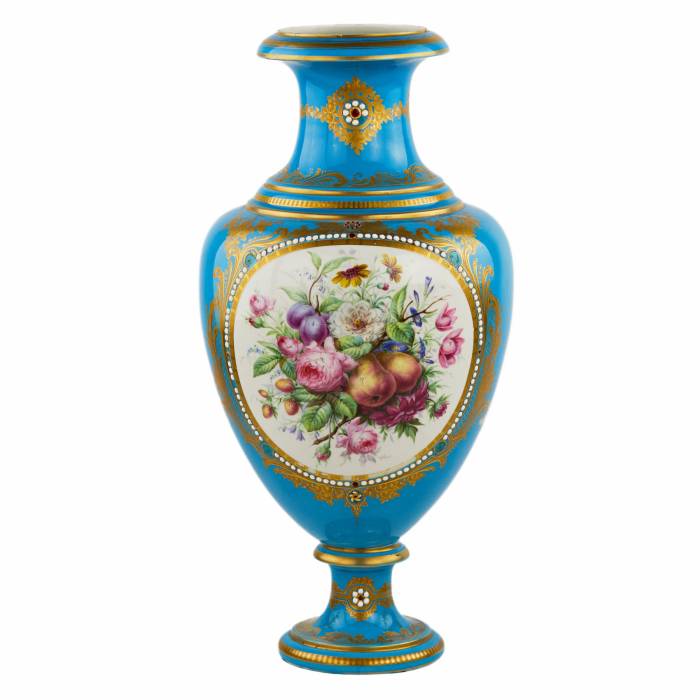
LARGE PORCELAIN VASE “THE BIRTH OF VENUS” FRANCE, MANUFACTURE NATIONALE DE SÈVRES, SECOND HALF OF THE 19TH CENTURY
A large ceremonial porcelain vase of amphora form, produced at the renowned Manufacture nationale de Sèvres. The shape is inspired by Renaissance prototypes, with carefully balanced proportions, a high neck, and a stable circular foot. The body is covered with a rich turquoise-blue glaze serving as a ground for refined polychrome painting and lavish gilt ornamentation, characteristic of the highest artistic production of Sèvres in the 19th century.The front is adorned with a large oval medallion depicting the mythological scene The Birth of Venus. The goddess is shown at the moment of her triumphant emergence from the sea in a shell, with a flowing red drapery, surrounded by putti and music-making nymphs. The movement of the waves, the play of wind, and the dynamic arrangement of figures emphasize the allegorical nature of the scene, symbolizing the triumphant power of love, harmony of nature, and ideal beauty. The composition draws upon Renaissance and academic traditions widely embraced by French art of the period.The reverse features a richly painted still life with an opulent bouquet of flowers, pears, and plums. This imagery, traditionally associated with abundance and fertility, forms a meaningful dialogue with the mythological subject on the front. The painting is framed by a gilt cartouche with a pearl border. The body is further enriched with elaborate gilt vegetal and classical ornamentation executed with exceptional precision.Marks:Hand-painted underglaze cobalt mark of the Manufacture nationale de Sèvres, featuring a working monogram and the letter “P”. Such letter marks formed part of the internal attribution system used by the artistic workshops and painting ateliers of the manufactory in the second half of the 19th century and are characteristic of ceremonial vases with painted medallions.Dimensions: Height: 42 cm; Width: 25 cm; Depth: 25 cm.Condition: Good. Even glaze, no cracks or chips. Minor signs of age and light wear to the gilding on raised areas. The painted decoration is well preserved, with no evidence of restoration.Provenance: Private European collection.
Bidding is completed
Subscribe to our newsletter
Never miss new auctions
Subscribe

Your latest views