USD
EUR
USD
English
Latviešu
Francais
English
Русский
Sign Up
Login
Auction
Best sellers
Upcomming auctions
Archive
Shop
Sell
Evaluation
Services
Expertise
Restoration
Antiq selection
Delivery
Contacts
Home
Shop
Show sold items
Show auction items
Available right now
Price
-
USD
New items
Gifts
EXCLUSIVE
Catalogue categories
ALL ITEMS
Russian art
Objects of Vertu (7)
+
Objects of Vertu (7)
Paintings (633)
+
Paintings (596)
Watercolor (22)
Miniature (3)
Other (12)
Graphic arts (47)
+
Graphic arts (47)
Icons (24)
+
Icons (22)
Church utensils (2)
Frames and easels (43)
+
Frames (29)
Easels (3)
Photo frames (11)
Sculpture (58)
+
Bronze sculptures (30)
Stone sculptures (9)
Stone carving miniature (6)
Other (13)
Silver and metal (183)
+
Russian silver (62)
European silver (54)
Other (67)
Porcelain and ceramics (347)
+
Russian porcelain (23)
European porcelain (111)
Other (213)
Glass (52)
+
Crystal (5)
Glass (47)
Clocks and watches (22)
+
Mantel clocks (8)
Wall clocks (3)
Wrist watches (7)
Pocket watches (1)
Grandfather floor clocks (1)
Other (2)
Furniture (147)
+
Furniture sets (8)
Showcases (26)
Dressers (10)
Tables (31)
Sofas (3)
Armchairs and chairs (17)
Columns (4)
Mirrors (9)
Consoles (10)
Other (29)
Lighting (52)
+
Chandeliers (12)
Sconce (8)
Floor lamps (4)
Lamps (16)
Candlesticks and candelabra (11)
Other (1)
Interior objects (31)
+
Interior objects (31)
Fireplaces and stoves (14)
+
Fireplaces and stoves (5)
Accessories (8)
Other (1)
Carpets and tapestries (2)
+
Carpets (1)
Tapestries (1)
Jewelry (127)
+
Diamonds and precious stones (0)
Rings (55)
Bracelets (7)
Brooches and pendants (2)
Earrings (9)
Jewelry sets (4)
Chains and necklaces (11)
Amber (0)
Bijoux (1)
Other (38)
Weapons and мilitary (19)
+
Weapon (11)
Military (5)
Other (2)
Armour (1)
Orders and medals (4)
+
Orders and medals (3)
Signs and Tokens (0)
Other (1)
Coins and banknotes (16)
+
Coins (16)
Banknotes and Bonds (0)
Other (0)
Mechanics (14)
+
Music boxes (8)
Mechanisms and tools (4)
Models (0)
Other (2)
Print, postcards and other antique paper production (9)
+
Posters (2)
Maps (3)
Postcards (0)
Photos (0)
Other (4)
Books (7)
+
Literature (1)
History (1)
Military (0)
Science (1)
Children`s literature (0)
Other (4)
Garden and architecture (2)
+
Garden sculpture (0)
Fountain (0)
Garden furniture (0)
Architectural elements (2)
Other (0)
Modern Art (72)
+
Paintings (10)
Sculpture (18)
Objects (29)
Other (15)
Collectibles (14)
+
Collectibles (14)
Vintage and fashion (2)
+
Accessories (2)
Clothing (0)
Footwear (0)
Other (0)
Other (9)
+
Other (9)
Asian art
Styles
Louis-Philippe Carl X (11)
Academic art (1)
Antiquity (9)
Art Deco (61)
Art Nouveau (24)
Asian Art (10)
Baroque (25)
Biedermeier (9)
Boulle (3)
Chinoiserie (6)
Classicism (25)
Design of 50-60’s (10)
Design of 70’s (6)
Eclecticism (53)
Empire (28)
Empire - Consulate (1)
Gothic (1)
Gothic Revival (2)
Impressionism (19)
Judaica (2)
Jugendstil (10)
Louis XIII - Renaissance (2)
Louis XIV - Regency (1)
Louis XV (29)
Louis XVI (32)
Modern (96)
Modern Art (95)
Napoleon III (40)
Neo-Baroque (10)
Neo-baroque (4)
Neo-Russian (23)
Neoclassicism (31)
Neorenaissance (4)
Neorococo (34)
Oriental Art (4)
Other style (62)
Realism (47)
Renaissance (7)
Rococo (38)
Romanticism (24)
Vanguard (20)
Victorian Style (3)
Epoques
16th century (2)
17th century (4)
18th century (28)
19th century (281)
20th century (325)
21th century (273)
At the turn of 17th-18th century (2)
At the turn of 19th -20th century (179)
At the turn of the 15th - 16th century (4)
At the turn of the 18th -19th century (10)
Early 17th century (1)
Early 18th century (1)
Early 19th century (18)
Early 20th century (381)
Late 18th century (2)
Late 19th century (86)
Mid-17th century (14)
Mid-18th century (1)
Mid-19th century (35)
Mid-20th century (273)
The end of the 17th century (1)
The end of the 20th century (44)
Price (descending)
Price (ascending)
Date (ascending)
Date (descending)
1
2
3
4
...
82
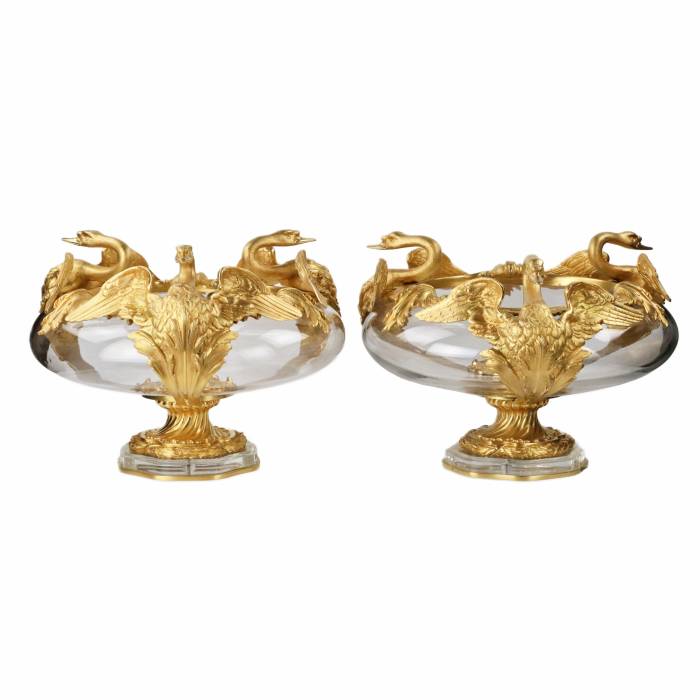
PAIR OF SWAN-MOTIF JARDINIÈRES FRANCE, 20TH CENTURY
A monumental pair of circular jardinières crafted from cast glass and gilt bronze, executed in France in the 20th century in the Historicist manner, drawing upon the artistic vocabulary of the French Empire. The composition is defined by the striking contrast between the massive transparent glass bowl and the sculptural bronze mounting, finely chased and richly articulated in detail.The bronze decoration forms a cohesive and dynamic ensemble: around the rim are arranged majestic swans with gracefully curved necks and outstretched wings. Their bodies create a rhythmic frieze characteristic of the Imperial decorative canon, where the swan symbolizes nobility, purity and fidelity. The central elements are enriched with lush palmettes and acanthus motifs, descending into a substantial profiled stem. The base combines bronze and transparent glass, enhancing the sense of monumentality while ensuring structural balance.The bronze displays refined casting of high artistic quality, with delicately modeled plumage conveying a vivid sense of movement. The even gilding underscores the ceremonial character of the pieces and amplifies the play of light across the relief surface. Such jardinières were conceived for grand interiors – winter gardens, salons and reception rooms – serving as decorative focal points and emblems of status.Marks: None observed.Dimensions: Height 34–36 cm. Diameter 46 cm.Condition: Good. Gilding even. Minor signs of age and handling. No losses to the glass and no deformation of the bronze.Provenance: Private collection. Formerly Paris, hôtel particulier.
14397 USD
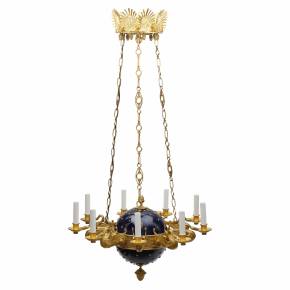
IMPRESSIVE EMPIRE STYLE CHANDELIER RUSSIA, FIRST QUARTER OF THE 19TH CENTURY
14397 USD
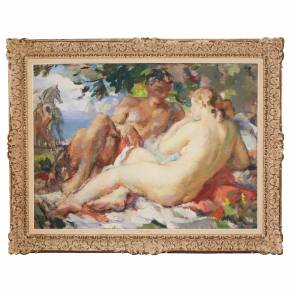
FERNAND RENAULT (1887 - 1939). “THE LOVING COUPLE” FRANCE, 1930S
13245 USD
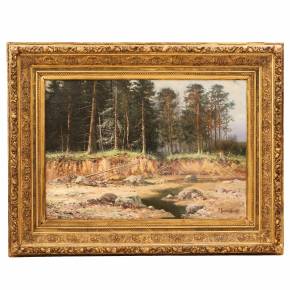
PINE FOREST. GAVRIIL PAVLOVICH KAMENSKY (1853–1912). 1897
11517 USD
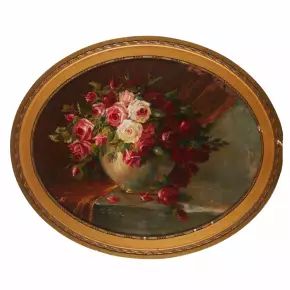
Still life Roses by T. Franz
864 USD
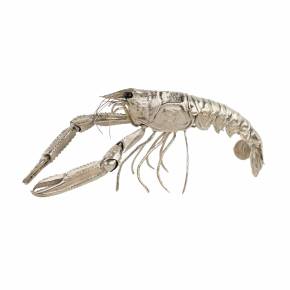
SILVER LANGOUSTINE SPAIN, 20TH CENTURY
2649 USD
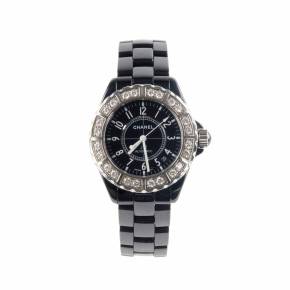
CHANEL J12 Classic Unisex Watch H1174.
10078 USD
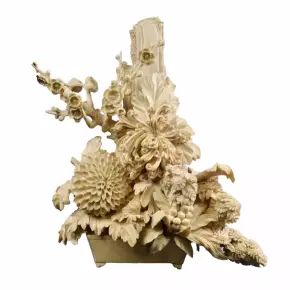
Ikebana Flowers. Bone carving from the Meiji Japan period
2880 USD
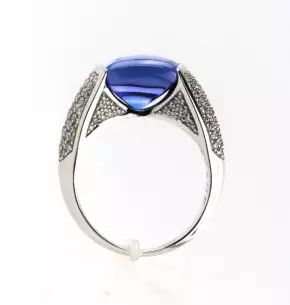
18K white gold ring with diamonds and tanzanite.
4031 USD
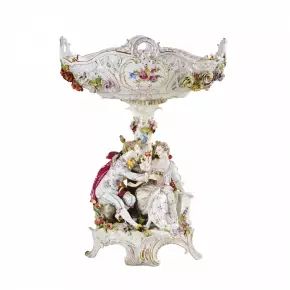
Fruit vase. Carl Thieme.
2880 USD
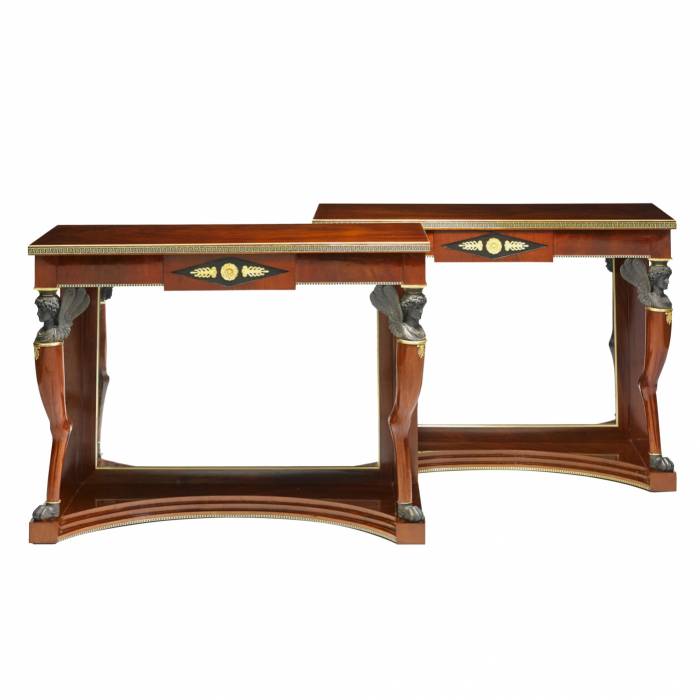
A PAIR OF RUSSIAN NEOCLASSICAL WALL CONSOLES ST PETERSBURG, LATE 19TH - EARLY 20TH CENTURY
A pair of ceremonial wall consoles executed in the traditions of Russian Neoclassicism, inspired by the models of the workshop of Heinrich Daniel Gambs (1765-1831). Structurally, each console is conceived according to a strict architectural principle: a rectangular top with a moulded edge rests on two front supports joined by a curved lower stretcher.The bodies are crafted in carefully selected mahogany veneer, enhanced by a deep mirror-like polish. The frieze is decorated with an inlaid geometric band recalling the antique meander motif. The central section features a diamond-shaped panel with a gilt-bronze medallion framed by stylised laurel branches, forming a solemn imperial accent.The front supports are designed as herm figures with busts of winged genii executed in patinated bronze. The sculptural modelling of curls, facial features and wings demonstrates a high level of artistic casting. The legs terminate in bronze lion’s paw feet, reinforcing the symbolism of strength and stability. Gilt mouldings and rosettes create a striking contrast with the warm tone of the mahogany and give the composition a sense of completion.The present pair reflects the characteristic reinterpretation of the St Petersburg Empire tradition at the turn of the 19th and 20th centuries, when historical models of the Alexander I period were reproduced in the interiors of aristocratic mansions and ceremonial halls of the late Imperial era.Dimensions: Height: 83 cm; width: 110 cm; depth: 48 cm (each).Condition: Professionally restored. Overall good condition. Minor signs of age and use.Provenance: Private collection.
14397 USD
SILVERED WINE DECANTER FRANCE, LATE 19TH – EARLY 20TH CENTURY
1152 USD
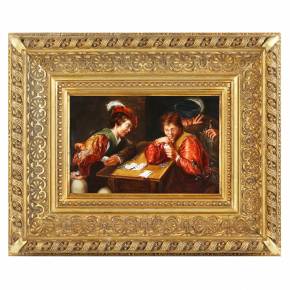
PORCELAIN PLAQUE WITH A GENRE SCENE “CARD SHARPS” KPM, BERLIN, TURN OF THE 19TH–20TH CENTURIES
3686 USD
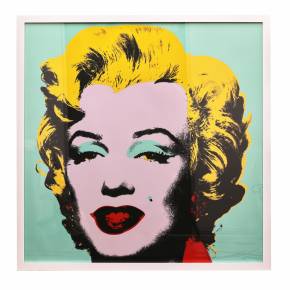
Marilyn. Print on paper. Andy Warhol (United States, 1928-1987).
2534 USD
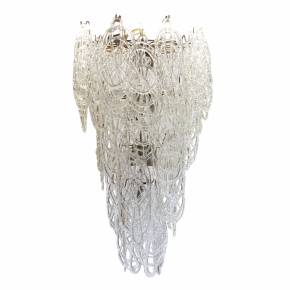
Gino Vistosi. Large salon chandelier Mazzega, Murano, Italy, 1960s.
1498 USD
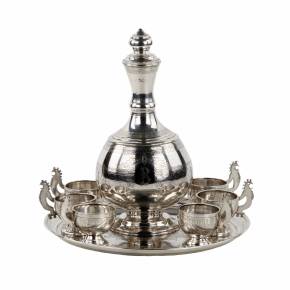
Elegant silver vodka set in the neo-Russian style, workshop S.M. Ikonnikov.
4147 USD
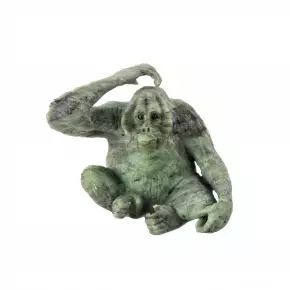
Stone-cut miniature Orangutan in Faberge style
1383 USD
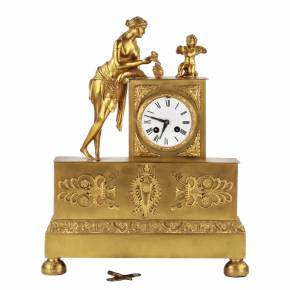
Mantel clock.
1993 USD
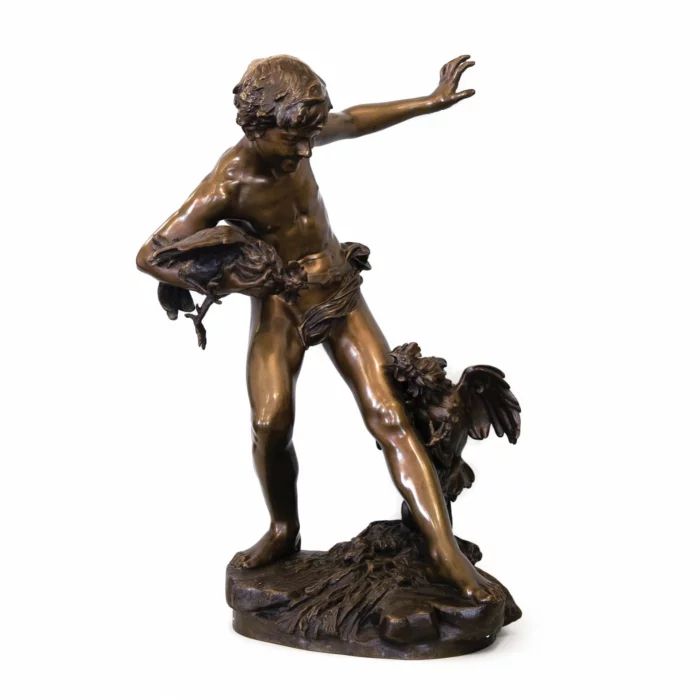
PAUL CHEVRE. BOY SEPARATING FIGHTING COCKS FRANCE / CANADA, LATE 19TH - EARLY 20TH CENTURY
A monumental author’s bronze sculpture executed by Paul Chevré, an eminent French-Canadian master of the academic school at the turn of the nineteenth and twentieth centuries. The composition depicts a nude youth in a moment of intense movement, striving to separate two fighting cocks engaged in a furious struggle.The figure of the boy is conceived in an antiquizing manner. The modelling of the torso reveals precise anatomical structure and a refined treatment of surface. The contrapposto enhances the sensation of a fleeting gesture captured in bronze. The diagonal formed by the outstretched wings and extended necks of the cocks cuts across the line of the body and the drapery around the hips, creating a powerful dramatic rhythm within the composition.The contrast between the smooth surface of the youthful body and the textured rendering of the feathers produces an expressive interplay of light across the noble dark patina. The base is treated in a naturalistic manner and reinforces the dynamic tension of the sculptural group. The work demonstrates the maturity of the artist’s language and corresponds to the aesthetic ideals of the Belle Époque.Marks: Signed “Paul Chevré” on the base; foundry mark.Dimensions: Height 75 centimetres; width 52 centimetres.Condition: Good. Even dark patina. Minor surface wear consistent with age.Provenance: Private European collection.
14397 USD
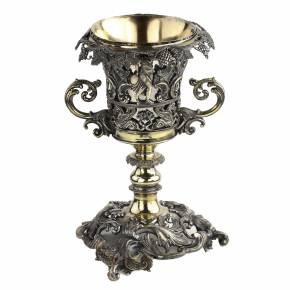
Large Russian silver cup. Ekvist Carl Gustav. St. Petersburg, mid-19th century.
6335 USD
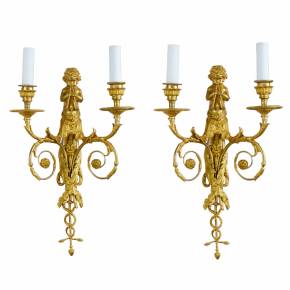
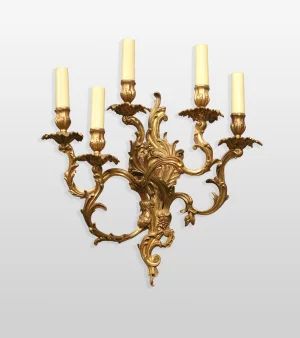
Pair of French gilt bronze sconces, Louis XVI style, 19th century.
2880 USD
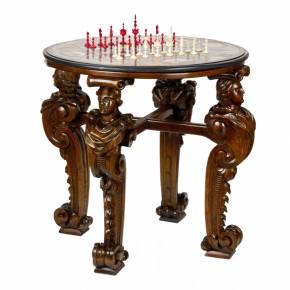
IMPRESSIVE CHESS TABLE WITH PRECIOUS ROMAN MOSAIC ON CARVED LEGS. ITALY. 19TH CENTURY
9790 USD
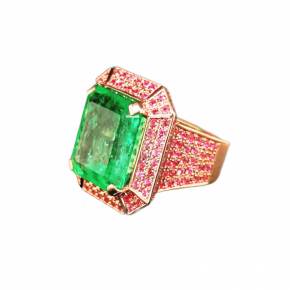
12.30 ct Colombian emerald ring with 2.15ct pink sapphires in 18k gold.
30521 USD
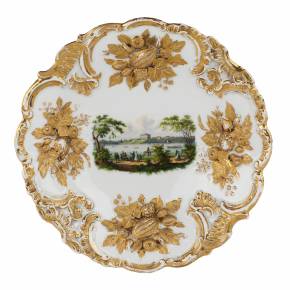
Luxurious decorative dish with a view of Zwickau. Meissen. 1815-1860.
1498 USD
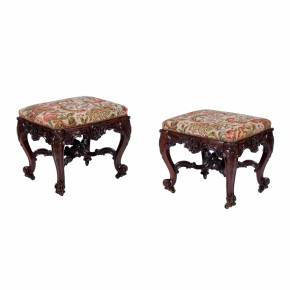
A pair of superb carved mahogany banquettes in the George II style. The turn of the 19th-20th centuries.
2649 USD
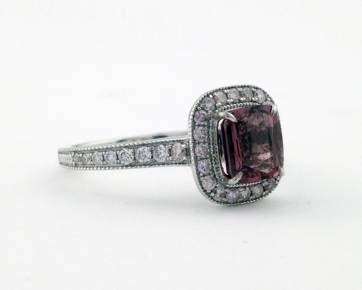
Ring 14K Whitegold with Spinel and Diamonds
1544 USD
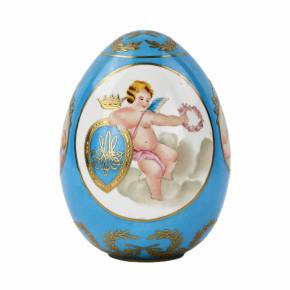
Large porcelain Easter egg.
1383 USD
1
2
3
4
...
82
Subscribe to our newsletter
Never miss new auctions
You have subscribed to our newsletter.
Subscribe
Your latest views
Sconce Rococo style
461 USD
Table
2765 USD
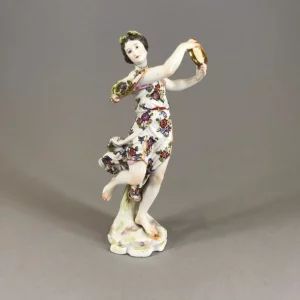
Girl with a tambourine. OSWALD LORENZ
265 USD
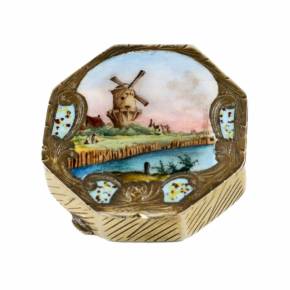
Snuff box
311 USD
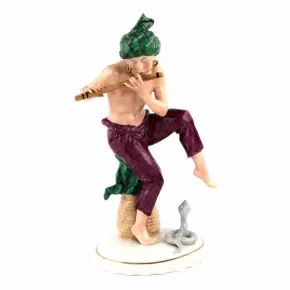
Snake Tamer. Sitzendorf.
346 USD
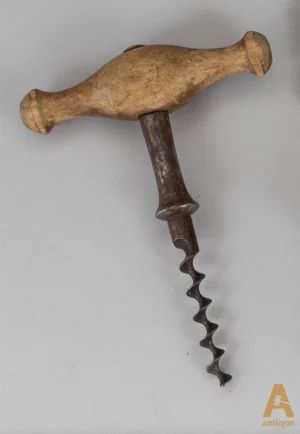
Corkscrew T-shaped
81 USD
Riverside
772 USD
Landscape
853 USD
Portrait of a girl
519 USD
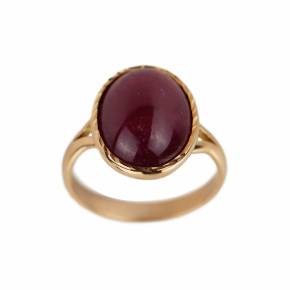
Golden ring with ruby.
3744 USD
Bronze figure Family
715 USD
Nude
2765 USD
Landscape
2926 USD
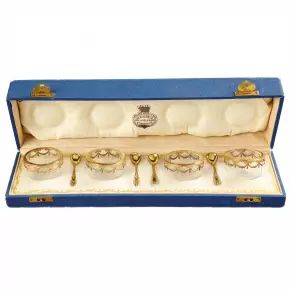
Salt cellars with spoons.
1325 USD
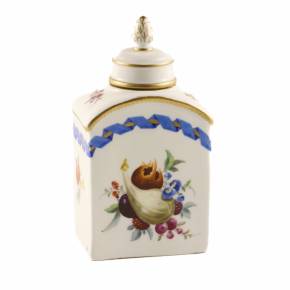
Tea caddy. Meissen.
933 USD
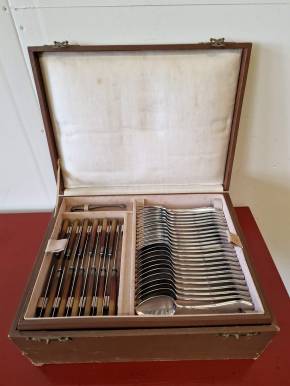
L.INOX Steel cutlery set
392 USD
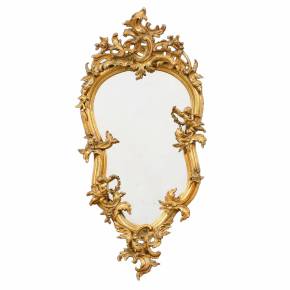
Rococo mirror.
2880 USD
Sunset
1383 USD
Evening
519 USD
Coast
553 USD
Start hunt for treasures!
Individual
Legal entity
Enter a name (min 3 characters)
Enter a Last name (min 3 characters)
Enter the email
User already exist
Algeria (+213)
Andorra (+376)
Angola (+244)
Anguilla (+1264)
Antigua & Barbuda (+1268)
Argentina (+54)
Armenia (+374)
Aruba (+297)
Australia (+61)
Austria (+43)
Azerbaijan (+994)
Bahamas (+1242)
Bahrain (+973)
Bangladesh (+880)
Barbados (+1246)
Belarus (+375)
Belgium (+32)
Belize (+501)
Benin (+229)
Bermuda (+1441)
Bhutan (+975)
Bolivia (+591)
Bosnia Herzegovina (+387)
Botswana (+267)
Brazil (+55)
Brunei (+673)
Bulgaria (+359)
Burkina Faso (+226)
Burundi (+257)
Cambodia (+855)
Cameroon (+237)
Canada (+1)
Cape Verde Islands (+238)
Cayman Islands (+1345)
Central African Republic (+236)
Chile (+56)
China (+86)
Colombia (+57)
Comoros (+269)
Congo (+242)
Cook Islands (+682)
Costa Rica (+506)
Croatia (+385)
Cuba (+53)
Cyprus North (+90392)
Cyprus South (+357)
Czech Republic (+42)
Denmark (+45)
Djibouti (+253)
Dominica (+1809)
Dominican Republic (+1809)
Ecuador (+593)
Egypt (+20)
El Salvador (+503)
Equatorial Guinea (+240)
Eritrea (+291)
Estonia (+372)
Ethiopia (+251)
Falkland Islands (+500)
Faroe Islands (+298)
Fiji (+679)
Finland (+358)
France (+33)
French Guiana (+594)
French Polynesia (+689)
Gabon (+241)
Gambia (+220)
Georgia (+7880)
Germany (+49)
Ghana (+233)
Gibraltar (+350)
Greece (+30)
Greenland (+299)
Grenada (+1473)
Guadeloupe (+590)
Guam (+671)
Guatemala (+502)
Guinea (+224)
Guinea - Bissau (+245)
Guyana (+592)
Haiti (+509)
Honduras (+504)
Hong Kong (+852)
Hungary (+36)
Iceland (+354)
India (+91)
Indonesia (+62)
Iran (+98)
Iraq (+964)
Ireland (+353)
Israel (+972)
Italy (+39)
Jamaica (+1876)
Japan (+81)
Jordan (+962)
Kazakhstan (+7)
Kenya (+254)
Kiribati (+686)
Korea North (+850)
Korea South (+82)
Kuwait (+965)
Kyrgyzstan (+996)
Laos (+856)
Latvia (+371)
Lebanon (+961)
Lesotho (+266)
Liberia (+231)
Libya (+218)
Liechtenstein (+417)
Lithuania (+370)
Luxembourg (+352)
Macao (+853)
Macedonia (+389)
Madagascar (+261)
Malawi (+265)
Malaysia (+60)
Maldives (+960)
Mali (+223)
Malta (+356)
Marshall Islands (+692)
Martinique (+596)
Mauritania (+222)
Mayotte (+269)
Mexico (+52)
Micronesia (+691)
Moldova (+373)
Monaco (+377)
Mongolia (+976)
Montserrat (+1664)
Morocco (+212)
Mozambique (+258)
Myanmar (+95)
Namibia (+264)
Nauru (+674)
Nepal (+977)
Netherlands (+31)
New Caledonia (+687)
New Zealand (+64)
Nicaragua (+505)
Niger (+227)
Nigeria (+234)
Niue (+683)
Norfolk Islands (+672)
Northern Marianas (+670)
Norway (+47)
Oman (+968)
Palau (+680)
Panama (+507)
Papua New Guinea (+675)
Paraguay (+595)
Peru (+51)
Philippines (+63)
Poland (+48)
Portugal (+351)
Puerto Rico (+1787)
Qatar (+974)
Reunion (+262)
Romania (+40)
Russia (+7)
Rwanda (+250)
San Marino (+378)
Sao Tome & Principe (+239)
Saudi Arabia (+966)
Senegal (+221)
Serbia (+381)
Seychelles (+248)
Sierra Leone (+232)
Singapore (+65)
Slovak Republic (+421)
Slovenia (+386)
Solomon Islands (+677)
Somalia (+252)
South Africa (+27)
Spain (+34)
Sri Lanka (+94)
St. Helena (+290)
St. Kitts (+1869)
St. Lucia (+1758)
Sudan (+249)
Suriname (+597)
Swaziland (+268)
Sweden (+46)
Switzerland (+41)
Syria (+963)
Taiwan (+886)
Tajikstan (+7)
Thailand (+66)
Togo (+228)
Tonga (+676)
Trinidad & Tobago (+1868)
Tunisia (+216)
Turkey (+90)
Turkmenistan (+7)
Turkmenistan (+993)
Turks & Caicos Islands (+1649)
Tuvalu (+688)
Uganda (+256)
UK (+44)
Ukraine (+380)
United Arab Emirates (+971)
Uruguay (+598)
USA (+1)
Uzbekistan (+7)
Vanuatu (+678)
Vatican City (+379)
Venezuela (+58)
Vietnam (+84)
Virgin Islands - British (+1284)
Virgin Islands - US (+1340)
Wallis & Futuna (+681)
Yemen (North)(+969)
Yemen (South)(+967)
Zambia (+260)
Zimbabwe (+263)
Enter the phone number
Minimum password length must be at least 6 characters
Enter a name of your company (min 3 characters)
Enter registration number (min 3 characters)
Enter the email
User already exist
Enter the phone number
Minimum password length must be at least 6 characters
I am a buyer
I am a seller
or log in with
Sign up for our weekly newsletter
I reviewed and agree
user agreement
,
«Privacy Policy»
i agree with Antiqon Terms and conditions
Register
Already have an account?
Log In
Enter your email and password for authorization
Enter the email
The number of attempts has been used uo, repeat after 2 hours
Minimum password length must be at least 6 characters
Invalid email or password
or log in with
Login
Forgot password?
Don't have an account?
register