Price
- USD
Catalogue categories

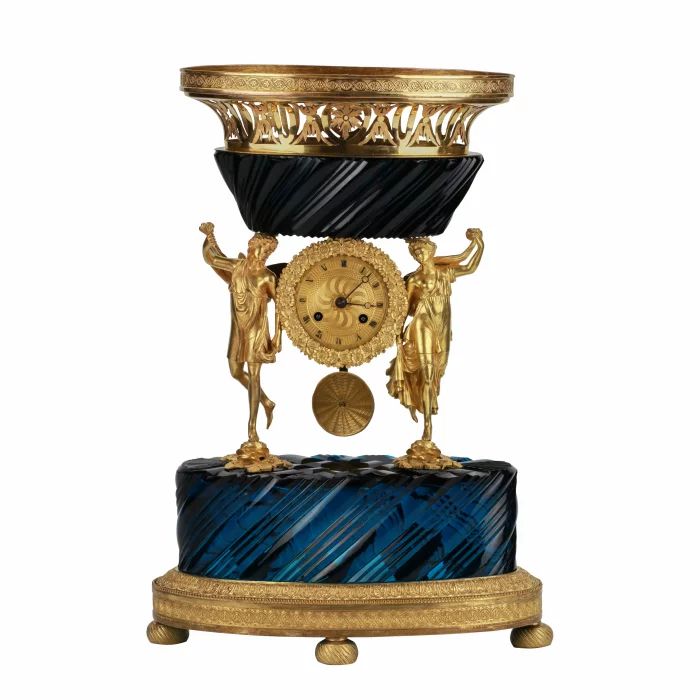
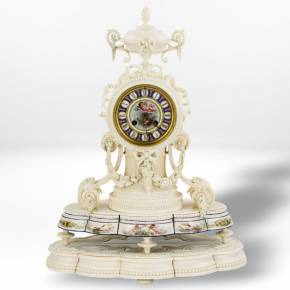
UNIQUE MANTEL CLOCK WITH SOLAR ALLEGORY. MODEL ATTRIBUTED TO CARLO ROSSI RUSSIAN EMPIRE, SAINT PETERSBURG, PERIOD OF NICHOLAS I, 1825-1855
A monumental mantel clock of the Late Russian Empire style, conceived within the artistic system associated with the design models of Carlo Rossi (1775-1849). The architectonics of the work are constructed upon a strict vertical axis and imbued with solar symbolism characteristic of court art of the 1830s-1840s.The composition is formed by two volumes of deep sapphire cobalt glass attributed to the Imperial Glass Factory of Saint Petersburg. The lower massive cylindrical body is decorated with a deeply cut diagonal spiral faceting, creating a dynamic effect of flowing water and the passage of time. The plastic rhythm of the glass reinforces the leitmotif of the wave as a symbol of continuity and eternal circulation.The central section features a gilt dial with Roman numerals, surrounded by a wreath of stylized vegetal ornament and a radiant solar composition. Two allegorical figures, male and female, support the upper vessel. Their gestures are directed toward the source of light, forming a cosmogonic image of the luminary rising from the waters. The iconography relates to the theme of Helios and the symbolism of Alpha and Omega, affirming harmony, love and fertility.The upper section takes the form of a cobalt glass vase crowned with an openwork gilt bronze frieze enriched with vegetal and solar motifs. The bronze elements display refined chasing and high-quality fire gilding characteristic of Saint Petersburg workshops of the first half of the nineteenth century.Marks: Not found.Dimensions: Height: 43 cm; Width: 30 cm; Depth: 20 cm.Material: Gilt and polished bronze; cobalt glass attributed to the Imperial Glass Factory; clock mechanism with pendulum.Condition: Good. Even gilding. Minor wear to the base. Minor micro-chips to the pedestal of the glass section, not affecting the overall visual integrity or structural stability of the piece.Provenance: Private European collection.Literature: Igor Sychev. Russian Lighting Fixtures of the Classical Period. 1760-1830. Moscow, P.V.B.R., 2003, illustrations 116, 189, 279, 305, 635, 795, 844, 845, 866, 868.
Begins 02.05.2026
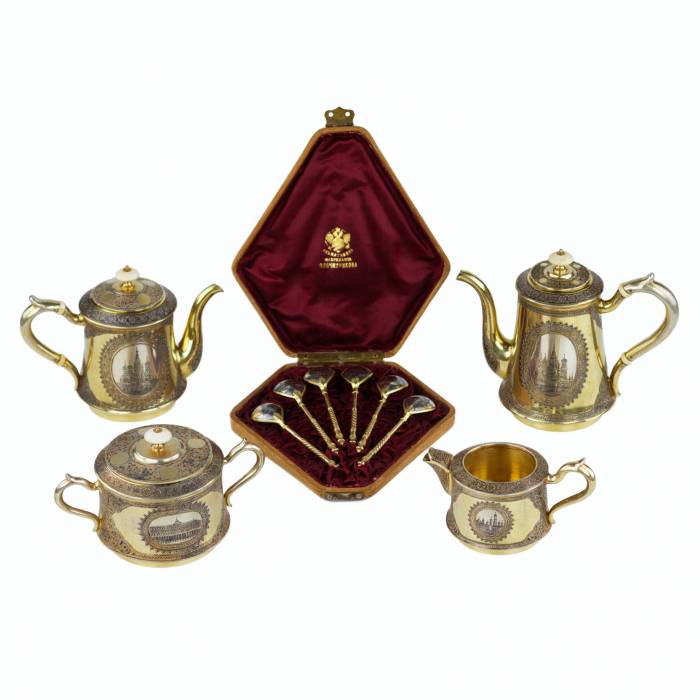
TEA AND COFFEE SET BY P. OVCHINNIKOV MOSCOW, LATE 19TH CENTURY
A magnificent gilded silver tea and coffee set created by the renowned Moscow firm of Pavel Ovchinnikov in the late 19th century, representing an outstanding example of Russian jewelry craftsmanship of the era. This refined ensemble, comprising a coffee pot, teapot, sugar bowl, cream jug, and a set of six spoons, embodies the essence of the Russian Revival style, combining national motifs, decorative richness, and exceptional technical execution.Each piece is adorned with medallions depicting views of the Moscow Kremlin, executed in niello, one of the most intricate and elegant decorative techniques in silverwork. The niello ornamentation frames architectural scenes with a sense of depth and precision, while the gilding lends a warm tone that enhances the contrast and sculptural clarity of the forms.The spoons feature miniature architectural scenes on the reverse, including St. Basil’s Cathedral, the Kremlin, the Ivan the Great Bell Tower, the Cathedral of Christ the Saviour, the towers of Kitay-gorod, and panoramic views of Red Square. Each image is executed with exquisite precision characteristic of Ovchinnikov’s finest work. The set is preserved in its original fitted case, embossed in gold with the inscription “FROM THE STORE OF THE MANUFACTURER P.A. OVCHINNIKOV” beneath the Russian Imperial coat of arms, indicating its sale through the Imperial Court Supplier’s official shop.Marks: Full and small maker’s marks of P. Ovchinnikov beneath a double-headed eagle, small mark “PO,” Moscow assay office mark with the stamp of Viktor Savinkov (active 1855–1888), dated 1872, state assay mark depicting St. George slaying the dragon, Russian 84 silver standard mark in a square shield with chamfered corners, later Latvian 875 mark with a girl’s head facing left (1922–1939) and the letter “A,” master’s mark “VS” for Vasily Semyonov.Dimensions: Coffee pot 24.5 × 12.6 × 24.0 cm, Sugar bowl 17.5 × 18.0 × 12.2 cm, Cream jug 11.8 × 8.2 × 9.6 cm, Spoons 10.5 × 2 cm.Weight: 1288 gMaterials: Silver 84 standard, gilding, niello, carving, casting, bone.Condition: Good collector’s condition. Partial wear to gilding and minor traces of age on niello consistent with use. Ornamentation remains sharp and detailed. Original case preserved with gold embossing and velvet interior.Provenance: Private European collection.
Begins 02.05.2026
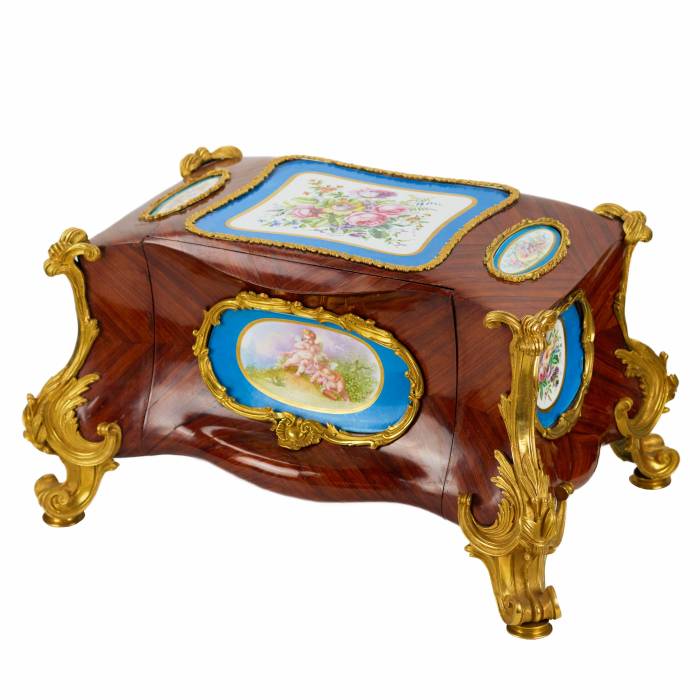
DESK JEWELRY CASKET WITH SÈVRES PORCELAIN PLAQUES FRANCE, FIRST HALF OF THE 19TH CENTURY, CIRCA 1830
An impressive desk jewelry casket executed in the opulent palatial manner of French decorative art of the Restoration period. The complex curvilinear body is crafted from finely selected rosewood, veneered in a striking diagonal pattern that enhances the sculptural volume and highlights the richness of the wood grain. The structure rests on four substantial sculptural feet in gilt bronze, modeled with pronounced Baroque scrolls and acanthus leaves.The surfaces are lavishly enriched with finely cast and chased gilt bronze mounts of high quality. Central to the decorative program are porcelain plaques from the Manufacture nationale de Sèvres, set within ornate gilt bronze frames. The polychrome paintings, executed on a blue ground, are devoted to themes of amorous lyricism: lush floral bouquets and playful putti, evoking the refined gallant imagery of the 18th century reinterpreted through the lens of early 19th-century taste.Particular attention is drawn to the porcelain plaque adorning the lid, featuring an exceptionally delicate floral composition. The painting is signed “BARRE SÈVRES,” allowing attribution to the Sèvres painter Barre, active during the first third of the 19th century. Signed plaques of this kind were reserved for objects of high representational status and were frequently commissioned for prestigious pieces of furniture and decorative works intended for aristocratic interiors.The interior of the casket is designed for the storage of jewelry and precious objects. A hinged front panel provides convenient access while preserving the monumentality and coherence of the exterior form. The casket stands as a refined example of the synthesis of cabinetmaking, gilt bronze work, and porcelain painting characteristic of leading French workshops of the period.Marks: Signed porcelain plaque: “BARRE SÈVRES”.Dimensions: Height 32 cm; width 58 cm; depth 36 cm.Condition: Good. Overall well preserved. Minor signs of age and use. Gilt bronze with even period patina. Porcelain plaques without chips or cracks.Provenance: France. Likely produced for an aristocratic interior or a formal salon in the first half of the 19th century.
Begins 03.05.2026
Subscribe to our newsletter
Never miss new auctions
Subscribe

Your latest views