Price
- USD
Catalogue categories

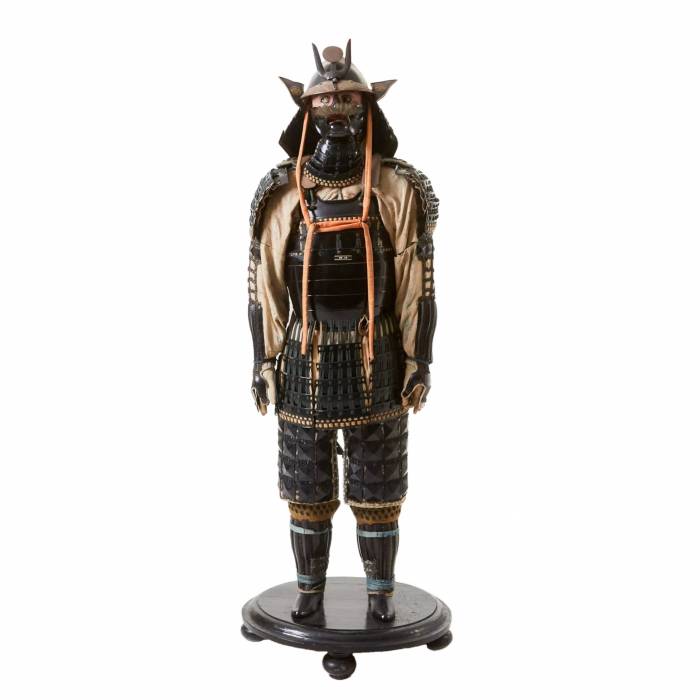
Samurai armor, Edo period.
Samurai armor, Edo period. Consisting of: cuirasses - do, plate skirt - kusazuri, leggings - haidate plate skirt, sections of which could be tied around the hips forming a kind of trouser leg knee pads - tate-oge, leggings - suneate, shoulder pads - sode, bracers - kote, mittens - tekko ( half-mittens) - as a rule, it was a plate (often in the form of a stylized palm), which is part of the kote and covers the back of the hand, the helmet is kabuto, the visor is the headband - mabizashi, the contour is kosimaki, a wide plate running along the lower edge of the helmet, the back of the neck is shikoro, decoration - date, mask - mengu, on the chin (protection of the throat) - yodare-kake. The Edo period (Jap. 江戸時代 edo-jidai) is a historical period (1603-1868) of Japan, during the reign of the Tokugawa clan. It began with the appointment of Tokugawa Ieyasu as shogun in 1603. Completed by the removal of the shogun Tokugawa Yoshinobu in 1868. It is characterized as the time of the establishment of the Tokugawa dictatorship, at the same time as the transition from medieval civil strife to a completely controlled country. During the Edo period, the formation of the Japanese spirit, the emergence of the national Japanese idea, the development of the economy and the bureaucracy took place. The Edo period is the golden age of literature and Japanese poetry, Matsuo Basho is the most prominent representative of the poetry of both the Edo period and Japanese poetry in general. As a result of the sakoku self-isolation policy, for almost the entire Edo period, the country was behind the Iron Curtain, without trading or communicating with other countries (a rare exception is China and the Netherlands).
Begins 03.05.2026
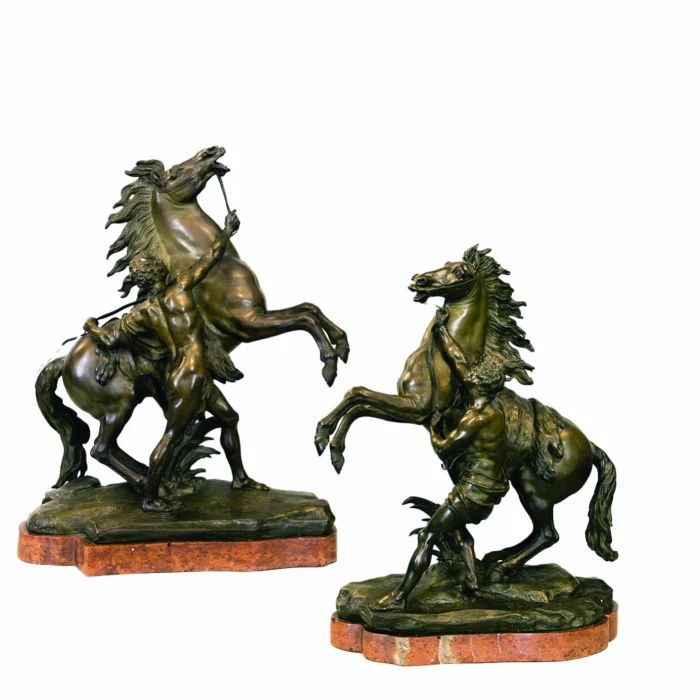
PAIR OF SCULPTURES “THE MARLY HORSES”, AFTER GUILLAUME COUSTOU THE ELDER (1677–1746) FRANCE, 19TH CENTURY
The pair of sculptural compositions known as “The Marly Horses”, also referred to as “The Horse Tamers”, represents a highly accomplished bronze interpretation of one of the most celebrated works of French court sculpture of the 18th century. The compositions derive from the original marble group created by Guillaume Coustou the Elder for the terrace of the royal château of Marly-le-Roi during the reign of Louis XV.The sculptures depict nude youths exerting great effort to restrain rearing horses. The dramatic tension of the scene is conveyed through the powerful contrast between the untamed energy of the animals and the academically precise treatment of human anatomy. The figures are conceived in complex spatial movement, creating a strong sense of continuous action and internal dynamism characteristic of the finest examples of French monumental sculpture.The bronzes are cast with exceptional attention to detail. The musculature of the human figures, the animated manes and strained necks of the horses, as well as the expressive gestures and corporeal plasticity, are all rendered with remarkable clarity. The surfaces retain a deep, even patina of a warm tone, enhancing the sculptural relief and the play of light and shadow. Each figure is mounted on a shaped marble base of harmonious coloration, lending the ensemble a distinctly ceremonial and interior-oriented presence.Material: Bronze; marble.Dimensions: Height – 66 cm; Width – 53 cm; Depth – 48 cm (each sculpture).Condition: Good.Provenance: Photo archive of a private collection. Formerly part of a private collection displayed in the Liechtenstein palaces, Stadtpalais Vienna and Schloss Vaduz, Liechtenstein, 1945.
Begins 03.05.2026
Subscribe to our newsletter
Never miss new auctions
Subscribe

Your latest views