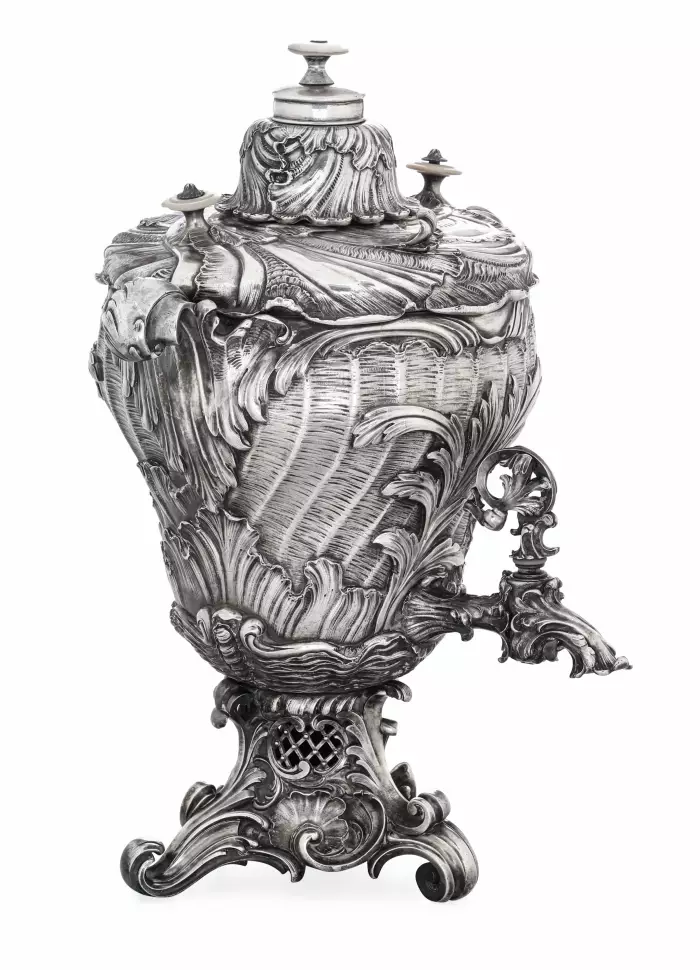
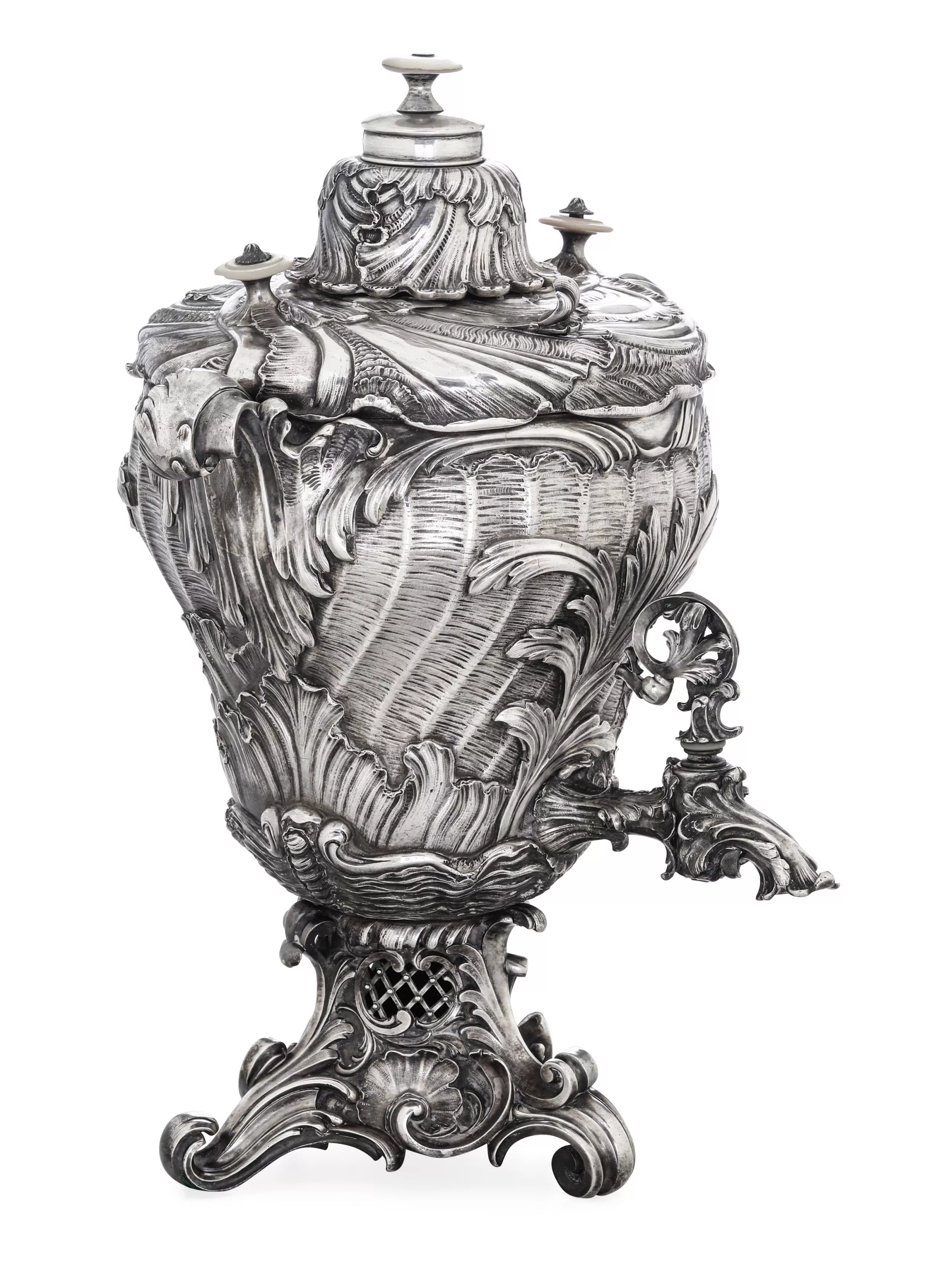
An outstanding example of Russian artistic silver from the late 19th century, created in the workshop of Andrei Stepanovich Bragin in St. Petersburg. The samovar is executed in the aesthetics of early Art Nouveau, featuring a pronounced Naturalistic approach and the influence of French Neo-Rococo, reflecting the transitional period from the historicist styles of the 19th century towards the new artistic language of the turn of the century.
The monumental pear-shaped samovar rests on three expressive feet enriched with rocaille scrolls and a sculptural shaped base of elaborate design. The entire body is covered with complex high-relief cast and chased decoration composed of flowing acanthus leaves, asymmetrical vegetal scrolls and dynamically modelled natural forms. The ornament is not merely applied decoration but becomes an integral part of the object’s structure, creating a unified organic composition characteristic of Art Nouveau aesthetics.
Particular artistic value is found in the sculptural side handles with mother-of-pearl insulators, the intricately shaped tap and the finely executed decorative elements of the base. The fluidity of the lines, natural movement of the forms and departure from strict symmetry demonstrate the influence of the European Naturalistic movement within Art Nouveau, which flourished in French decorative arts at the end of the 19th century.
This samovar represents a rare example of Russian silver in which a traditional object of tea culture has been transformed into an exhibition-quality objet d’art, combining the technical excellence of the St. Petersburg silversmithing tradition with the innovative artistic ideas of the Art Nouveau period.
Marks: Maker’s mark «А.Б.» - Andrei Stepanovich Bragin; St. Petersburg assay mark for 84 zolotnik silver standard; assay master’s mark «А.Ш.» - Alexander Vladimirovich Shishkin dated «1896».
Dimensions: 31 × 31 × 42 cm.
Weight: 5370 g.
Condition: In good collector’s condition. Showing natural signs of age, minor surface wear, localised old restoration interventions and rare minimal chips to the socket areas, consistent with the age of the object.
Provenance: Old Italian collection G. F. Mazzoleni. Preserved with the original collection label bearing the attribution inscription: “Pietroburgo 1896 / Orafo Andrey Stef. Braghin”, confirming its early European collecting provenance.
Andrei Stepanovich Bragin (1852-1908) occupies an important place among the masters of the St. Petersburg school of artistic silver of the late 19th and early 20th centuries. His workshop belonged to the circle of high-quality silversmithing establishments active during the flourishing period of Russian decorative arts. Bragin’s creations were distinguished by exceptional craftsmanship, sophisticated hand-working of silver, virtuoso chasing and particular attention to the sculptural expressiveness of form, qualities associated with the finest workshops of Imperial Russia.
The late 19th century represented a turning point in the development of European artistic silver. After decades dominated by Historicism and the revival of earlier artistic styles, craftsmen began to search for a new visual language based on natural forms, free-flowing lines and the organic unity between structure and decoration. These artistic ideas developed internationally into the Art Nouveau movement. One of its most expressive tendencies was Naturalism, inspired by living botanical forms, asymmetry and the transformation of functional objects into independent works of art.
French decorative arts of the second half of the 19th century played a significant role in shaping European jewellery and silver design. The dynamic rocaille vocabulary of Neo-Rococo gradually evolved into the flowing organic forms of Art Nouveau. Artists of the Belle Époque sought to move beyond the direct imitation of historical models, creating objects where decoration became inseparable from the structure itself. This principle is clearly reflected in the present samovar, where the vegetal relief does not simply adorn the surface but appears to grow naturally from the silver body, creating the impression of a living organic form.
Within Russian silver, such a Naturalistic interpretation is particularly rare. During the late 19th century, Russian workshops more frequently explored the Neo-Russian style, national ornament and historical motifs. St. Petersburg, however, maintained a close artistic dialogue with Europe and became a centre where French and international decorative trends were actively absorbed. Works from this artistic environment combined European aesthetics with the traditions of Russian silversmithing and exceptional technical execution.
The samovar itself held a special place in 19th-century Russian culture as a symbol of hospitality, family tradition and social status. In the hands of leading silversmiths, however, it moved far beyond its utilitarian purpose. Richly decorated silver samovars were created as ceremonial objects intended for aristocratic interiors, representative settings and important collections.
The present samovar by Andrei Stepanovich Bragin, dated 1896, is a remarkable example of this artistic transition. Its monumental form, sculptural modelling of acanthus foliage, asymmetrical decorative composition and influence of French Naturalistic design allow it to be considered a rare example of Russian Art Nouveau silver. It reflects the moment when Russian decorative arts became part of the wider European Art Nouveau movement while preserving the distinctive identity of the St. Petersburg silversmithing school.
The object is preserved in good collector’s condition with natural signs of age. The silver surface retains the expressiveness and depth of the high-relief decoration.
The condition report is provided for informational purposes only.
It is not comprehensive and may not reflect all defects, restorations, alterations, or adaptations, as Antiqon does not perform professional conservation-level assessments. The information is based on a qualified, yet subjective, evaluation by our specialists.Before purchasing, we recommend consultation with an independent expert.Please also consult our Terms and conditions and Glossary A-Z, which contain important information on lot characteristics and sale conditions.