



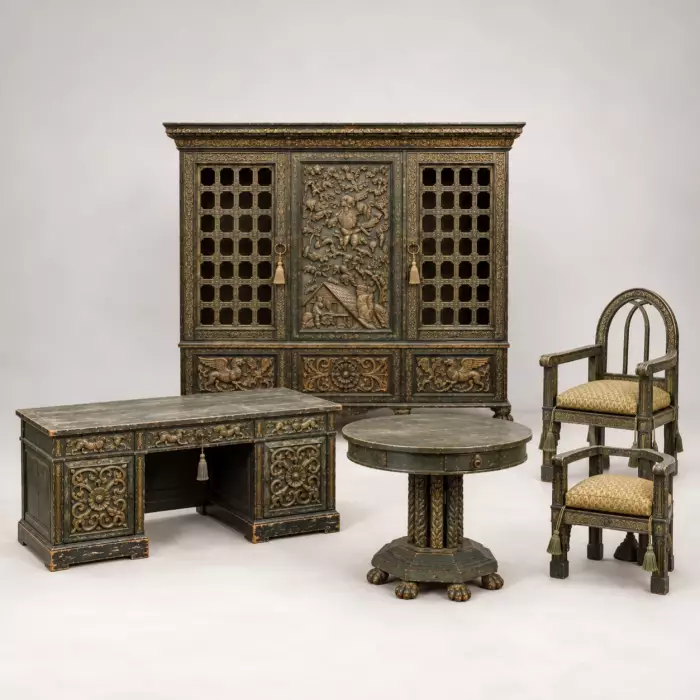
A MONUMENTAL STUDY FURNITURE SUITE WITH FIGURAL RELIEF CARVING. RUSSIAN EMPIRE, CIRCA 1890
Antiqon consultant will contact you within one business day after receiving your request.


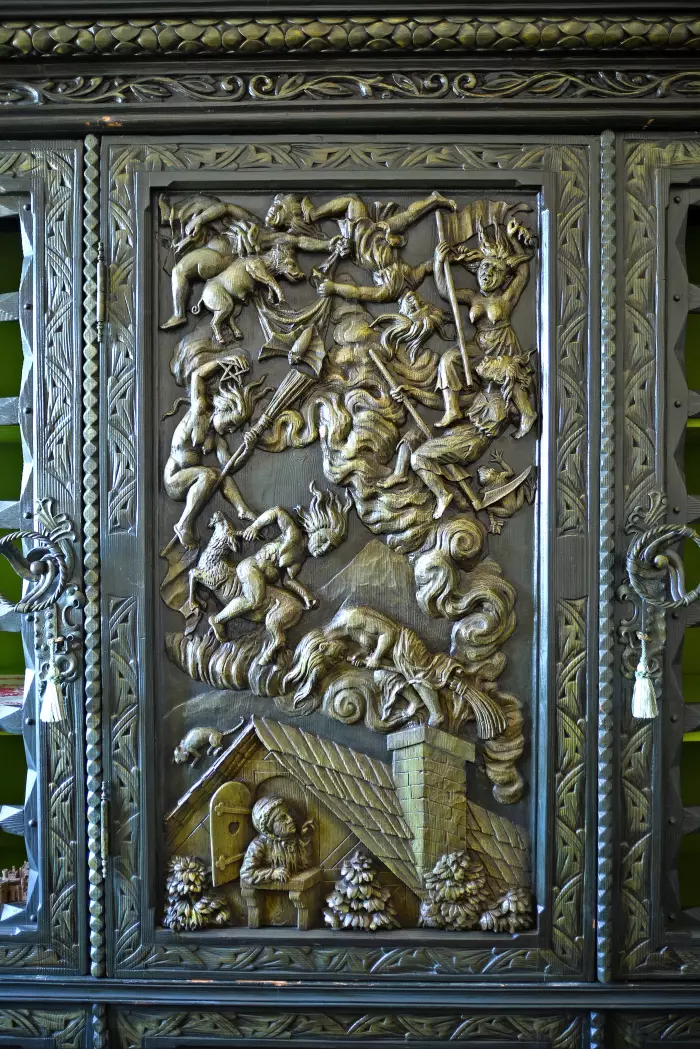
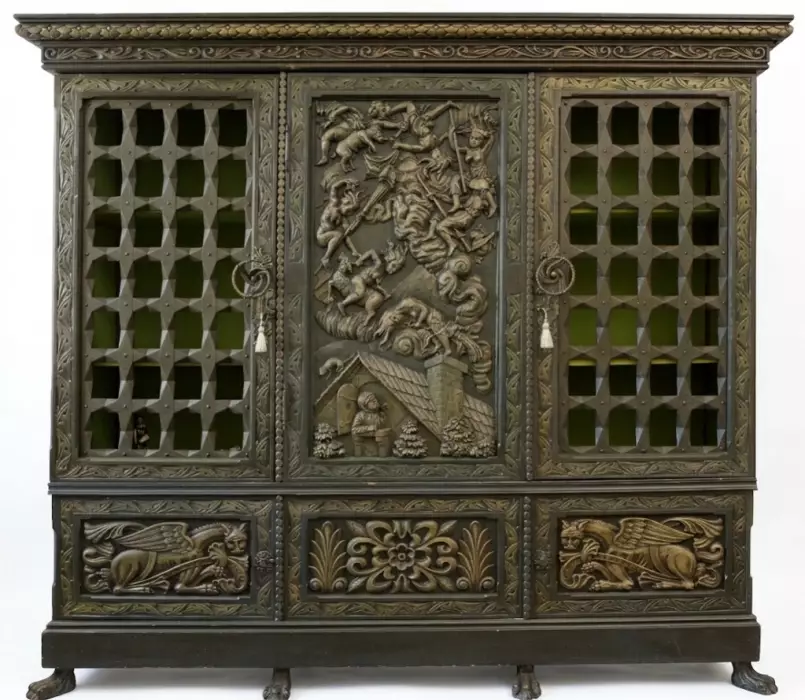
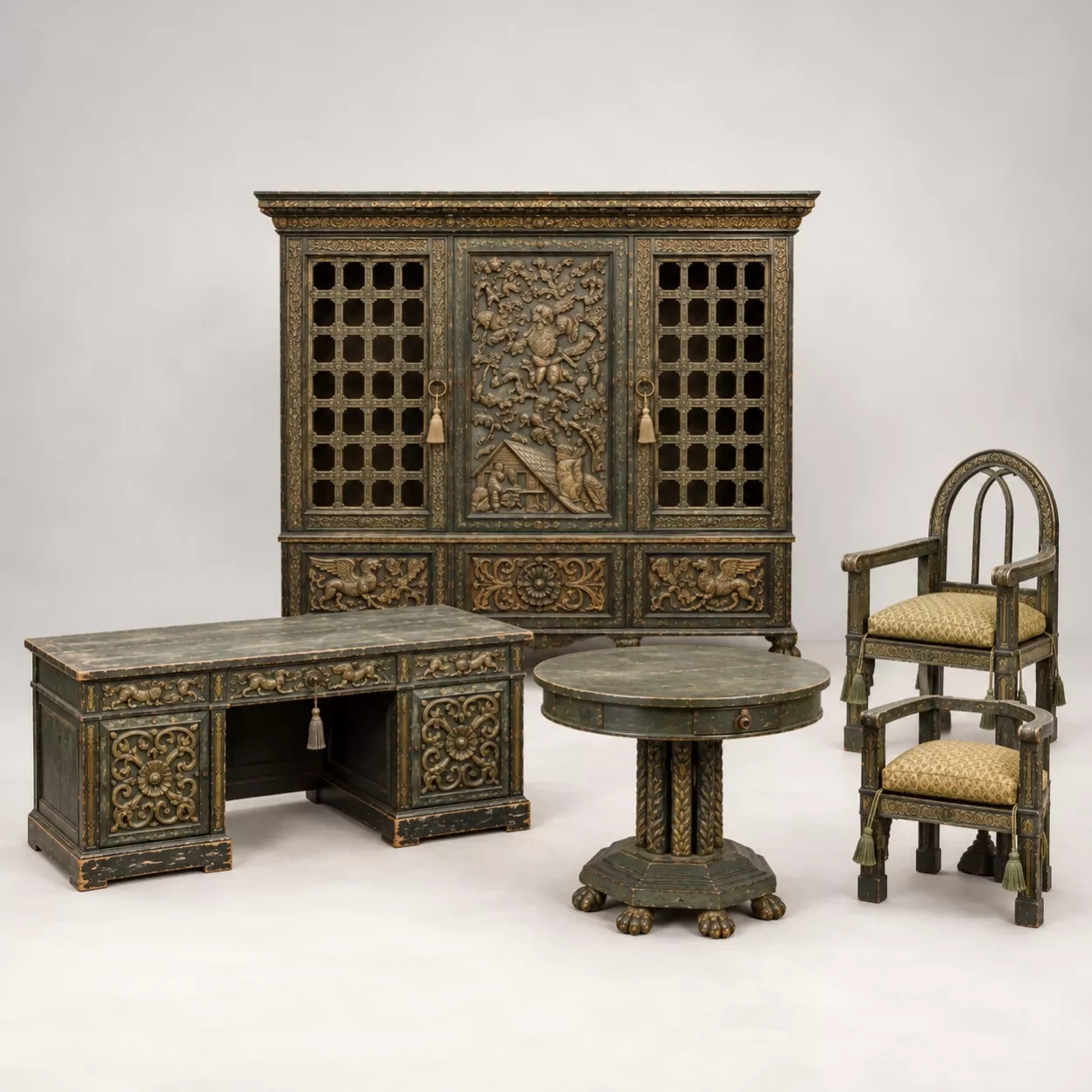
A rare monumental study furniture suite dating from the late 19th century, executed in the Historicist style with elements of Gothic Revival, Renaissance Revival and National Romanticism. The ensemble is distinguished by its striking architectural forms, elaborate relief carving and unusual iconographic programme, combining subjects drawn from medieval epics, European folklore and the world of fantastical beasts.
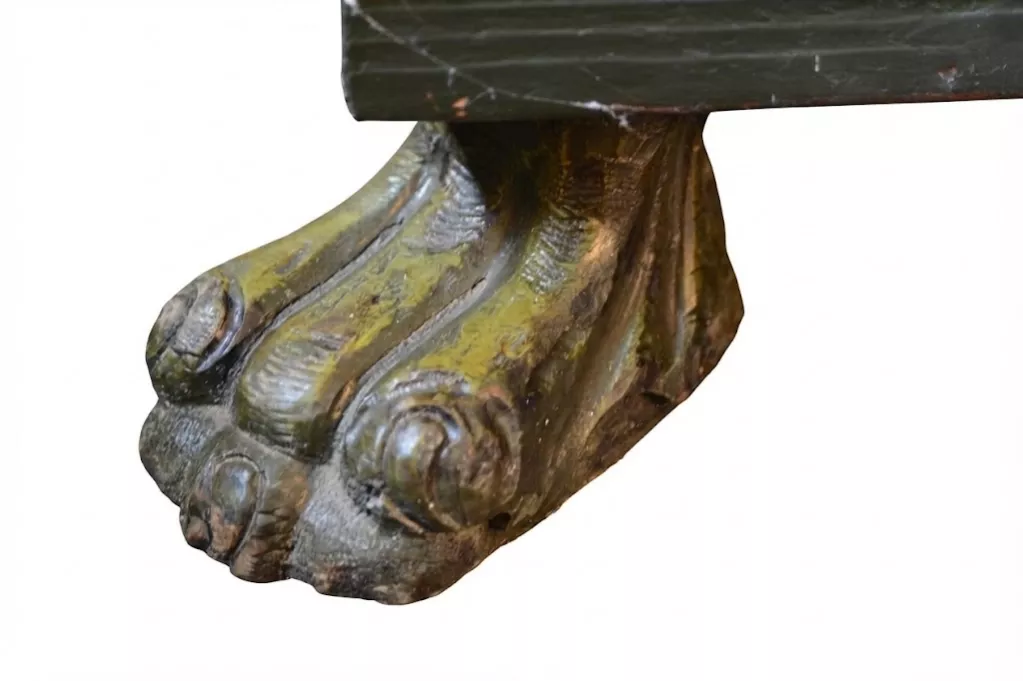
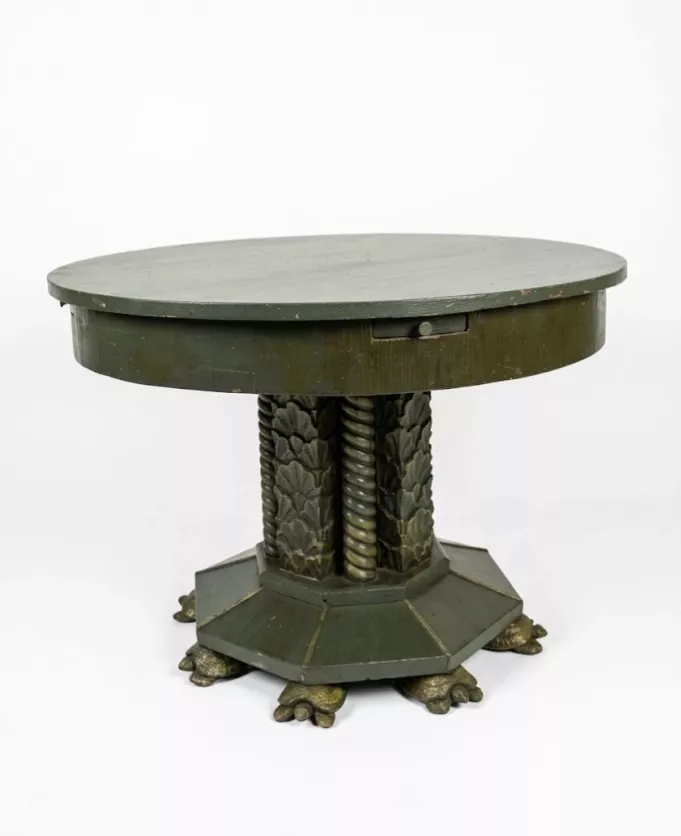
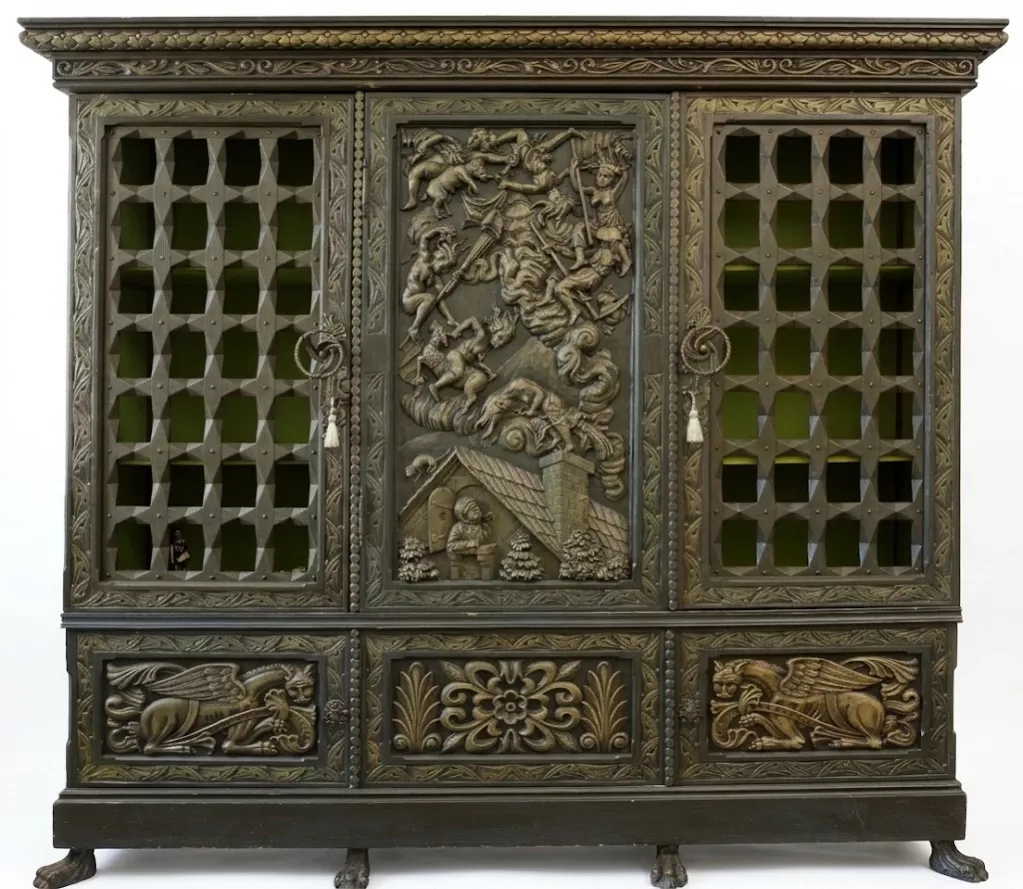
The suite comprises five pieces: a monumental cabinet, a writing desk, two armchairs of differing designs and a circular table raised on a carved central support.
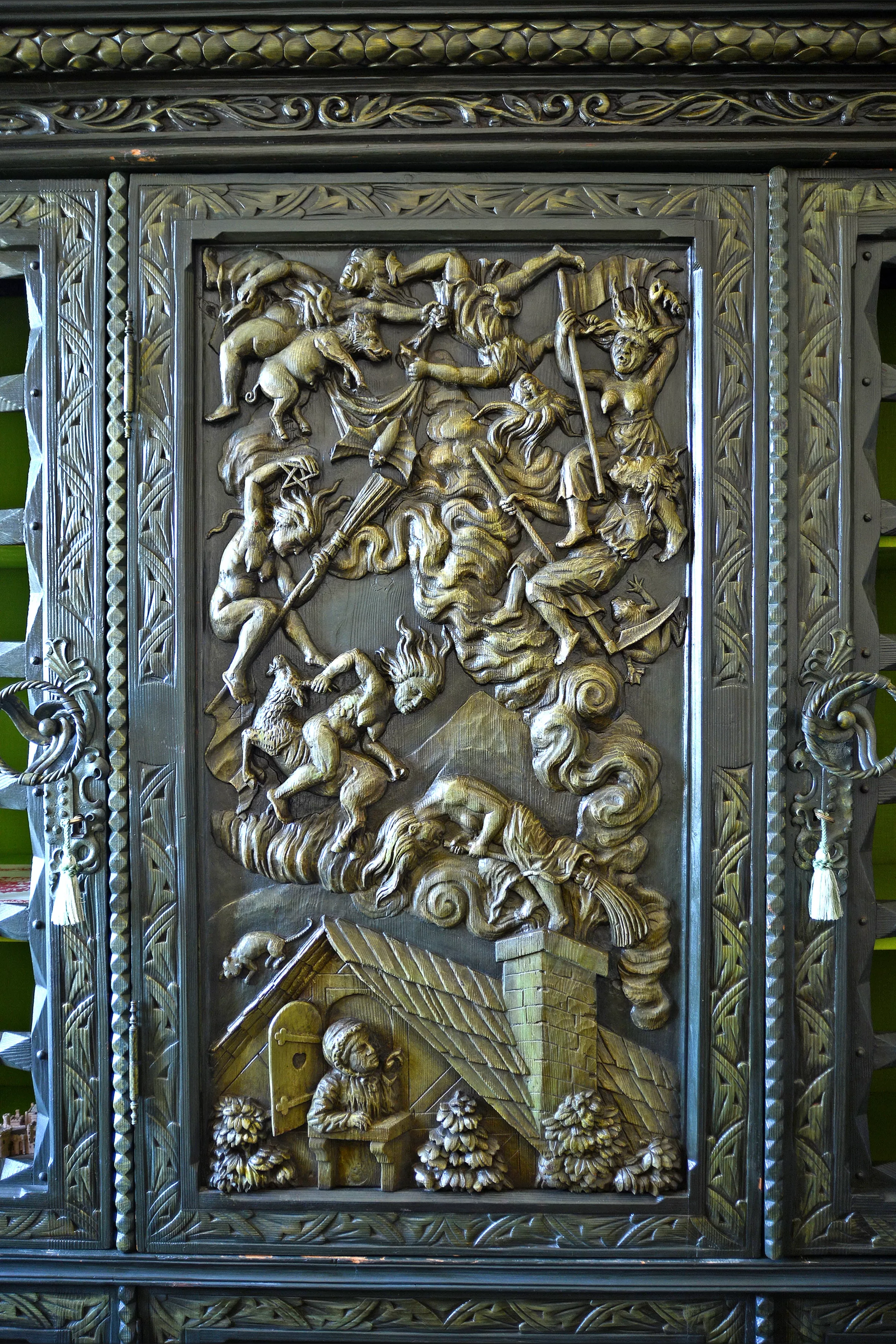
The centrepiece of the ensemble is an imposing three-section cabinet surmounted by a moulded cornice with a carved foliate frieze. Two lateral doors with geometric latticework flank a central panel featuring an elaborate multi-figure relief depicting a fantastical scene suggestive of a witches` sabbath. Above a small house, with a figure visible at the window, a swirling composition unfolds, populated by human figures, witches carrying broomsticks, animals and grotesque creatures emerging from billowing clouds.
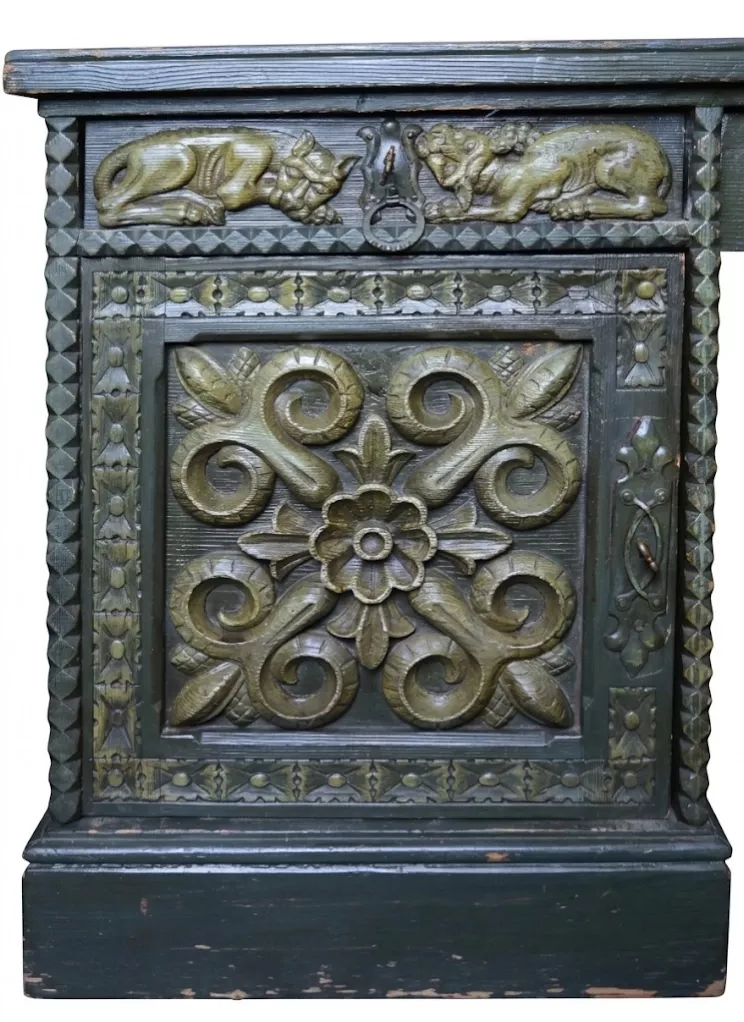
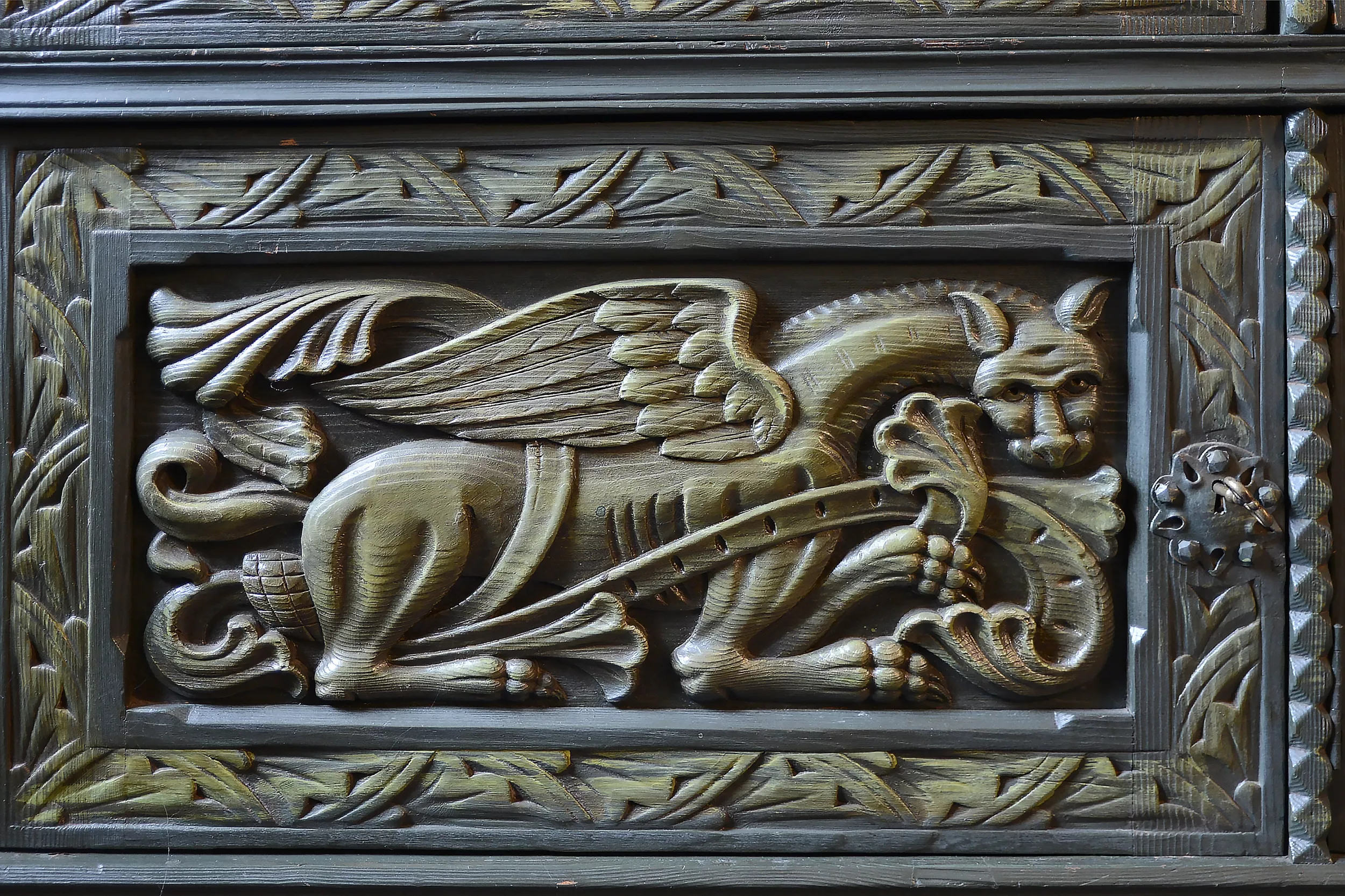
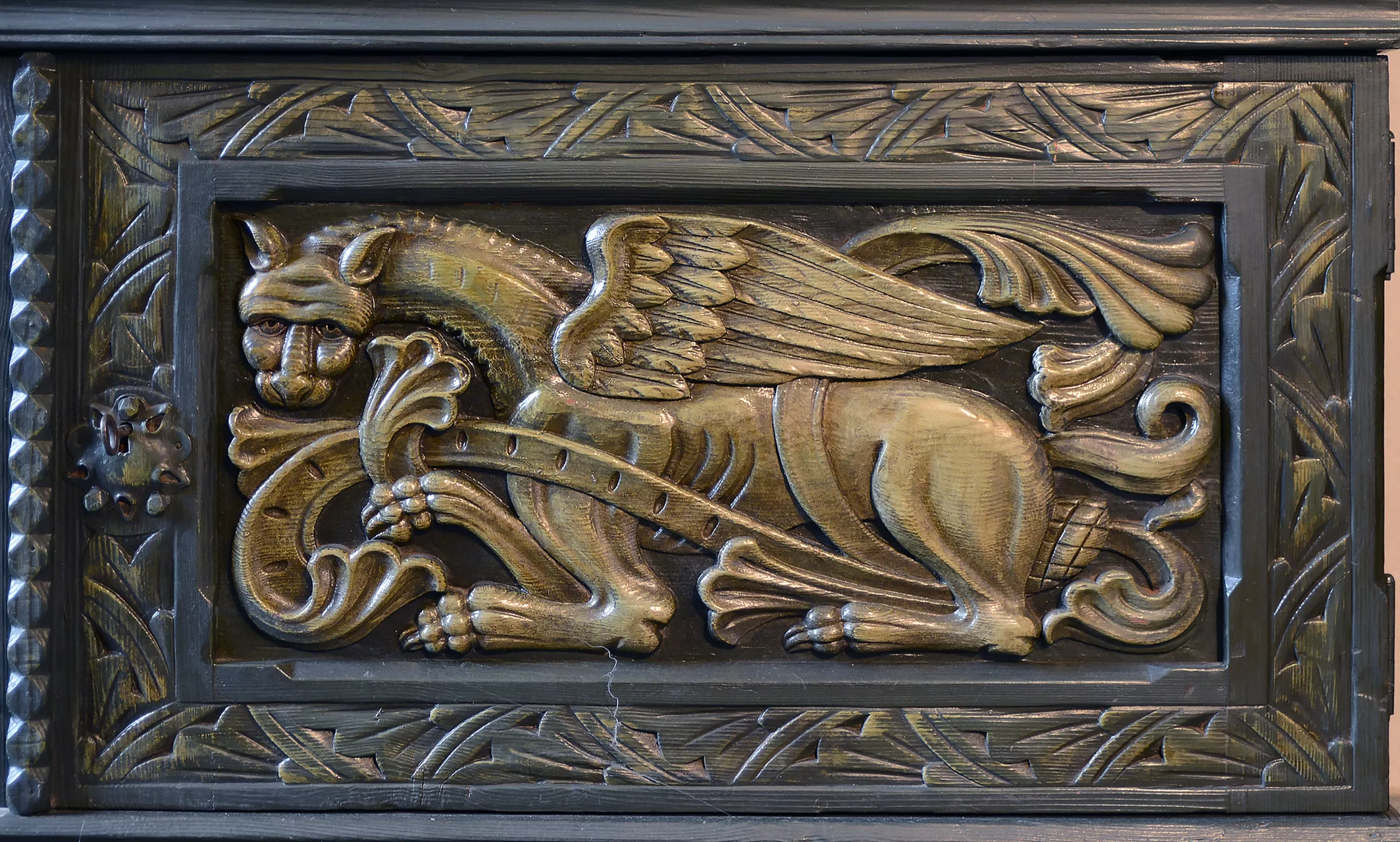
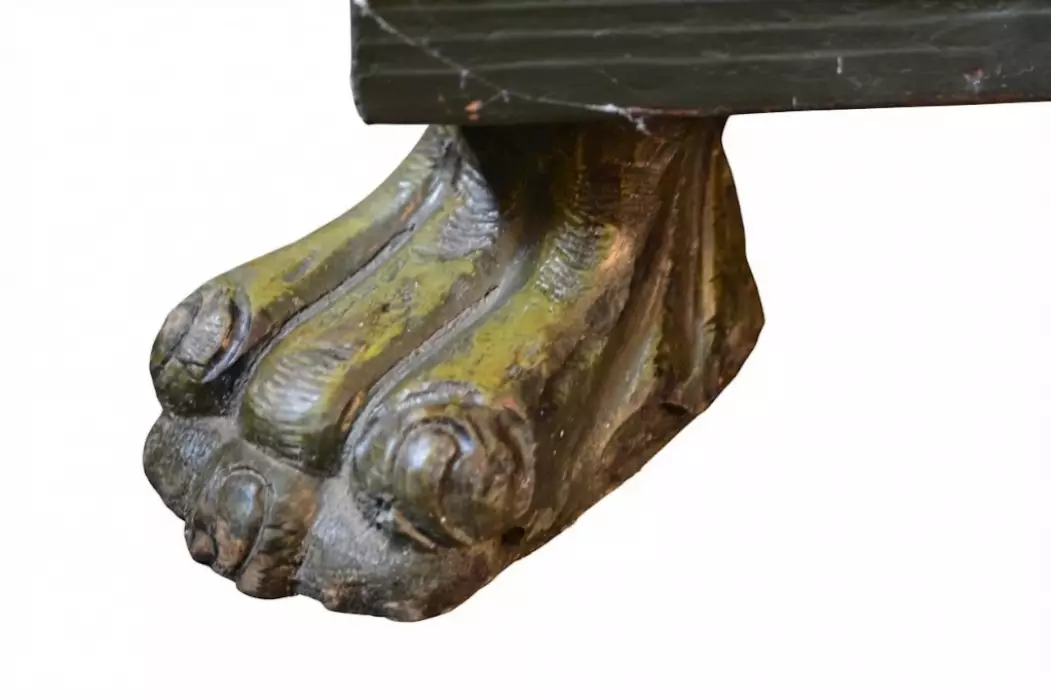
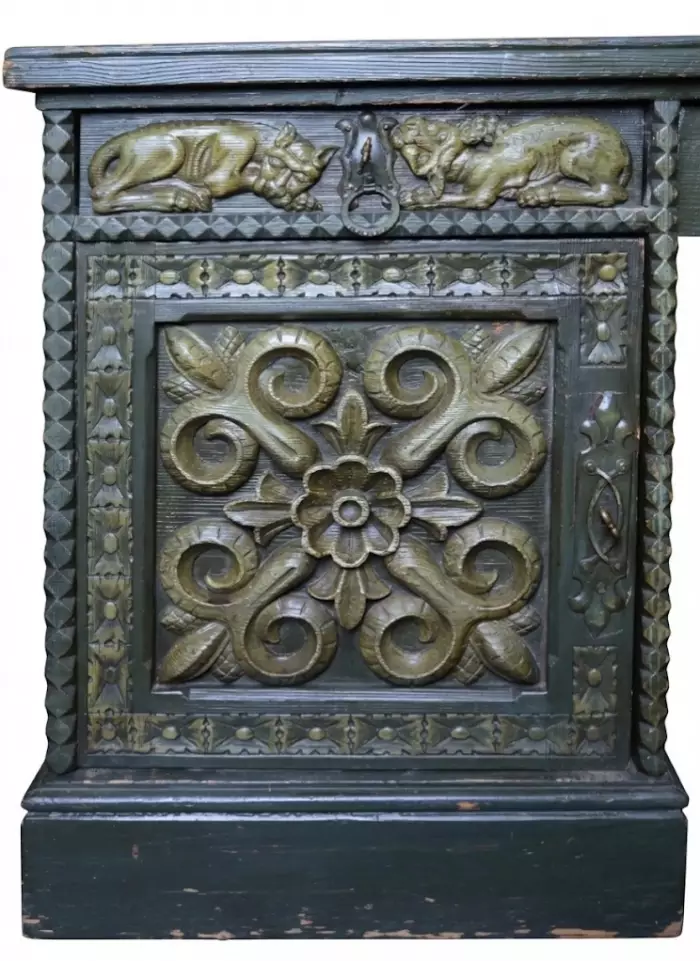
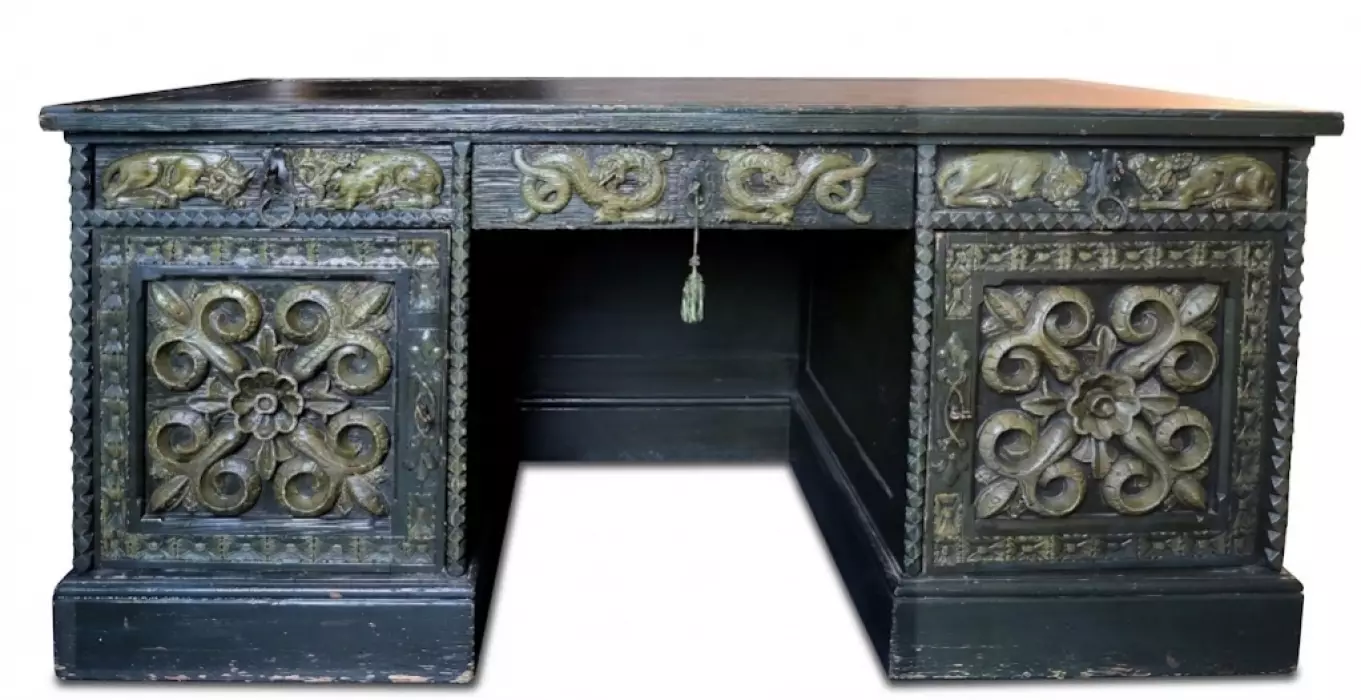
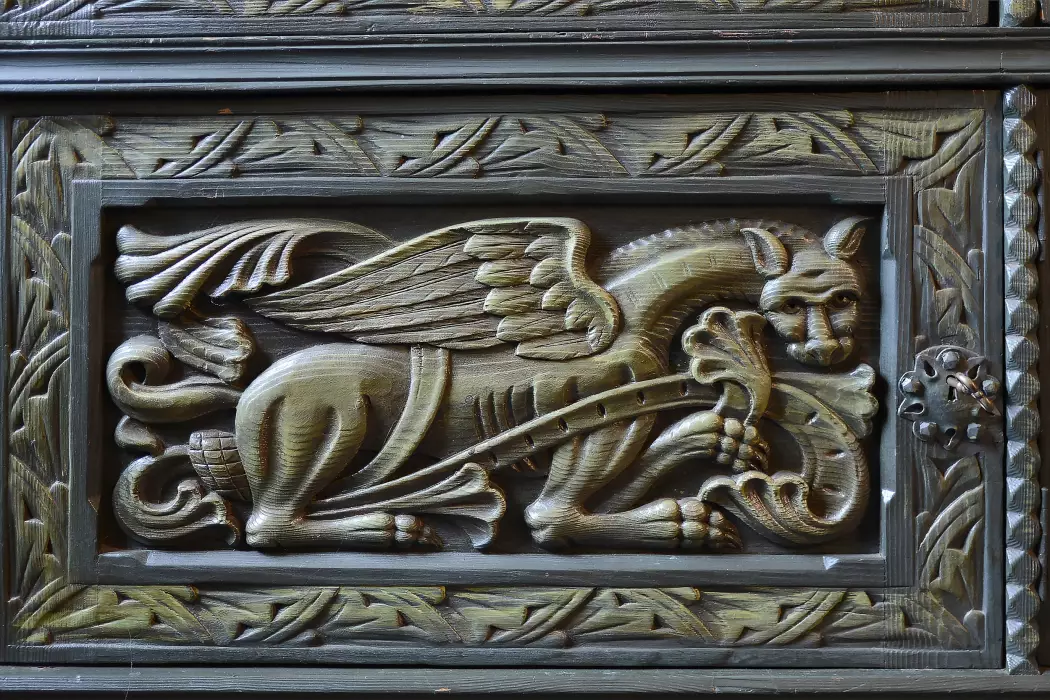
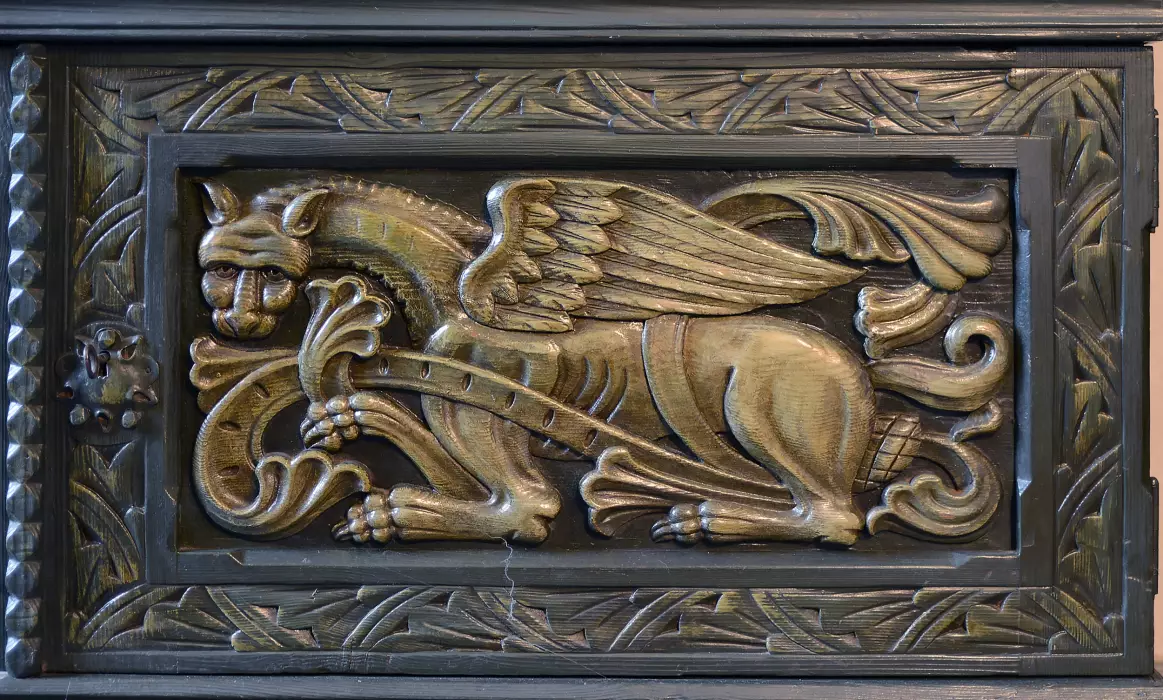
The lower section of the cabinet is decorated with a pair of fantastical winged lions, a large foliate rosette with acanthus leaves and geometric ornament. The carved decoration is complemented by metal ring handles.
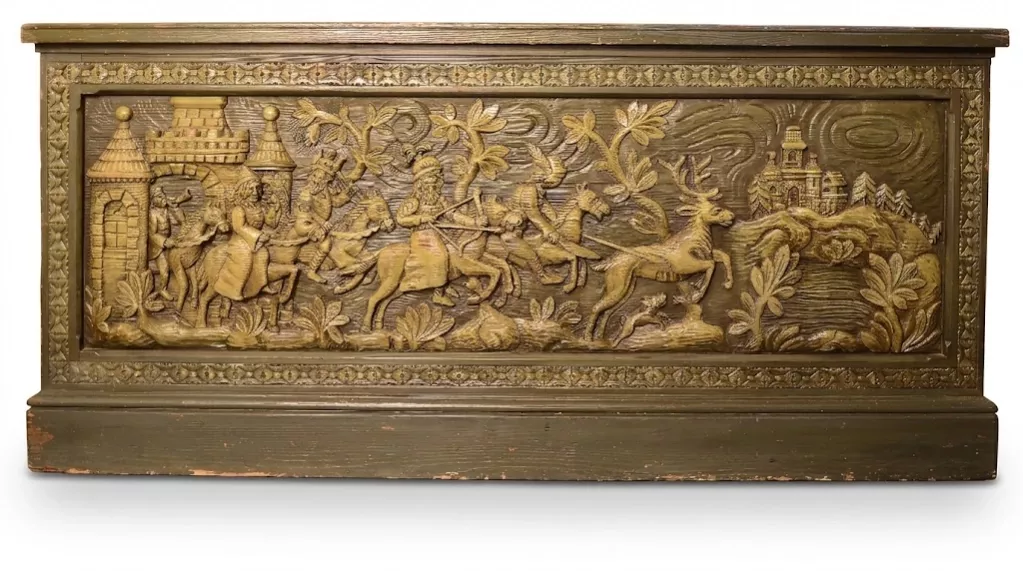
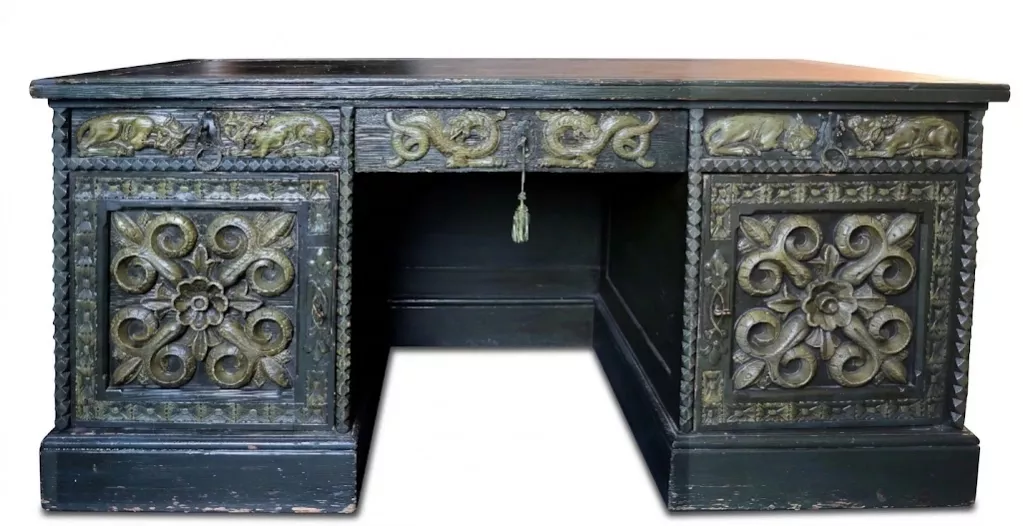
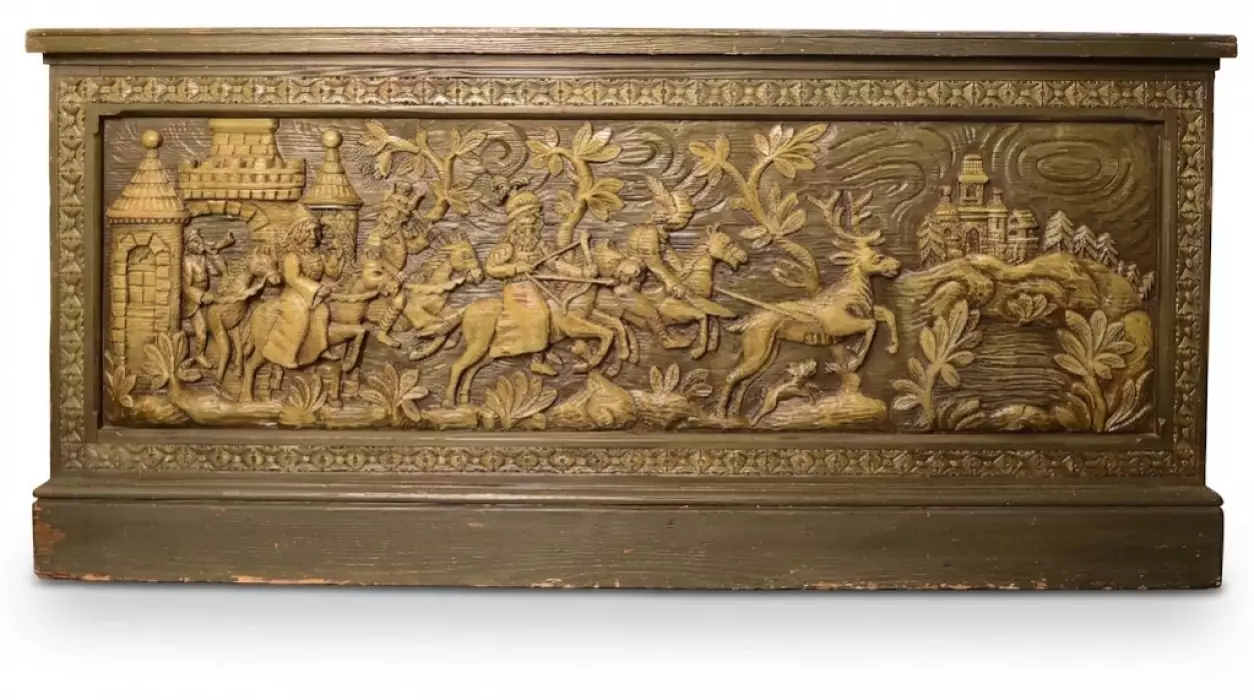
The monumental writing desk, with its rectangular top and substantial pedestal supports, is enriched with narrative reliefs depicting horsemen, armed figures, scenes of battle and hunting, set against medieval fortifications and stylised landscapes. The fronts of the pedestals are ornamented with large foliate rosettes within geometric borders.
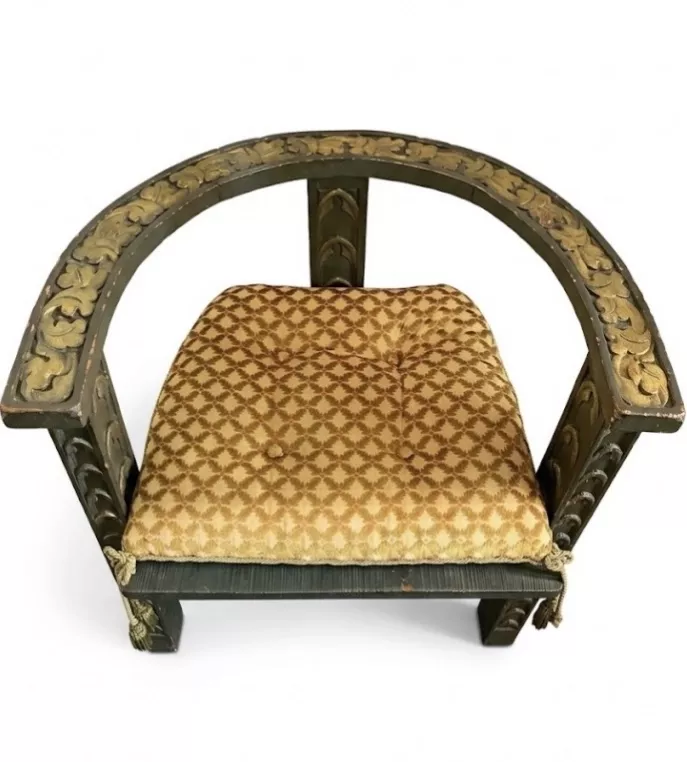
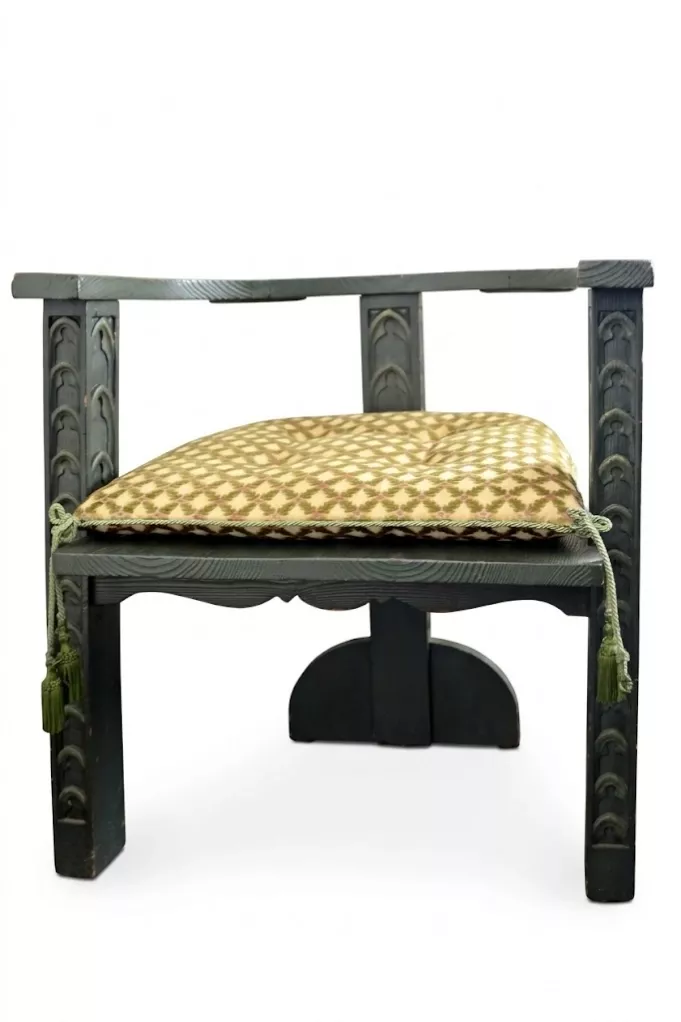
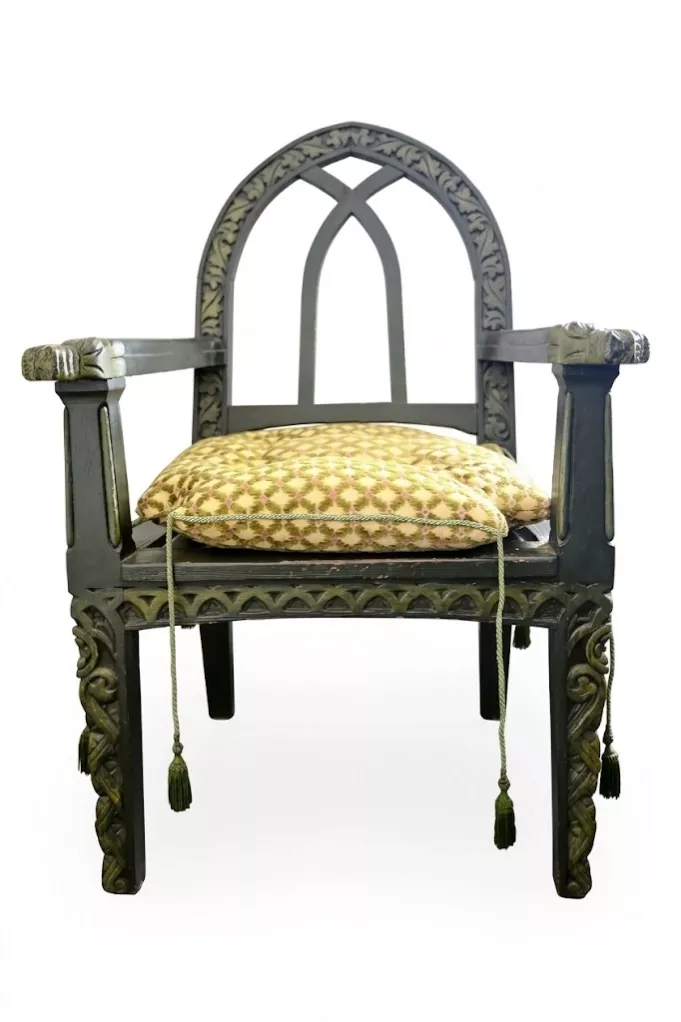
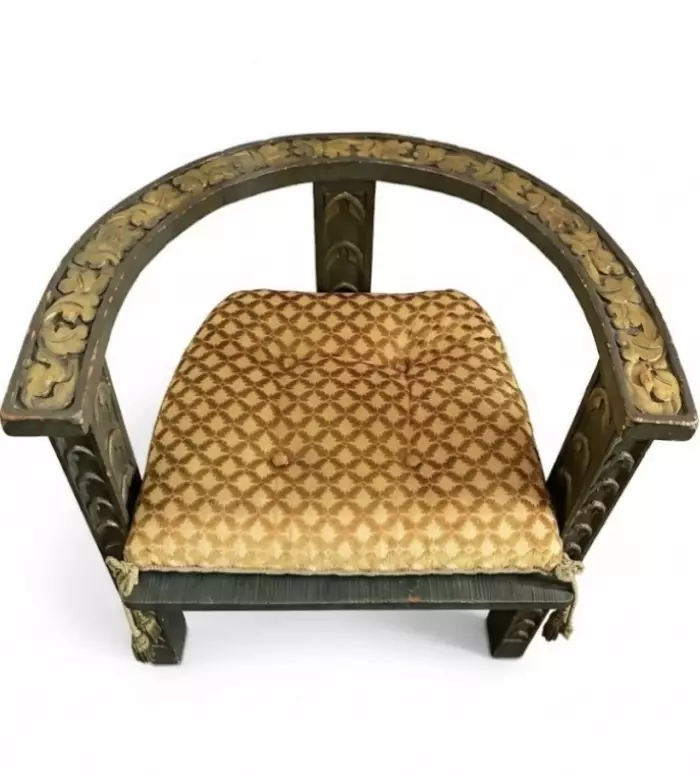
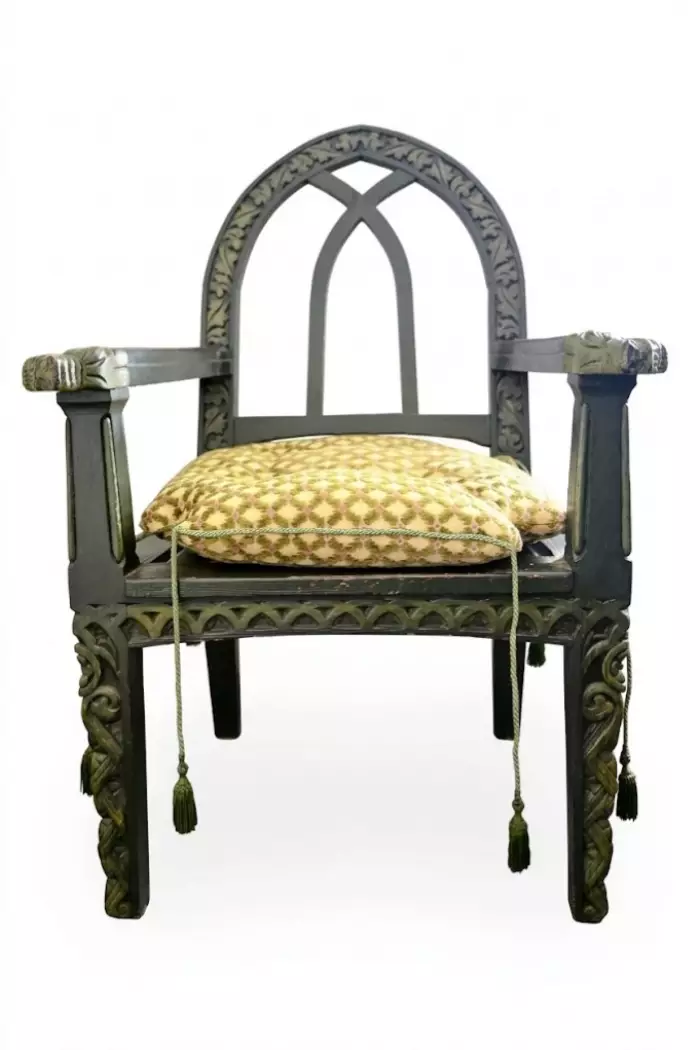
The two armchairs share a common stylistic vocabulary while differing in construction. The first features a broad, curved back continuing into the armrests, while the second has a tall, pierced, pointed-arch back with Gothic Revival ornament. Their carved wooden frames are complemented by upholstered seats with textile cushions and decorative tassels.
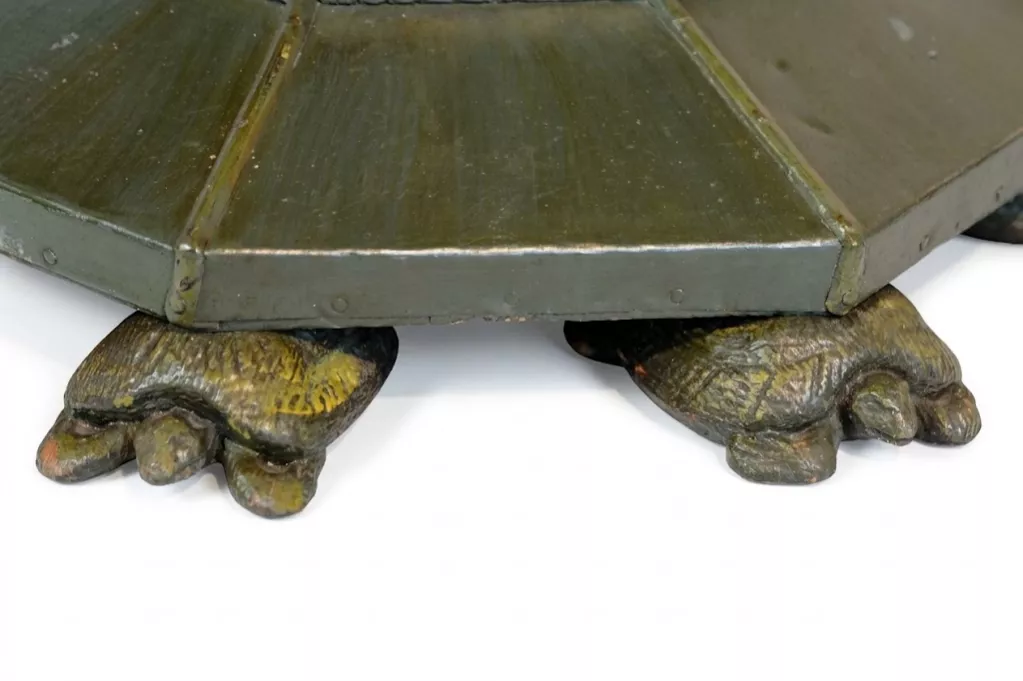
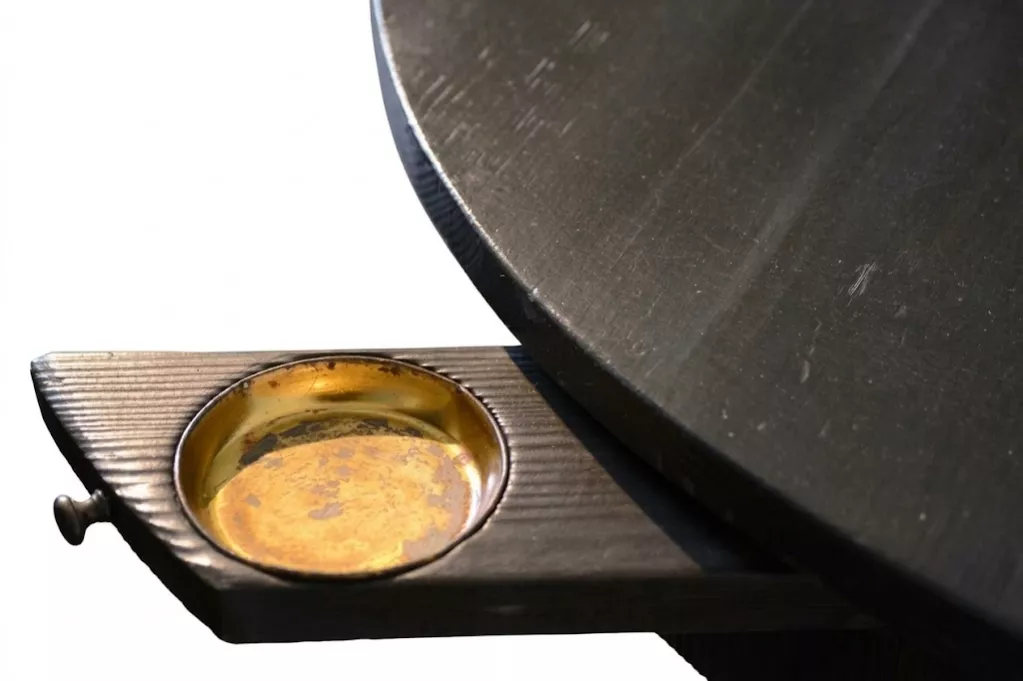
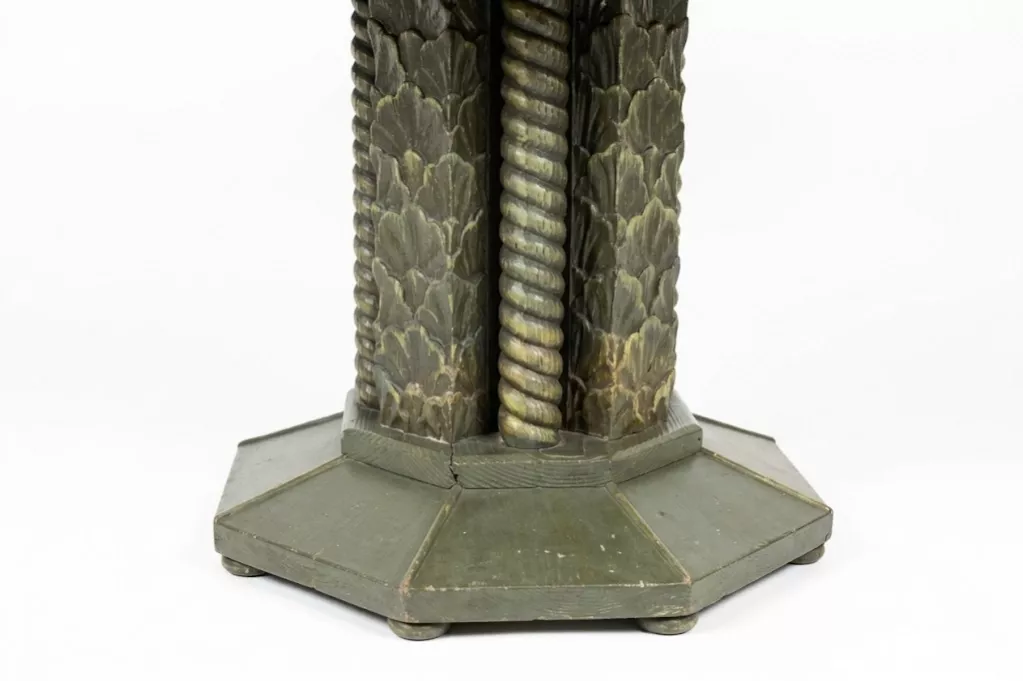
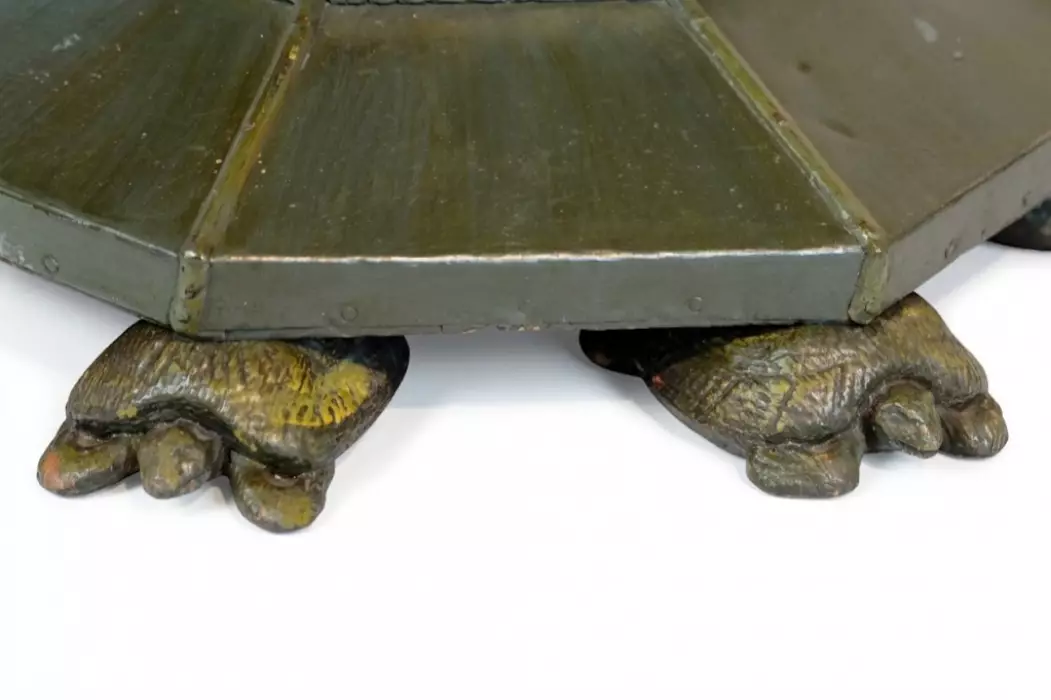
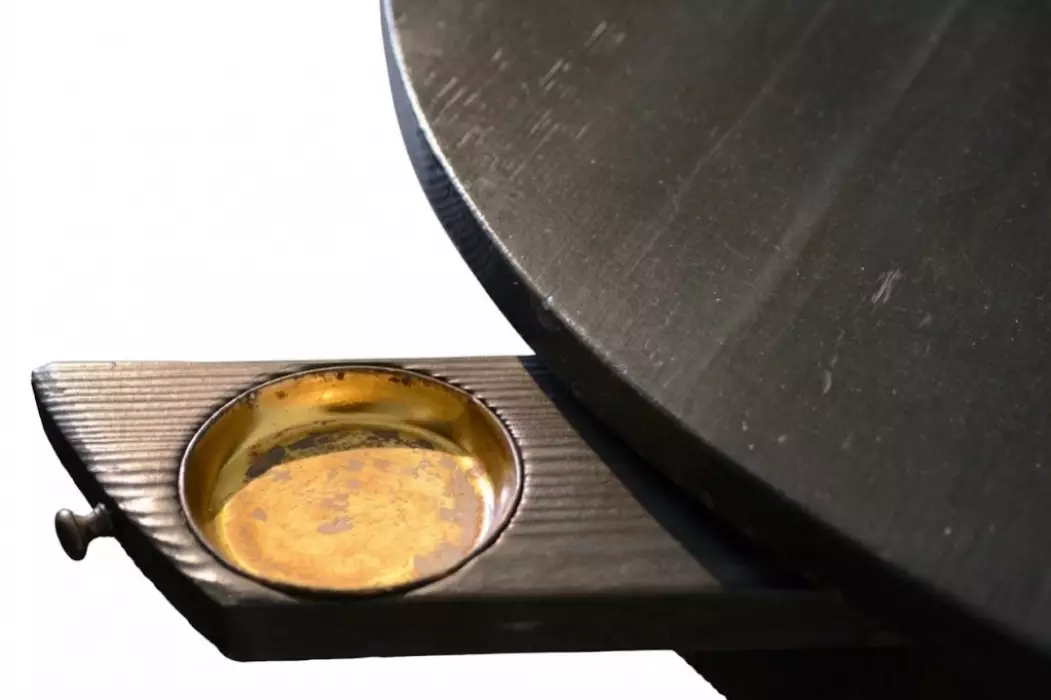
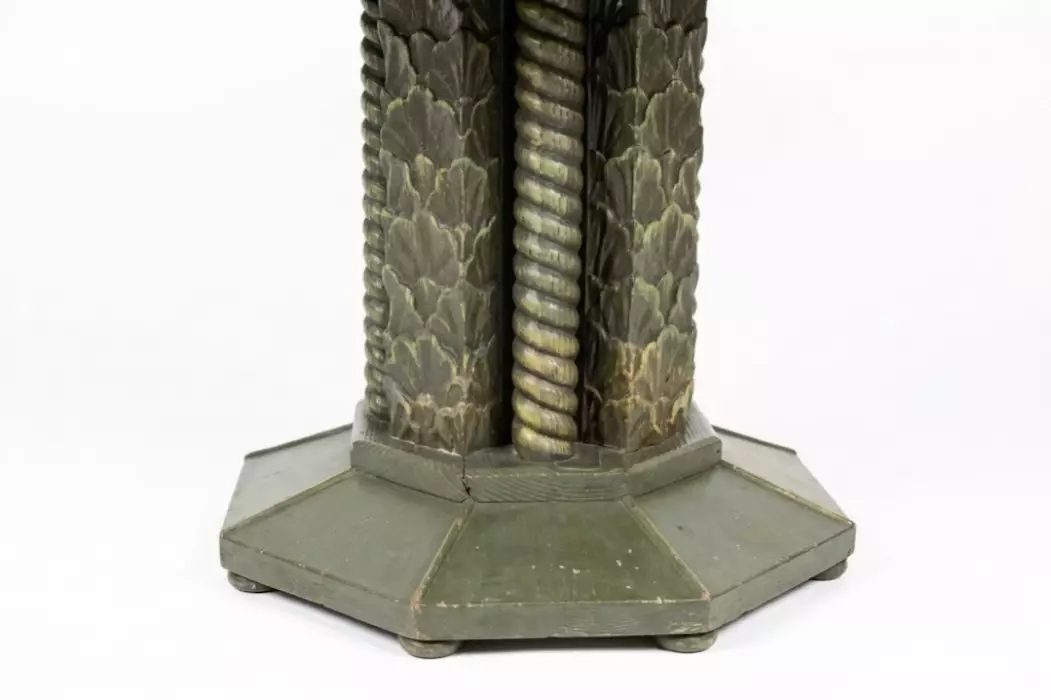
The circular table rests on a substantial faceted, carved pedestal terminating in feet modelled as tortoises. Beneath the top is a pull-out tray fitted with an inset metal bowl, possibly intended for smoking accessories.
The artistic unity of the ensemble is enhanced by the dark greenish-grey painted finish, expressive carving and gilt-toned decorative highlights.
Materials: Wood, carved decoration, polychrome painted finish with gilt-toned details, metal fittings and textile upholstery.
Dimensions:
Cabinet: 205 × 220 × 50 cm.
Writing desk: 78 × 166 × 84 cm.
Circular table: height 60 cm, diameter 84 cm.
Dimensions are taken from the Bruun Rasmussen auction catalogue of 1994.
Condition: The condition is consistent with the age and history of use of the suite. Natural signs of wear, localised rubbing, minor damage and losses to the painted finish are present. Previous restorations and later overpainting cannot be ruled out.
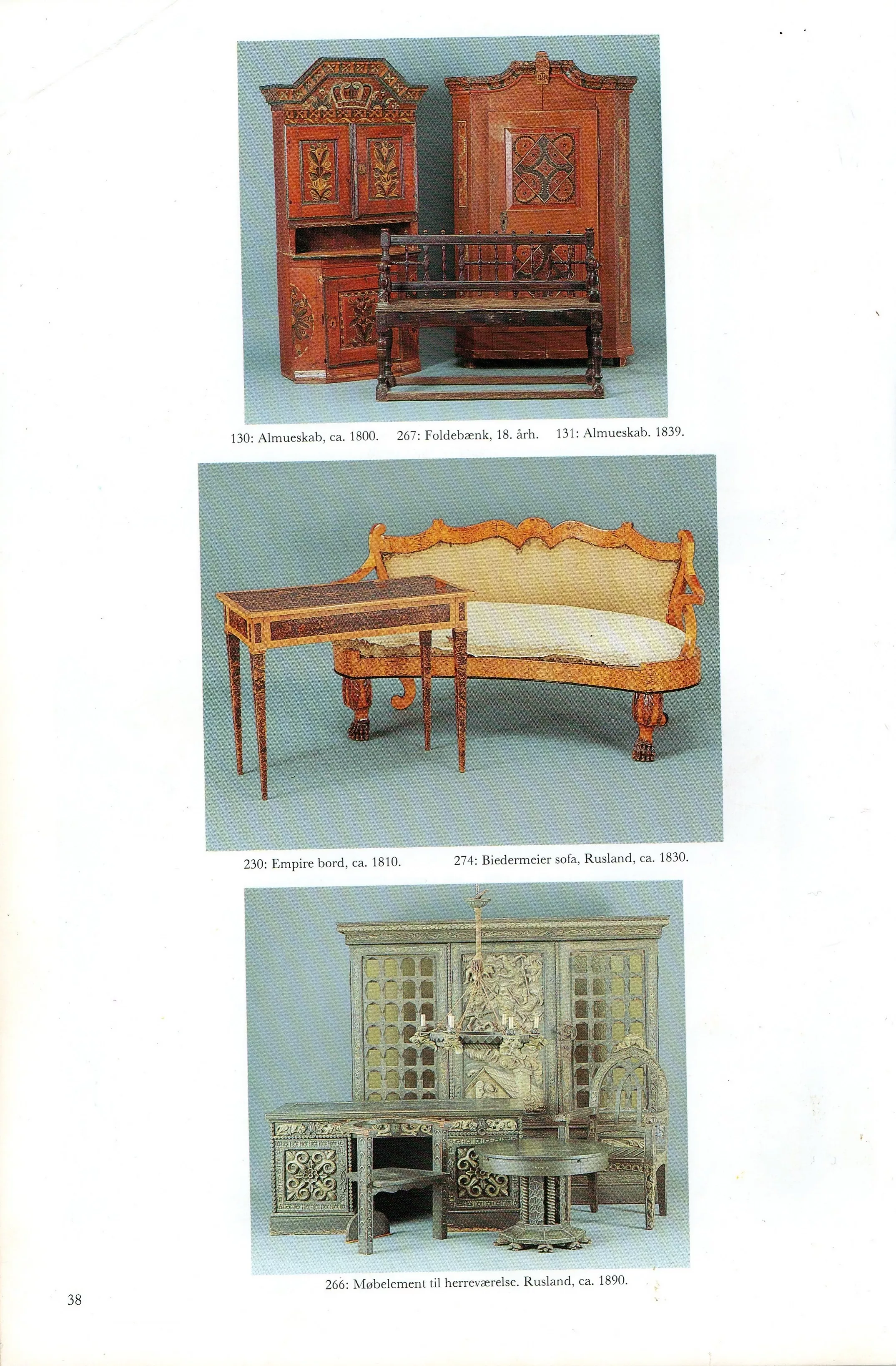
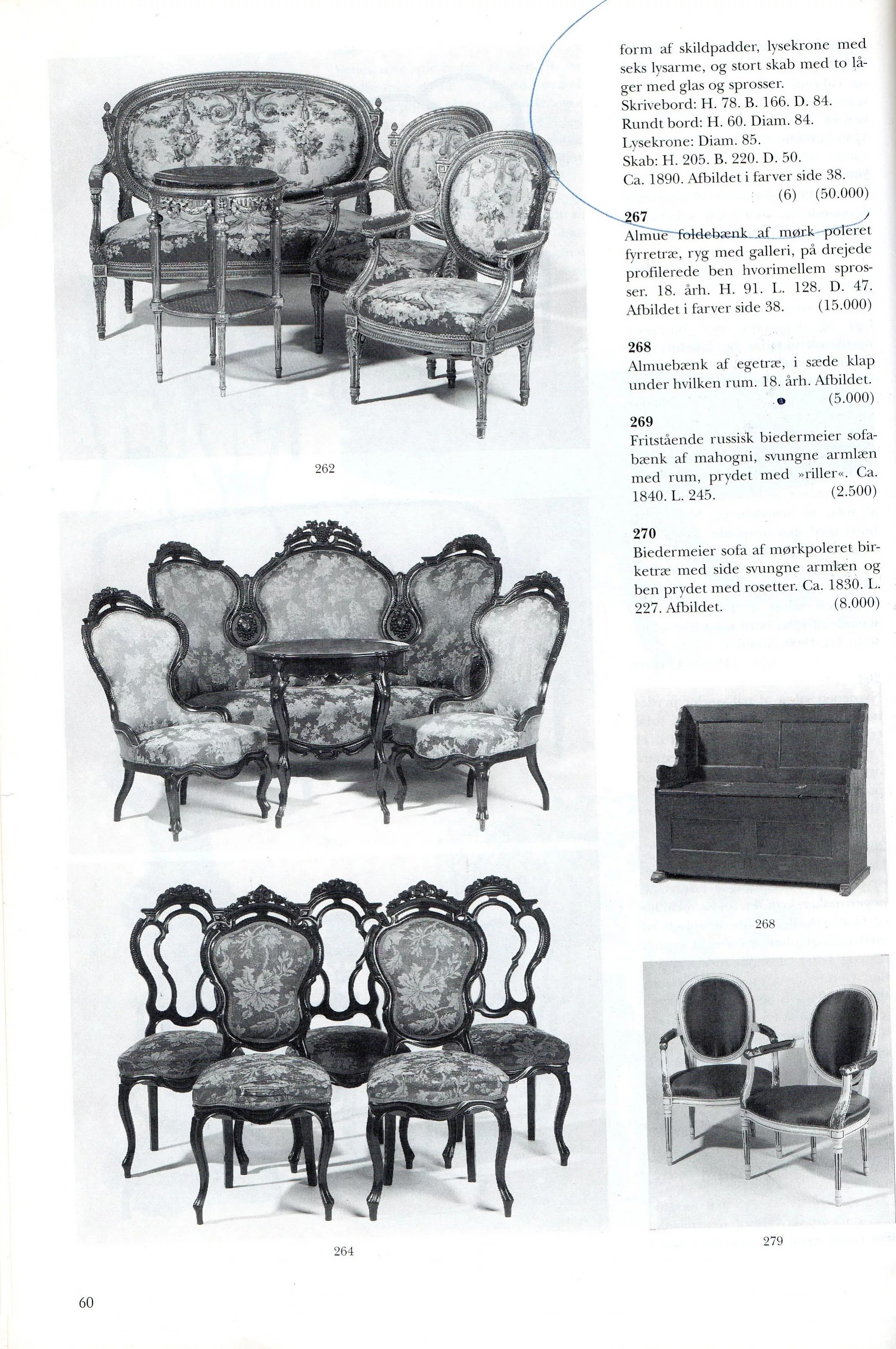
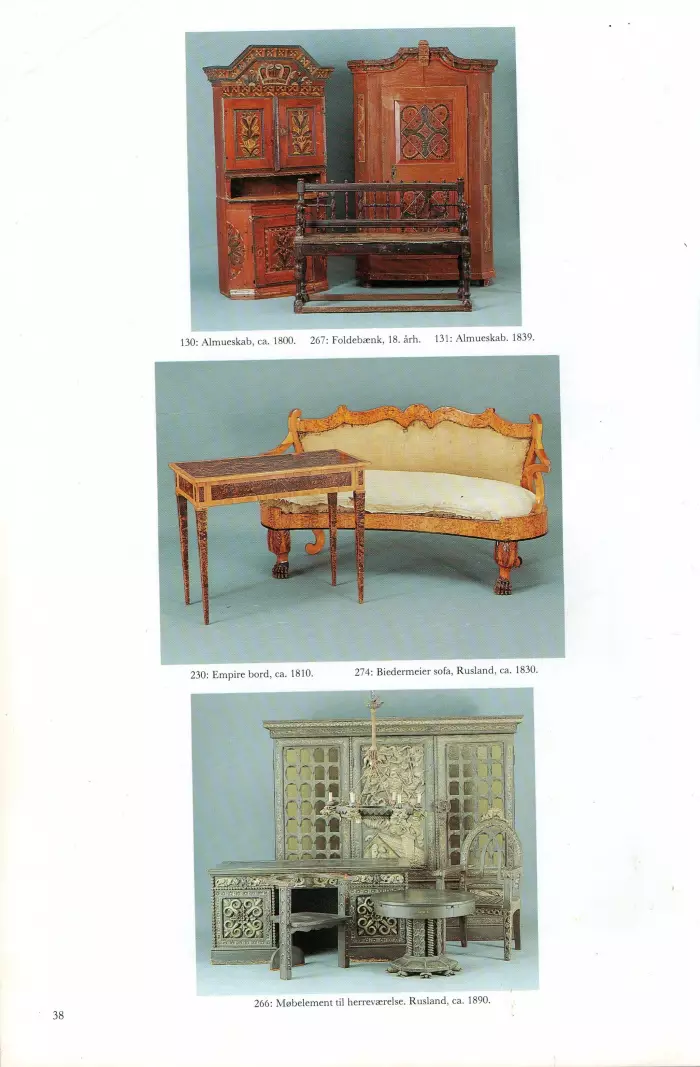
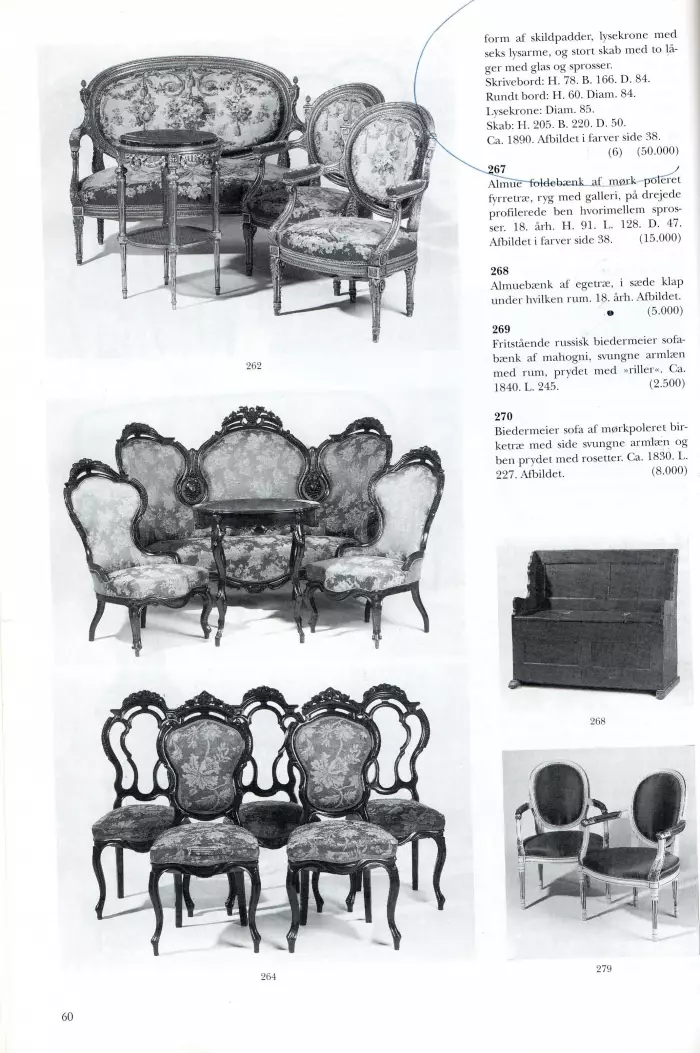
Provenance: Bruun Rasmussen Kunstauktioner, Vejle, Denmark, Kunstauktion 31, 19 April 1994, lot 266. Subsequently in a private family collection in Northern Italy, where the suite furnished the private study of an antiques dealer specialising in Russian art at the family villa.
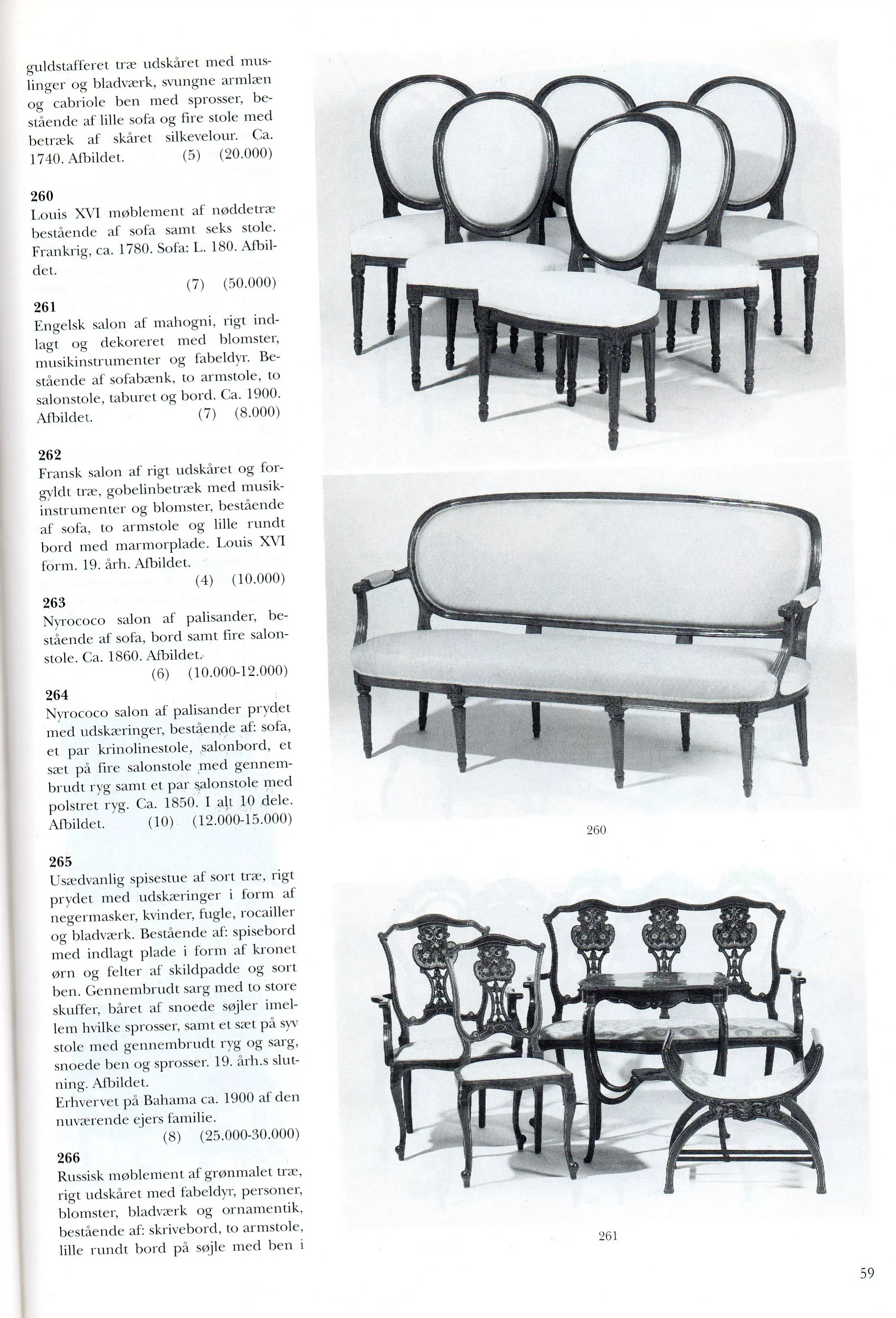
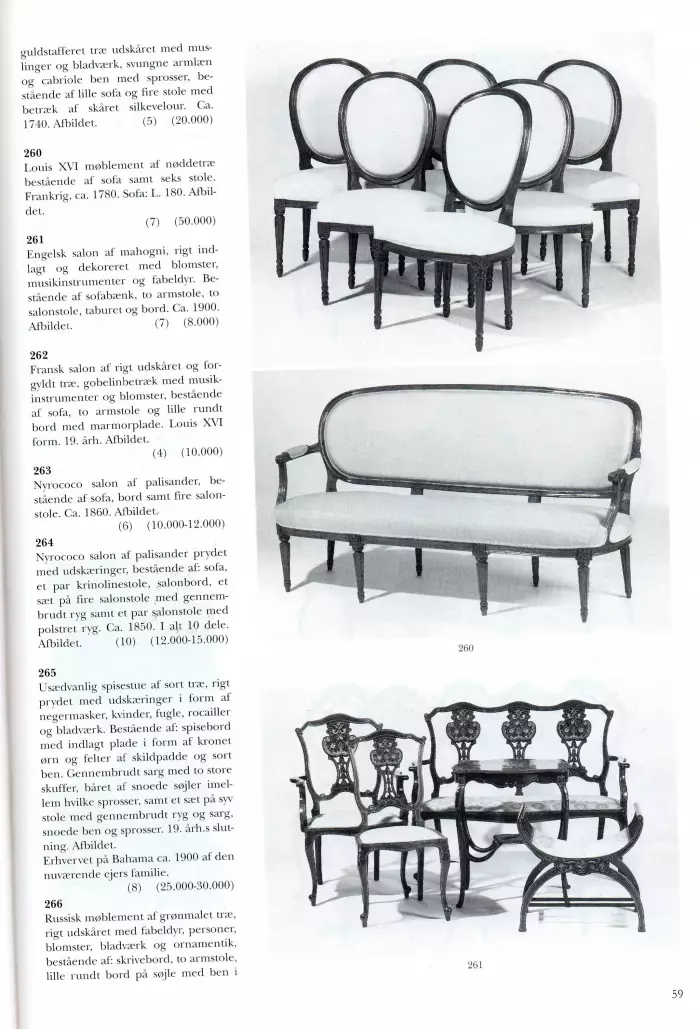
Literature: Bruun Rasmussen, Kunstauktion 31. Internationale og danske Malerier - Antikviteter, Vejle, 1994, lot 266, p. 38 (colour illustration), pp. 59-60 (catalogue entry).
In 1994, the ensemble was published as a suite of six pieces, including a six-light chandelier. The present offering comprises five pieces, excluding the chandelier.
Note: The furniture suite is available for private viewing by prior appointment.
During the second half of the 19th century, Historicism became one of the leading movements in European decorative arts. Artists and cabinetmakers freely drew upon medieval and Renaissance forms, combining Gothic Revival architecture, Renaissance Revival ornament and Romantic subject matter. Studies and libraries occupied a particularly important place in this artistic culture, serving as interiors in which carved furniture fulfilled both a practical function and an expression of the owner`s intellectual and cultural interests.
In the Russian Empire during the final quarter of the century, renewed interest in historical heritage was accompanied by the development of National Romantic tendencies. Museum collections of furniture in the Russian Revival style demonstrate a particular appreciation for expressive woodcarving and motifs derived from folk culture. Artistic production within the Empire, however, extended well beyond its principal metropolitan centres. Its western territories, including the Governorates of Courland, Livonia and Estonia, the Lithuanian lands and Vistula Land, maintained close connections with Baltic German, Polish and wider European craft traditions.
The stylistic characteristics of the present ensemble raise the possibility that it originated within this multicultural artistic environment. Particularly noteworthy is its unusual iconographic programme. The central relief of the cabinet presents a fantastical narrative: above a house, a whirlwind of figures unfolds, incorporating characters carrying broomsticks, animals and grotesque creatures. Such imagery recalls legends of witches and their sabbaths prevalent in Germanic and Northern European folklore, although no specific literary source has yet been identified.
The carved panels of the writing desk, by contrast, evoke the world of medieval epic, depicting mounted horsemen, armed confrontations, fortified buildings and the pursuit of animals. The two winged lions adorning the cabinet introduce a motif from the fantastical bestiary, familiar to both medieval Russian and Western European art.
The suite displays natural wear, localised rubbing, chips and cracking to the painted finish. The carved decoration largely retains its definition and expressive quality. Later overpainting and previous restoration interventions cannot be ruled out.
The condition report is provided for informational purposes only.
It is not comprehensive and may not reflect all defects, restorations, alterations, or adaptations, as Antiqon does not perform professional conservation-level assessments. The information is based on a qualified, yet subjective, evaluation by our specialists.Before purchasing, we recommend consultation with an independent expert.Please also consult our Terms and conditions and Glossary A-Z, which contain important information on lot characteristics and sale conditions.