



CHURCH ICON OF THE HOLY APOSTLES PETER AND PAUL. VELIKY USTYUG, RUSSIA, LAST QUARTER OF THE 18TH CENTURY
Antiqon consultant will contact you within one business day after receiving your request.
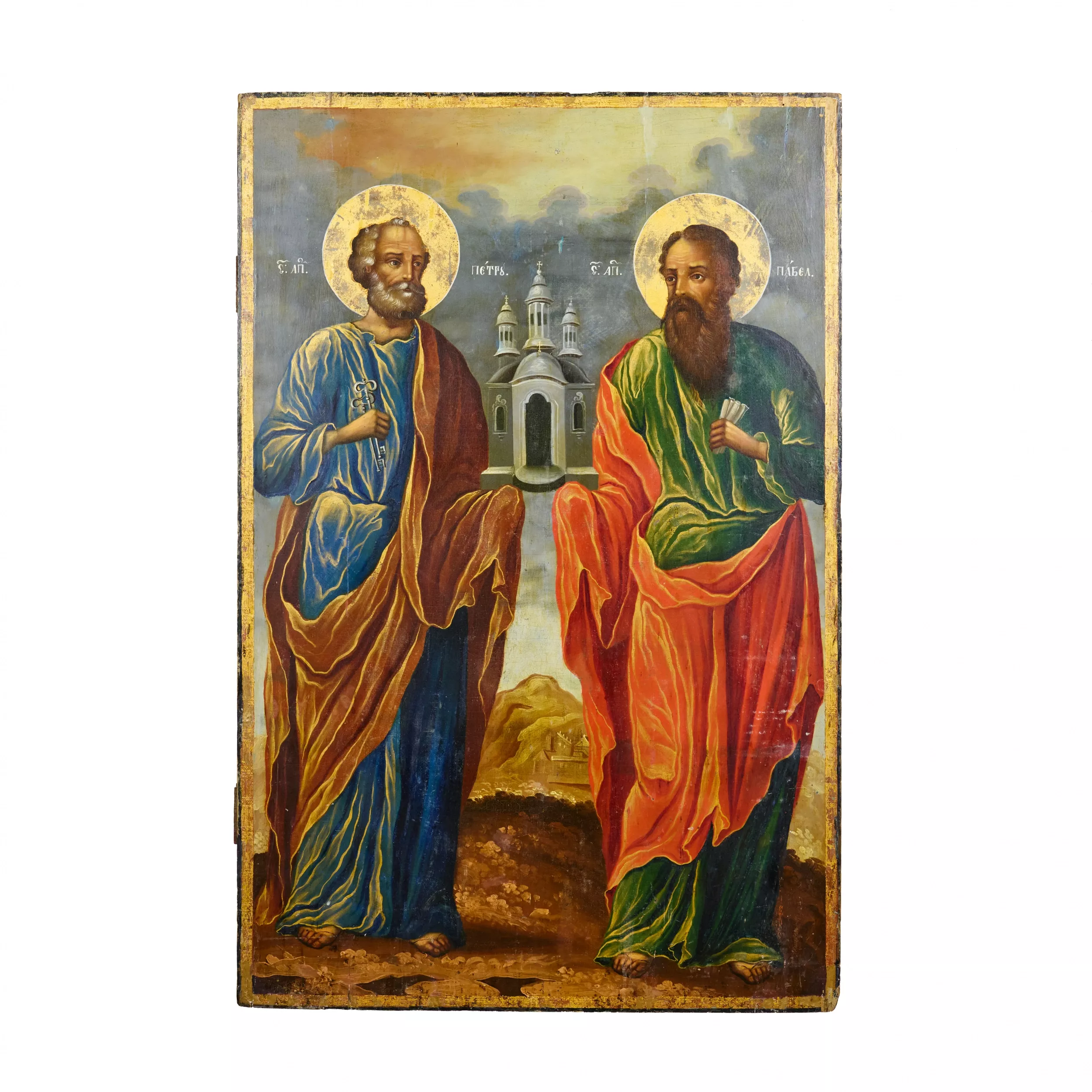
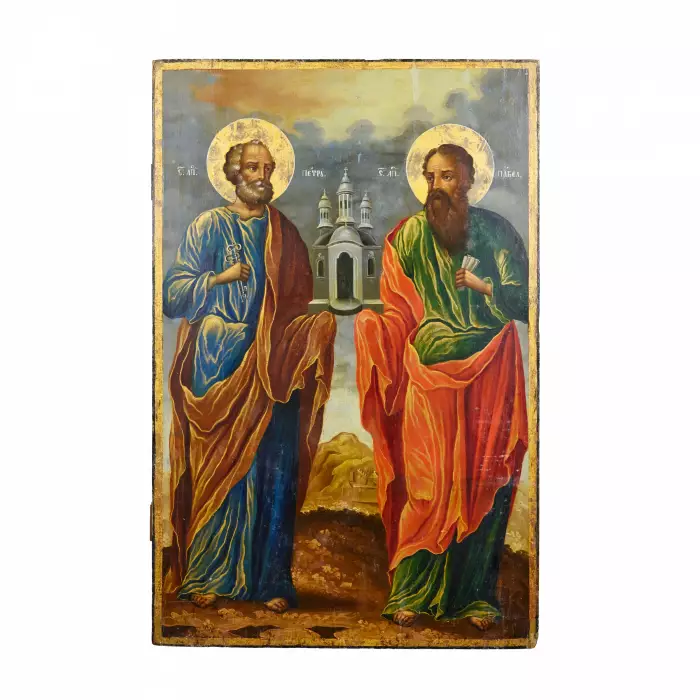
A monumental church icon depicting the Holy Chief Apostles Peter and Paul, painted in Veliky Ustyug in the last quarter of the 18th century. The work exemplifies the late Ustyug icon-painting tradition, combining established Orthodox iconography with painterly devices that became increasingly widespread in Russian ecclesiastical art during the second half of the 18th century.
The Apostles are shown full length and frontally within a solemn, symmetrically balanced composition. Saint Peter appears on the left, with short grey hair and beard, wearing a blue-toned chiton beneath an ochre-brown himation. In his right hand he holds the keys, his traditional iconographic attribute, referring to the Gospel image of the Keys of the Kingdom of Heaven.
Saint Paul is represented on the right, identifiable by his high forehead and long dark beard. He wears a green chiton beneath a richly coloured cinnabar-red himation and holds a rolled scroll, symbolising his apostolic teaching and Epistles.
Between the two figures stands a representation of a Christian church, forming both the visual and theological centre of the composition. This motif emphasises the traditional understanding of Peter and Paul as the foremost Apostles and spiritual pillars of the Church, uniting both figures within a coherent theological programme.
The faces are rendered with pronounced chiaroscuro modelling and an evident aspiration towards volume. The softly articulated cloud-filled sky, together with the spatial treatment of the landscape, architecture and figures, reflects the influence of European and academic painting on Russian ecclesiastical art of the late 18th century. At the same time, the gilded haloes, frontal presentation of the saints and traditional system of attributes retain the canonical foundations of Orthodox iconography.
The colour scheme is built upon a striking combination of deep blue, green, ochre-brown and intense cinnabar-red tones. The gilded haloes and gilt border enhance the solemn character of the work and underline its intended function within a church interior.
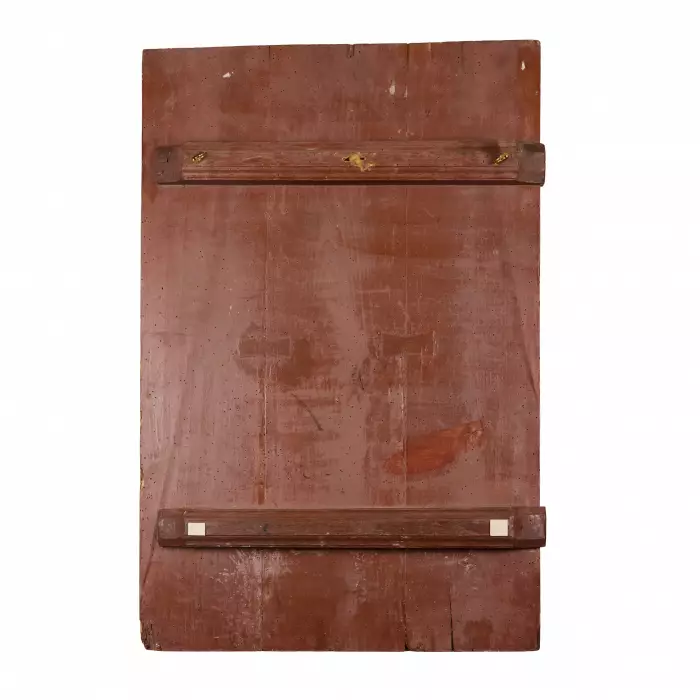
Material: Wood panel, gesso, tempera, gilding.
Dimensions: 88 × 55 cm.
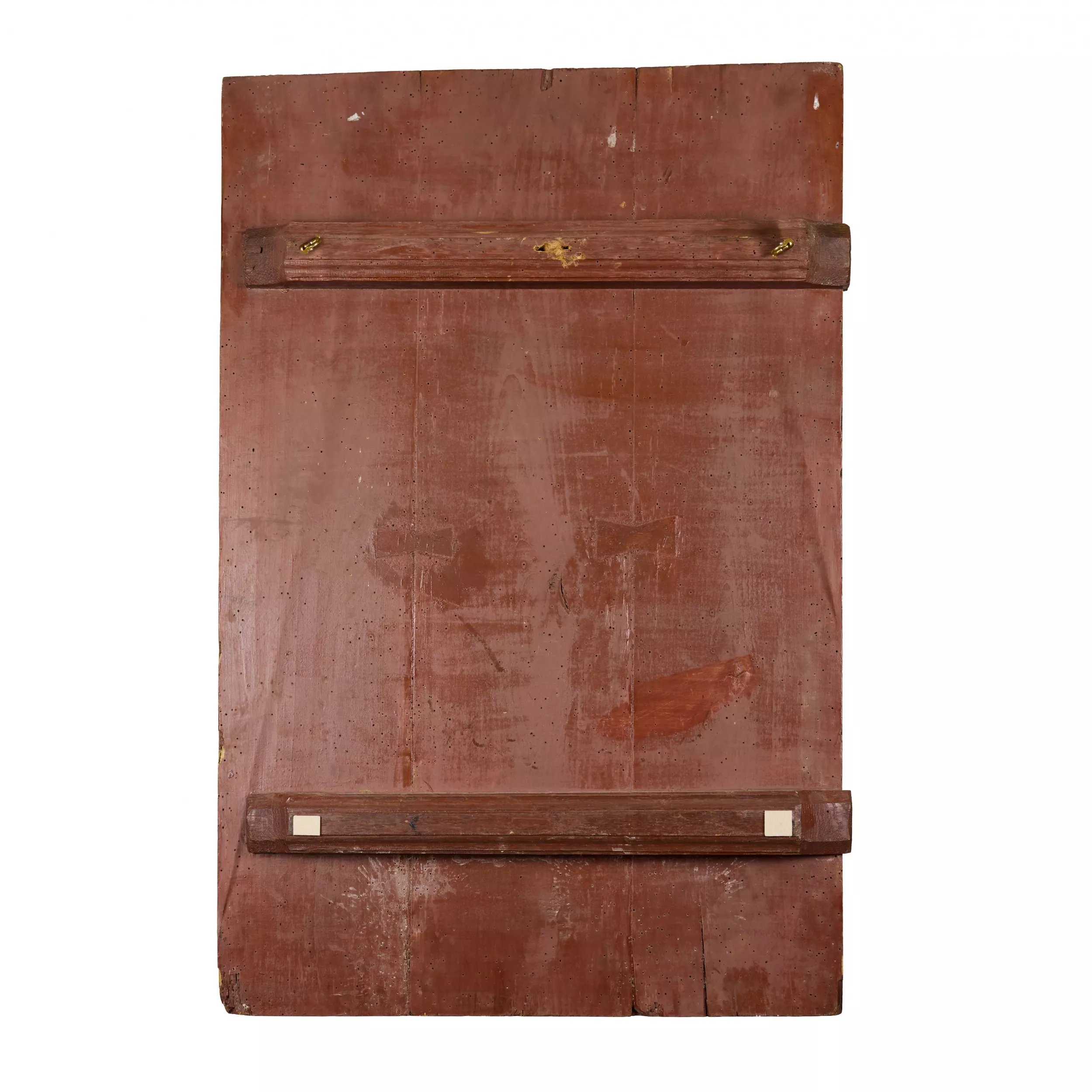
Condition: In good collector`s condition, consistent with the period of its creation.
During the 17th and 18th centuries, Veliky Ustyug was one of the important artistic centres of the Russian North. Its active ecclesiastical life, numerous churches and monasteries created sustained demand for church icons, iconostases and works of decorative art. The Ustyug icon-painting tradition became distinguished by refined draughtsmanship, close attention to detail, expressive colour and the high level of craftsmanship achieved by local painters.
During the second half of the 18th century, the art of Veliky Ustyug underwent a significant stylistic transformation. While retaining the fundamental principles of Orthodox iconography, local painters increasingly incorporated techniques associated with European Baroque and academic painting. Facial features were modelled with greater use of light and shade, figures acquired enhanced plastic volume, draperies became more freely articulated, and the conventional icon background was increasingly supplemented by cloud-filled skies, architectural settings and spatially conceived landscapes. Such characteristics are particularly evident in large-format church icons intended to be viewed within ecclesiastical interiors.
The iconography of the Holy Chief Apostles Peter and Paul held particular significance within the Russian Orthodox tradition. Peter, represented with the keys, symbolises the apostolic foundation of the Church and spiritual authority, while Paul, holding a scroll, embodies Christian teaching and its dissemination through his missionary work and Epistles. Their paired representation was understood as an image of the unity of the Church and the continuity of apostolic tradition.
In the present work, this theological meaning is further emphasised by the church placed between the two Apostles. The carefully structured symmetry, monumental figures, saturated palette and gilded haloes create a solemn image appropriate to its original ecclesiastical setting. The combination of canonical iconography with pronounced painterly naturalism allows the work to be regarded as a characteristic example of Veliky Ustyug icon painting from the last quarter of the 18th century.
Good collector`s condition, consistent with the age of the work. Minor traces of age and natural craquelure do not detract from the integrity or overall appearance of the icon.
The condition report is provided for informational purposes only.
It is not comprehensive and may not reflect all defects, restorations, alterations, or adaptations, as Antiqon does not perform professional conservation-level assessments. The information is based on a qualified, yet subjective, evaluation by our specialists.Before purchasing, we recommend consultation with an independent expert.Please also consult our Terms and conditions and Glossary A-Z, which contain important information on lot characteristics and sale conditions.