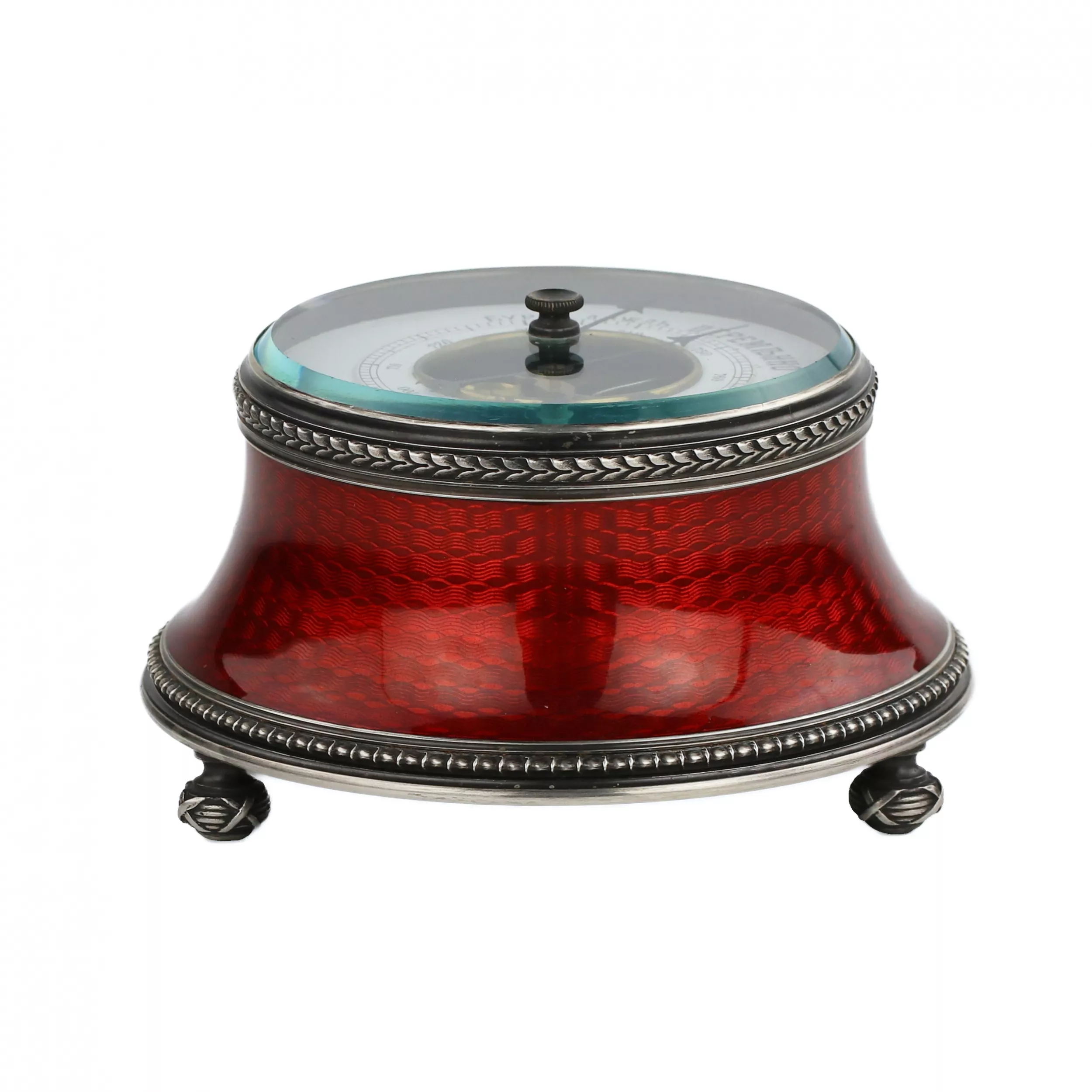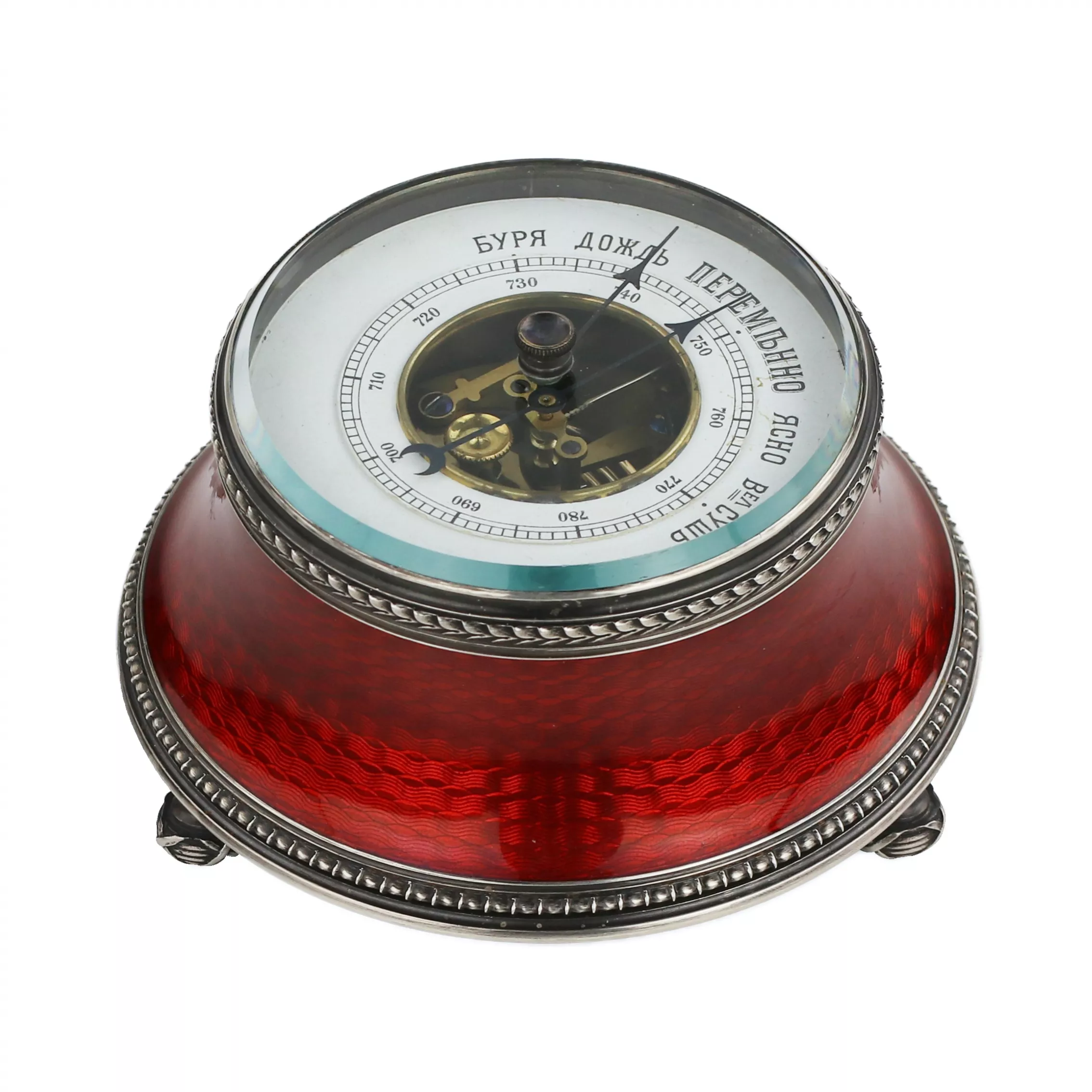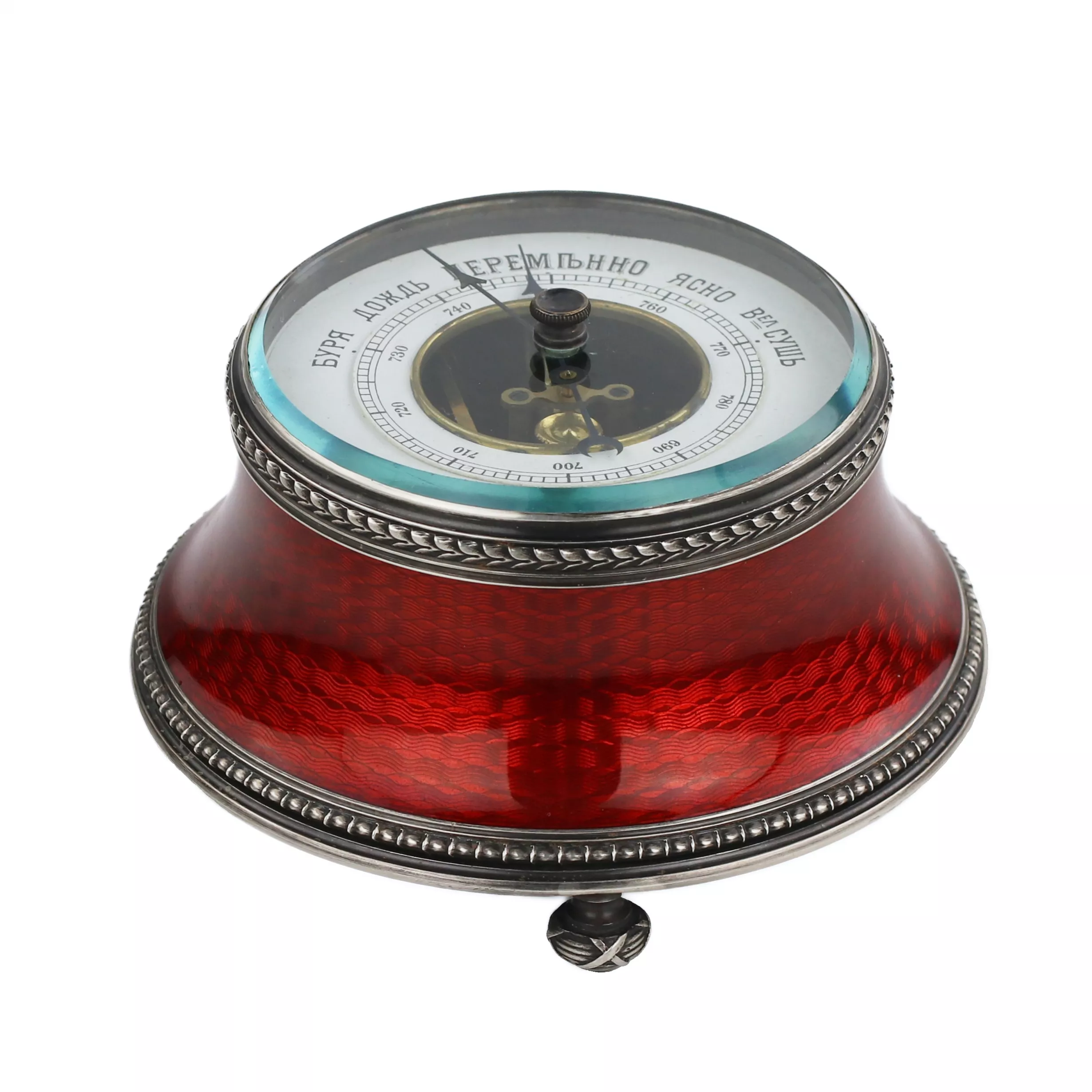
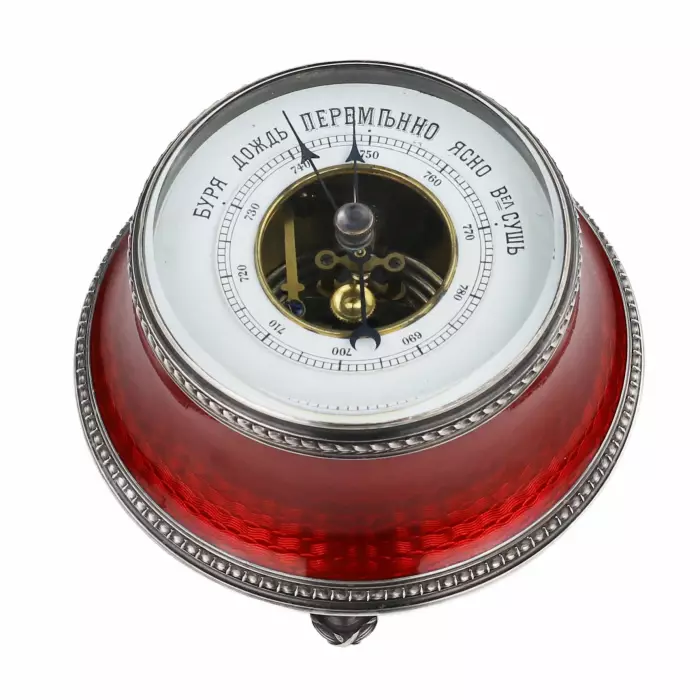
DESK BAROMETER BY THE HOUSE OF CARL FABERGÉ, MASTER VICTOR AARNE. ST PETERSBURG, 1899–1904
Antiqon consultant will contact you within one business day after receiving your request.
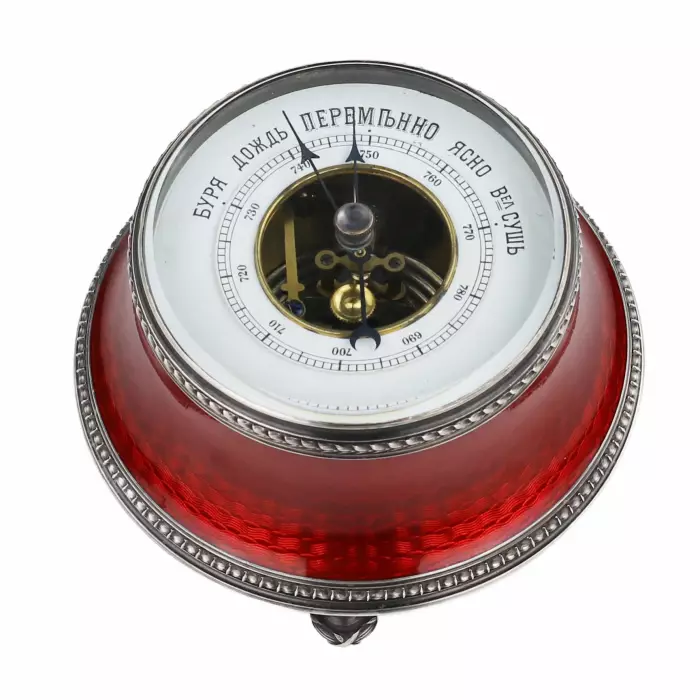
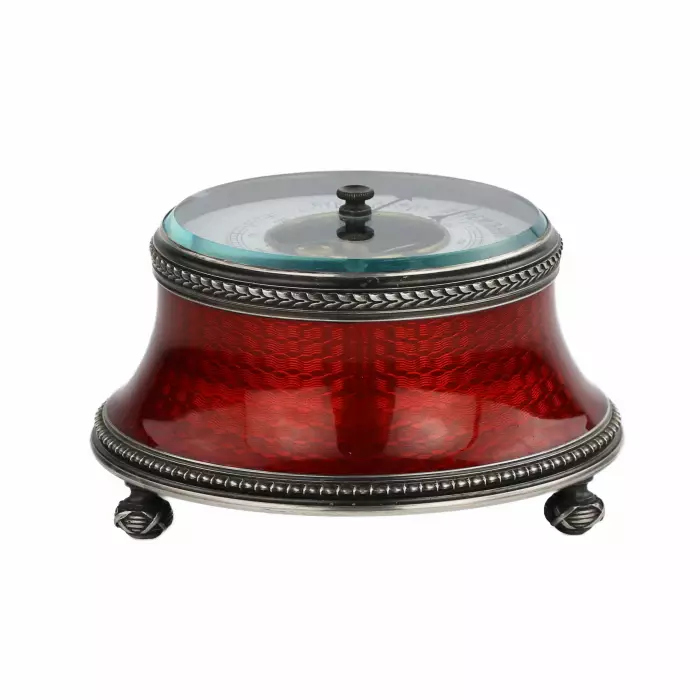
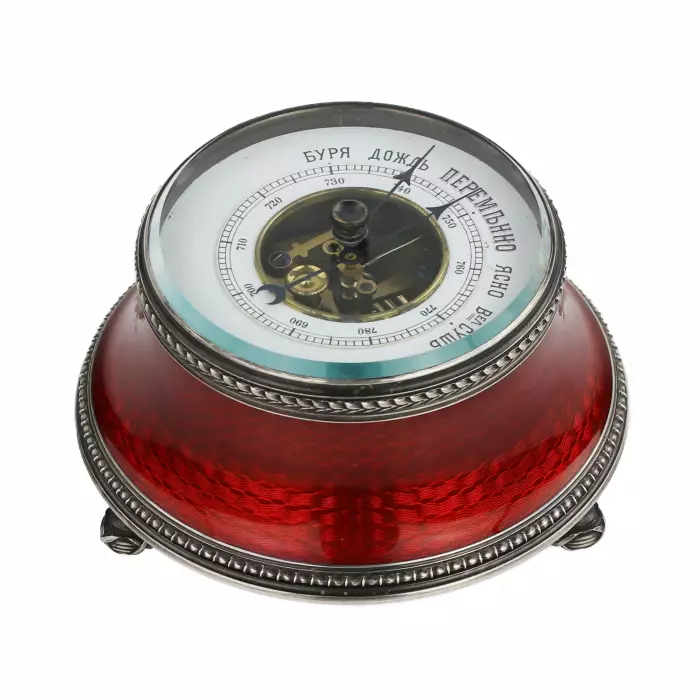
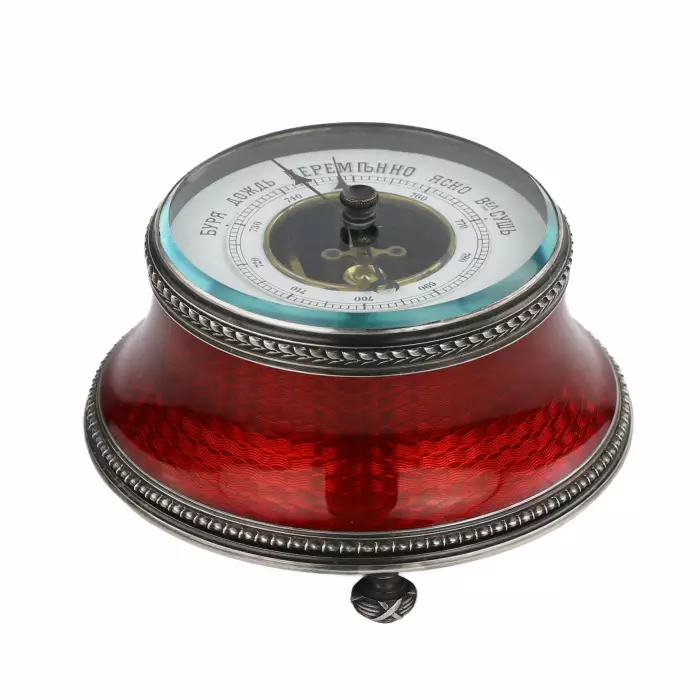
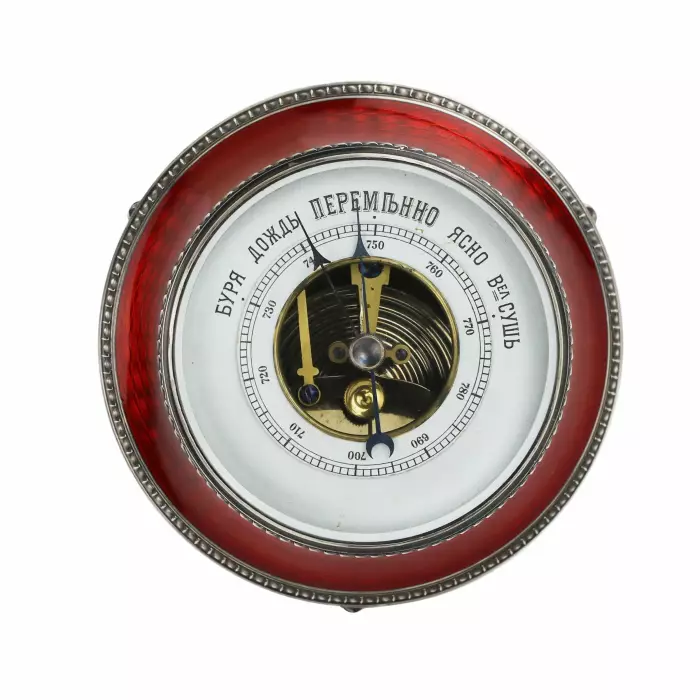
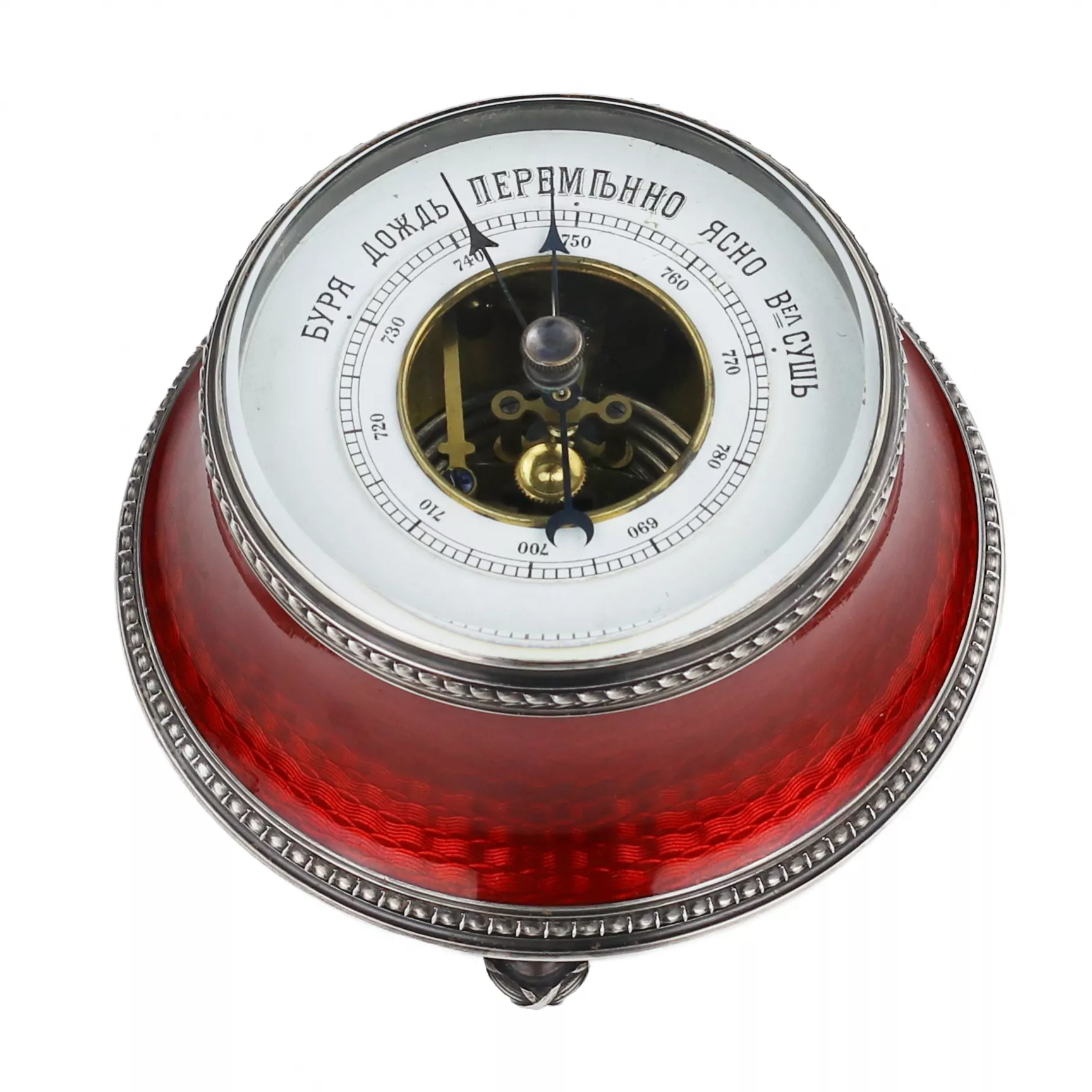
A rare desk barometer created by the master goldsmith Victor Aarne for the celebrated House of Carl Fabergé in St Petersburg between 1899 and 1904. This refined object represents an exceptional synthesis of scientific precision, practical function and the highest standards of Russian Imperial jewellery craftsmanship at the turn of the twentieth century.
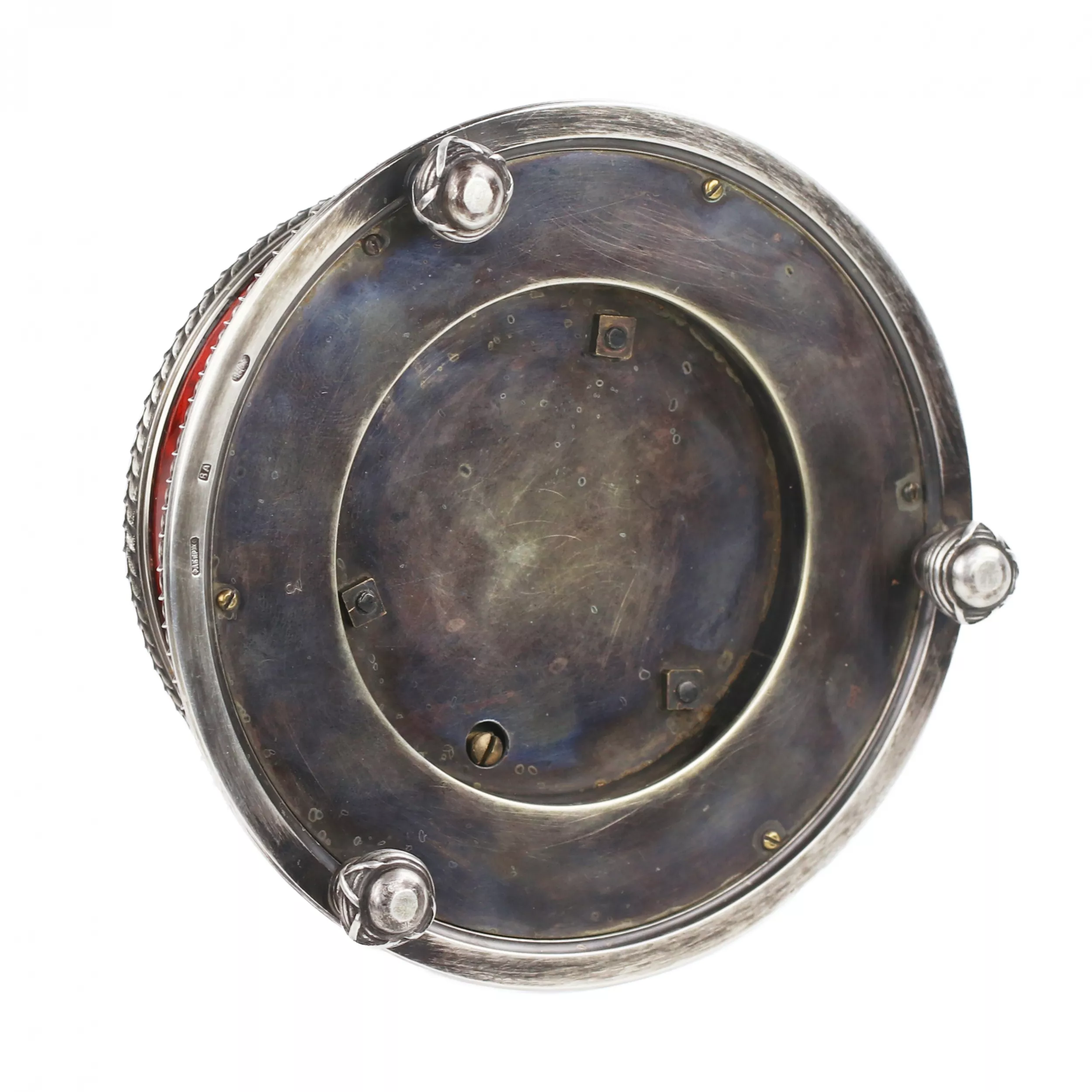
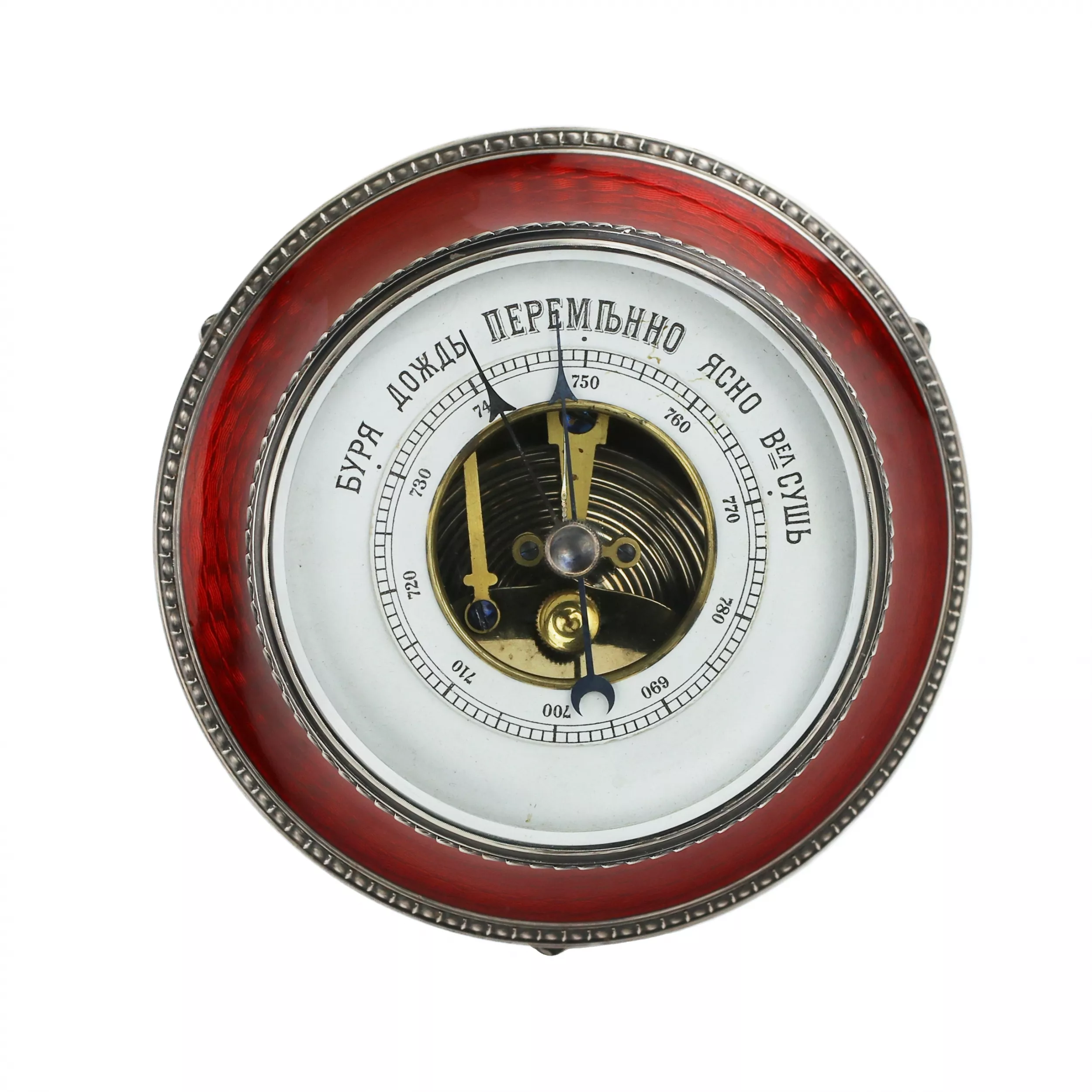
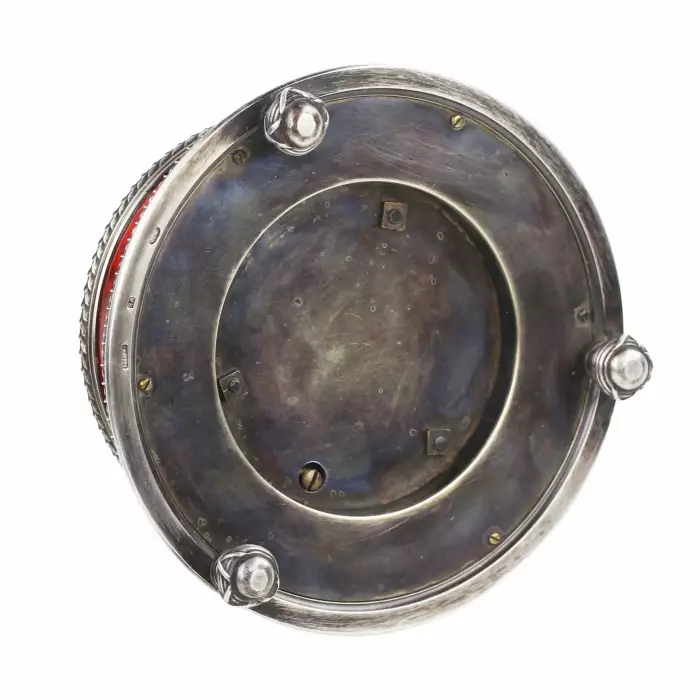
The body is executed in 88 standard silver and raised on three elegantly modelled scroll feet. Its surface is covered with translucent ruby-red guilloché enamel over an engine-turned wavy ground. The upper section is decorated with opaque white enamel beneath a faceted glass crystal. The dial bears Russian weather indications: «Буря» (Storm), «Дождь» (Rain), «Переменно» (Changeable), «Ясно» (Fair), and «Весьма сухо» (Very Dry). The composition is crowned by a finely chased laurel wreath in the Imperial Empire style, lending the piece both classical dignity and architectural balance.
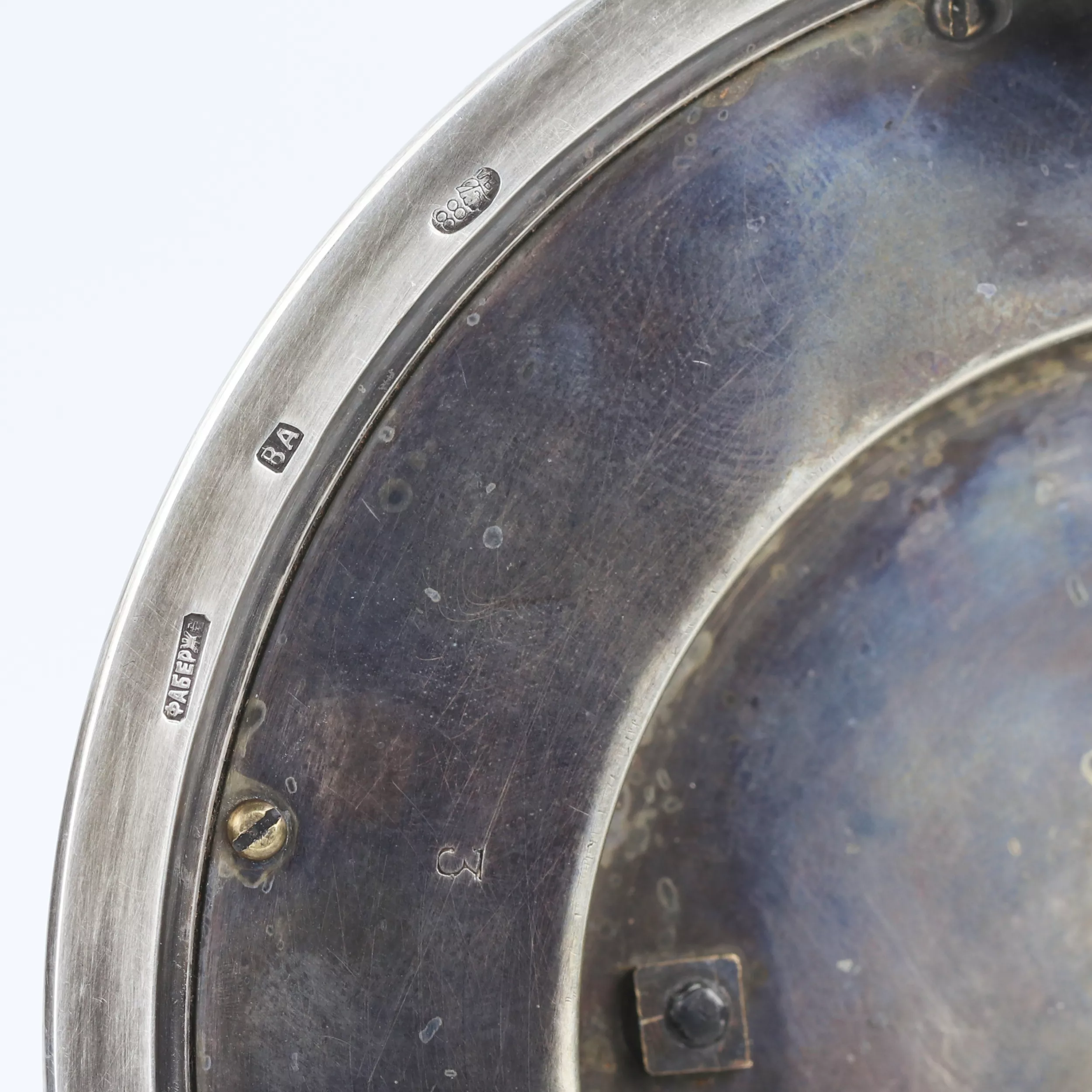
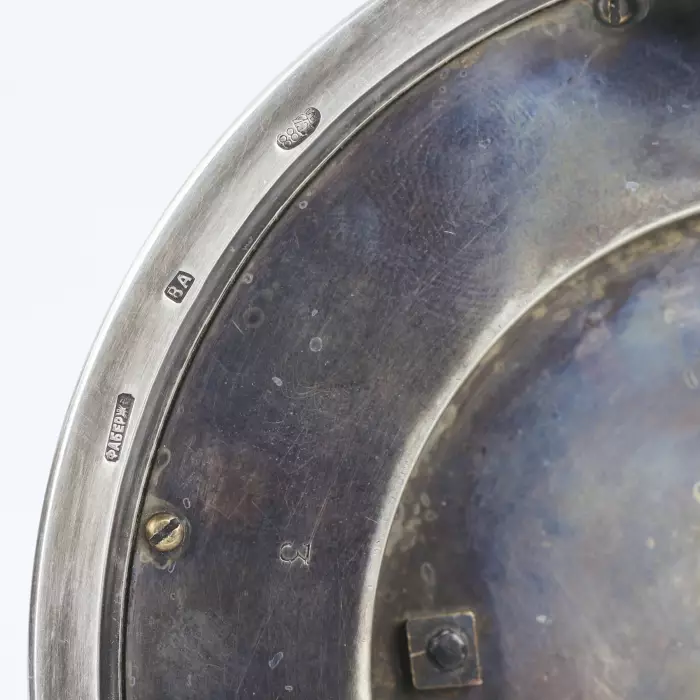
Hallmarks: Makers mark of the House of Fabergé, masters mark ВА for Victor Aarne, official St Petersburg assay mark for 1899–1904 with the initials of the District Assay Master Yakov Lyapunov, and the silver standard 88.
Dimensions: Height: 6.3 cm. Diameter of base: 11.5 cm. Diameter of upper section: 8.5 cm.
Weight: 66 g.
Condition: Excellent.
Provenance: Produced in the workshop of Victor Aarne for the House of Carl Fabergé, St Petersburg, between 1899 and 1904. By its artistic and technical characteristics, the present example belongs to the exceptionally rare group of silver desk barometers produced by Fabergé.
Desk barometers produced by the House of Fabergé rank among the rarest functional objects created by the firms workshops at the turn of the nineteenth and twentieth centuries. Unlike silver tea services, cigarette cases, photograph frames or desk accessories that formed part of the companys regular production, barometers were never manufactured in quantity. Instead, they were produced only in very limited numbers or commissioned individually for discerning private patrons, making surviving examples exceptionally scarce today.
As Court Jeweller to the Russian Imperial Family, Carl Fabergé established a distinctive artistic language founded upon impeccable craftsmanship, perfect proportions and the masterful use of enamel. His workshops brought together the finest craftsmen of the Russian Empire, each specialising in a particular discipline. Among the most distinguished silversmiths was Victor Aarne, who established his own workshop in 1888. His work is characterised by extraordinary precision in silverwork, exceptional mastery of guilloché enamel and a refined balance between utility and artistic excellence.
The present barometer perfectly illustrates this philosophy. Its restrained architectural form, harmonious symmetry, finely modelled laurel wreath and carefully balanced proportions derive from the vocabulary of the Russian Empire style, one of the defining artistic expressions of Imperial Russia during the nineteenth century. Combined with luminous ruby-red guilloché enamel and exquisitely finished silver, these classical motifs acquire the unmistakable elegance associated with the finest creations of Fabergé.
Today, comparable desk barometers are preserved in leading museum and private collections, including the State Hermitage Museum, the Fabergé Museum in St Petersburg, the Westley Foundation Collection, and distinguished collections throughout Europe and the United States. They remain among the most desirable and elusive examples of Fabergés silver production and stand as enduring monuments to the extraordinary achievements of Russian Imperial decorative arts.
The barometer is preserved in excellent condition. The ruby guilloché enamel retains its rich colour and exceptional brilliance, while the silver displays crisp chasing and sharply struck hallmarks throughout. Only minimal signs of age and careful handling are visible, entirely consistent with the period.
The condition report is provided for informational purposes only.
It is not comprehensive and may not reflect all defects, restorations, alterations, or adaptations, as Antiqon does not perform professional conservation-level assessments. The information is based on a qualified, yet subjective, evaluation by our specialists.Before purchasing, we recommend consultation with an independent expert.Please also consult our Terms and conditions and Glossary A-Z, which contain important information on lot characteristics and sale conditions.