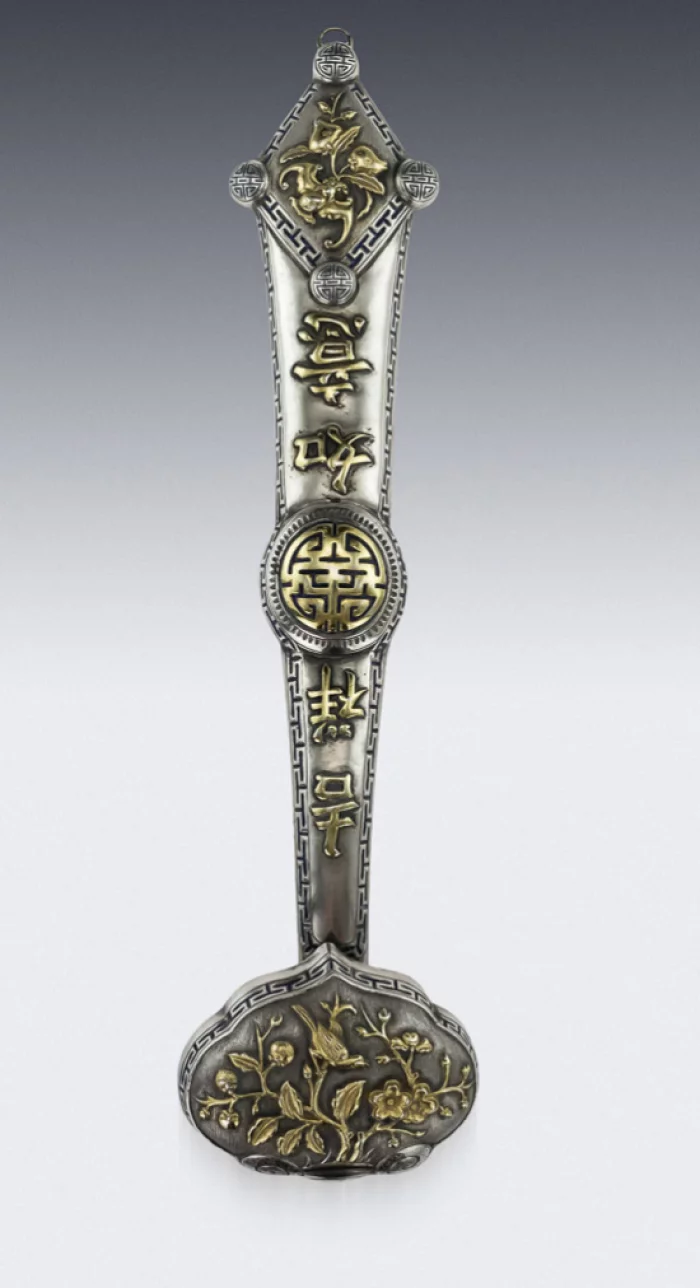
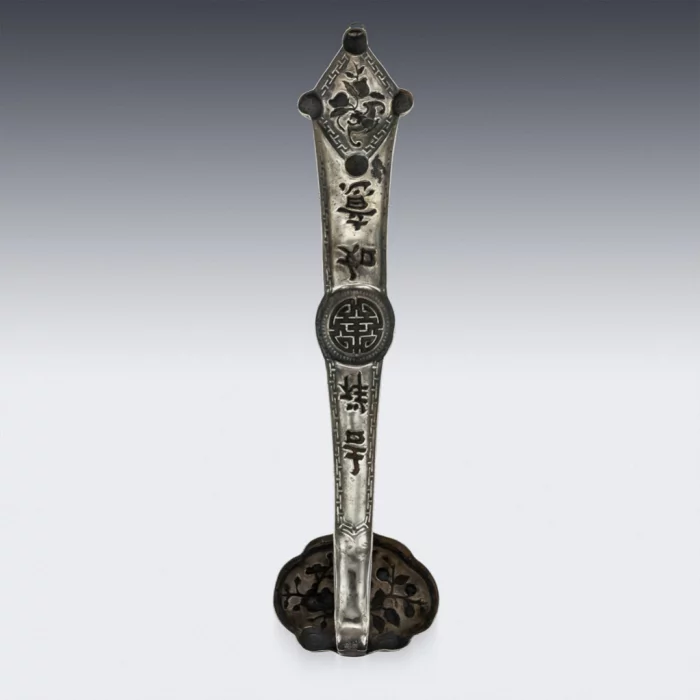
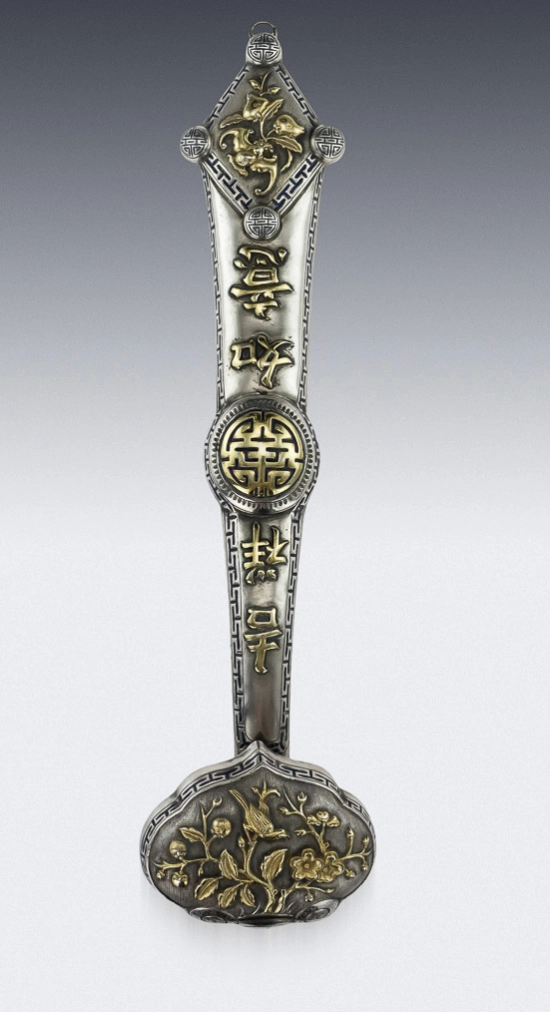
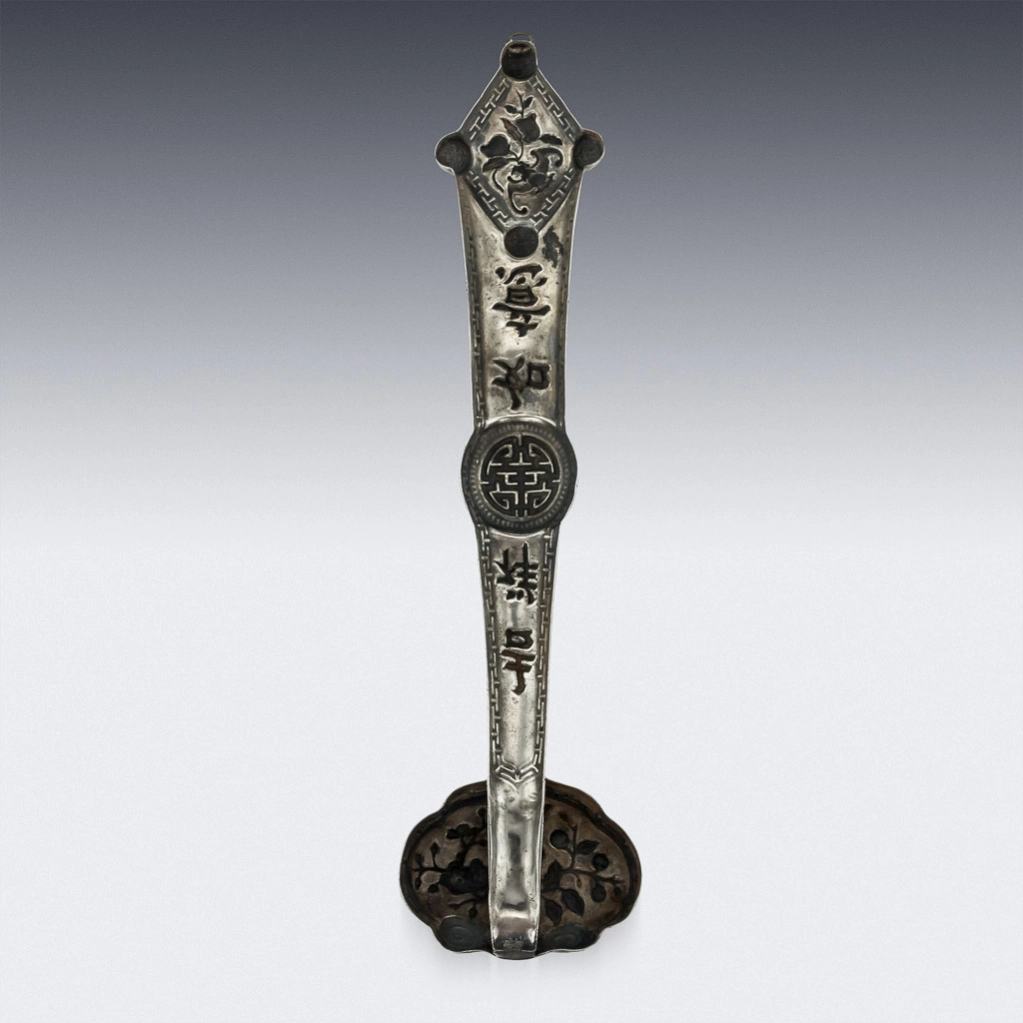
Antique 19th Century extremely rare Chinese solid silver-gilt & blue enamel Ruyi scepter, (Chinese: 如意; literally: "as desired; as [you] wish") is a curved decorative object that serves as a ceremonial scepter in Chinese Buddhism or a talisman symbolizing power and good fortune in Chinese folklore. A traditional ruyi has a long S-shaped handle and a head fashioned like a fist, cloud, or lingzhi mushroom. Ruyi are constructed from diverse materials. For example, the Palace Museum in Beijing has nearly 3000 ruyi that are variously made from valuable materials like gold, silver, iron, bamboo, wood, ivory, coral, rhinoceros horn, lacquer, crystal, jade, and precious gems. The "ruyi" image frequently appears as a motif in Asian art.Hallmarked with the mark of a renowned Beijing silversmith, Tian Bao (active 1860-1940) who specialised in silver and enamel combination work and cloisonne, Beijing being the traditional home of Chinese enamel work. It is unclear whether Tian Bao was a manufacturing silversmith, a retail silversmith or both, but there is certainly evidence the Tian Bao operation was built upon a long standing silver making tradition that was probably family generational during the last years of the decline of the Qing Dynasty, it became increasingly clear that drastic economies and changes had to be made to the unwieldy establishment behind the Imperial throne. Many of the Imperial workshops in the Forbidden City were disbanded and this caused some of the master enamelers and metalworkers to set up independent workshops, of which Tian Bao was one. For more information and examples of Tian Bao work please see A. Von Ferscht, Chinese Export Silver 1785-1940, 4th edition 2015, page 719.
The condition report is provided for informational purposes only.
It is not comprehensive and may not reflect all defects, restorations, alterations, or adaptations, as Antiqon does not perform professional conservation-level assessments. The information is based on a qualified, yet subjective, evaluation by our specialists.Before purchasing, we recommend consultation with an independent expert.Please also consult our Terms and conditions and Glossary A-Z, which contain important information on lot characteristics and sale conditions.