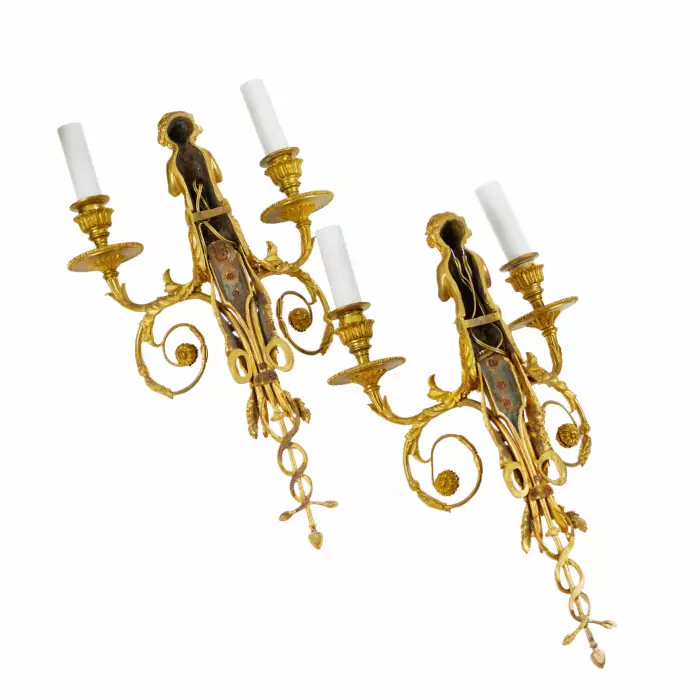
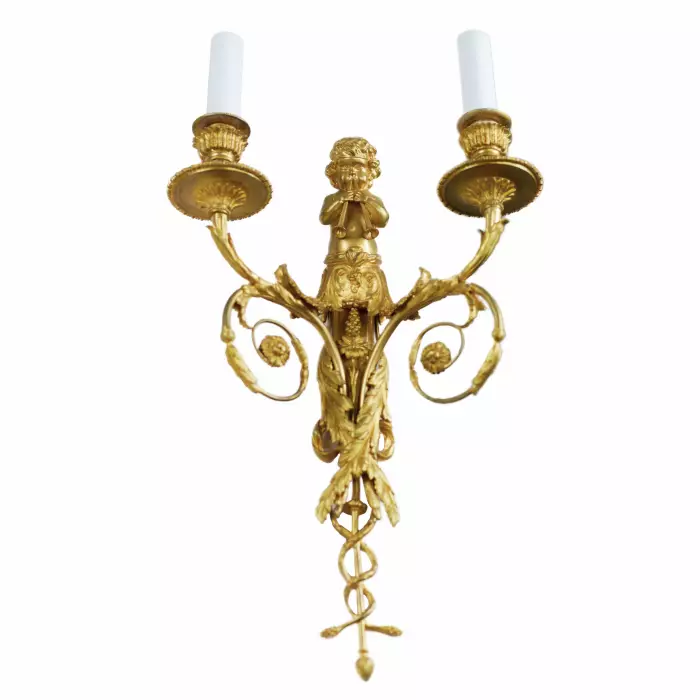
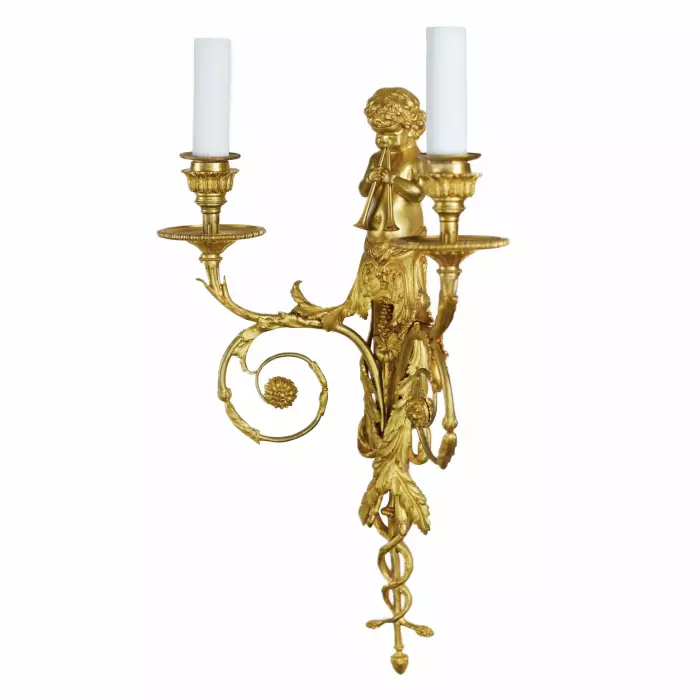
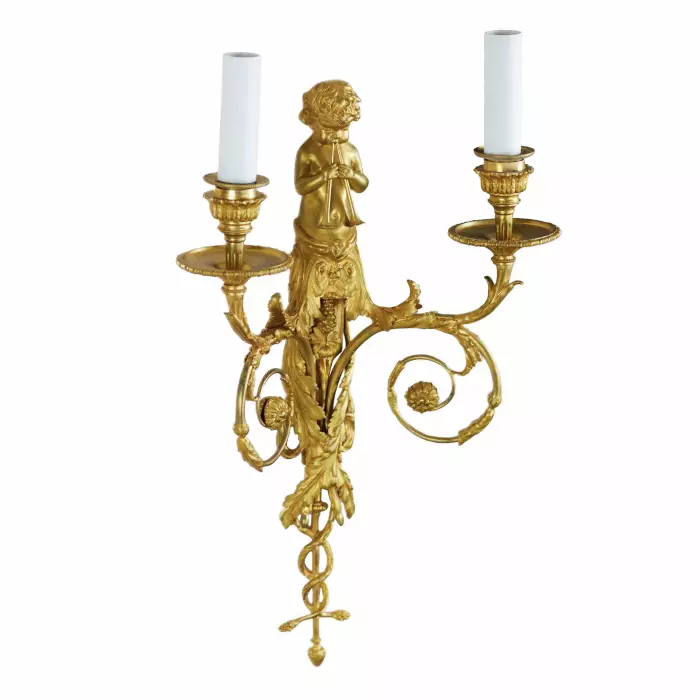
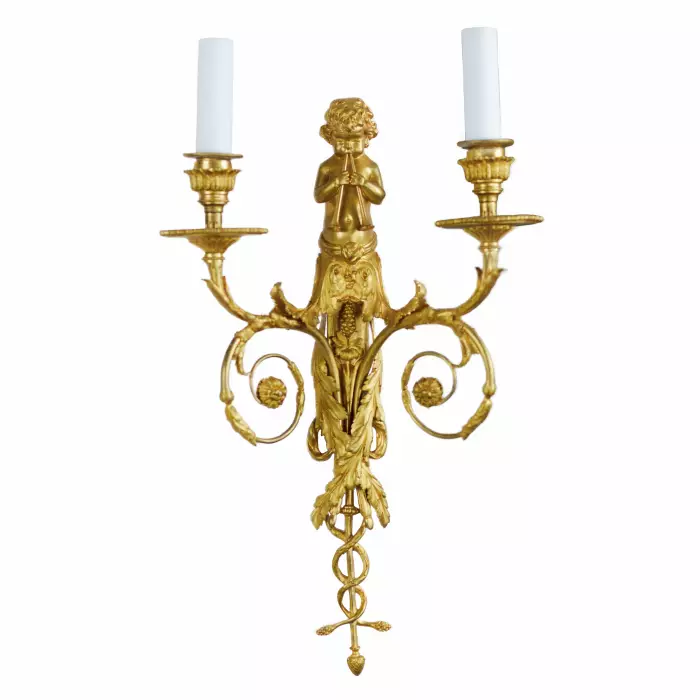
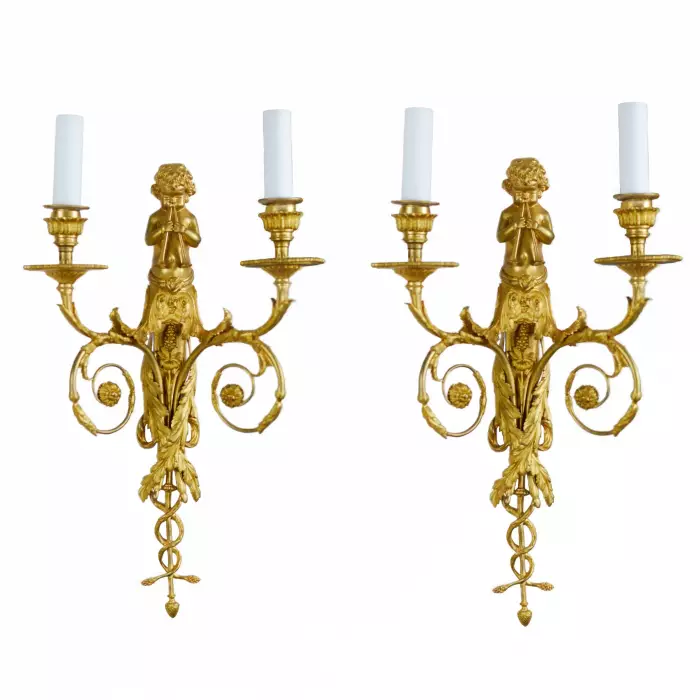
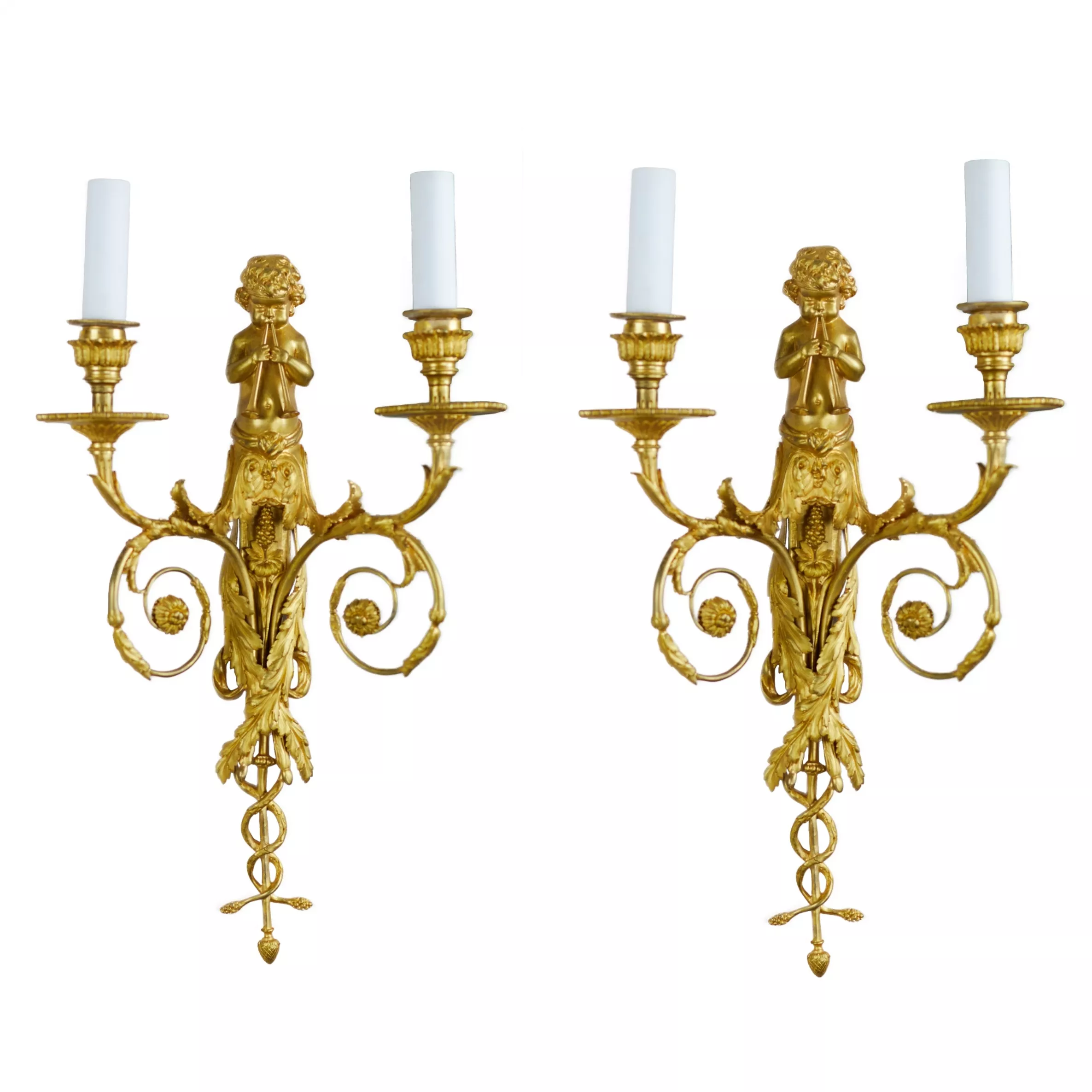
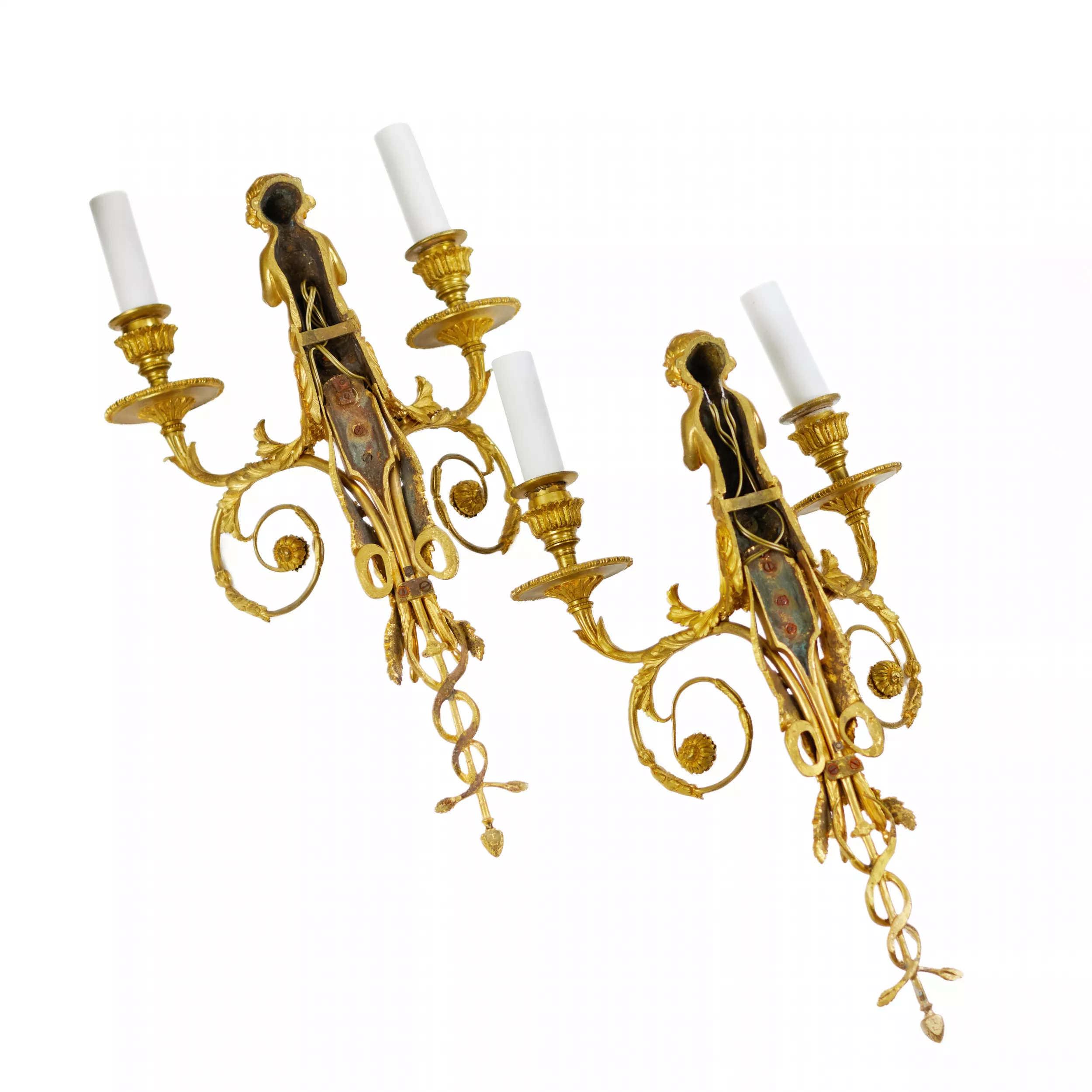
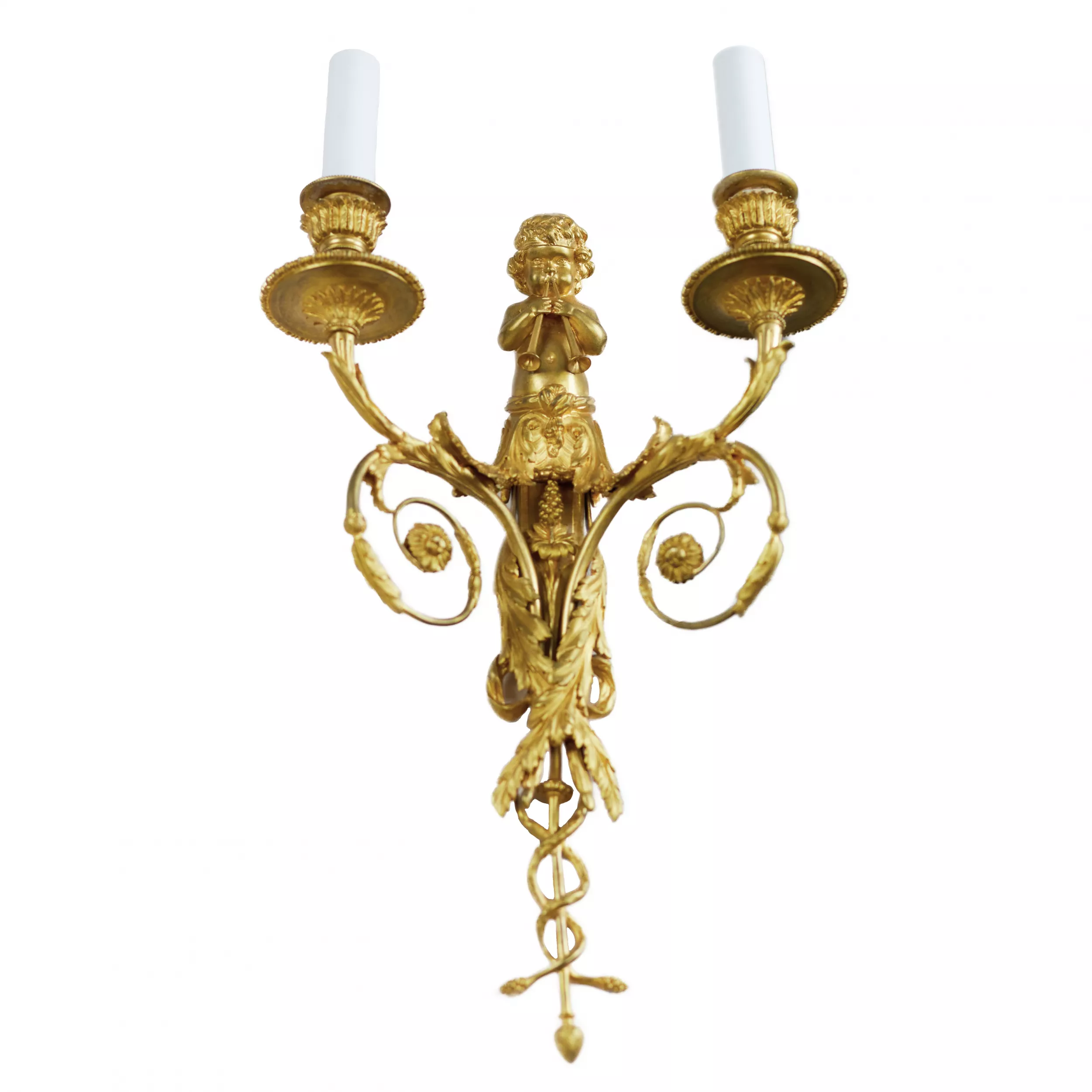
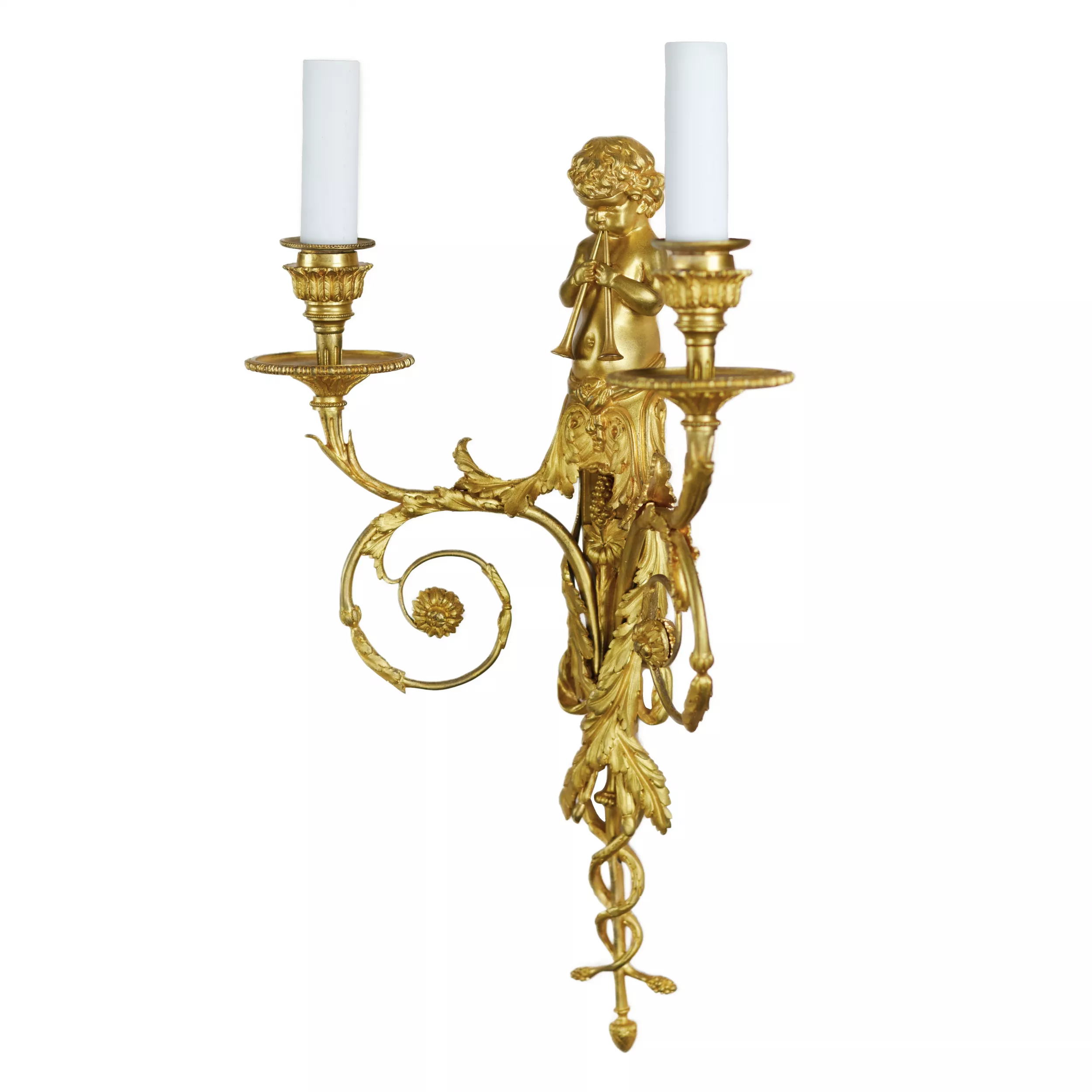
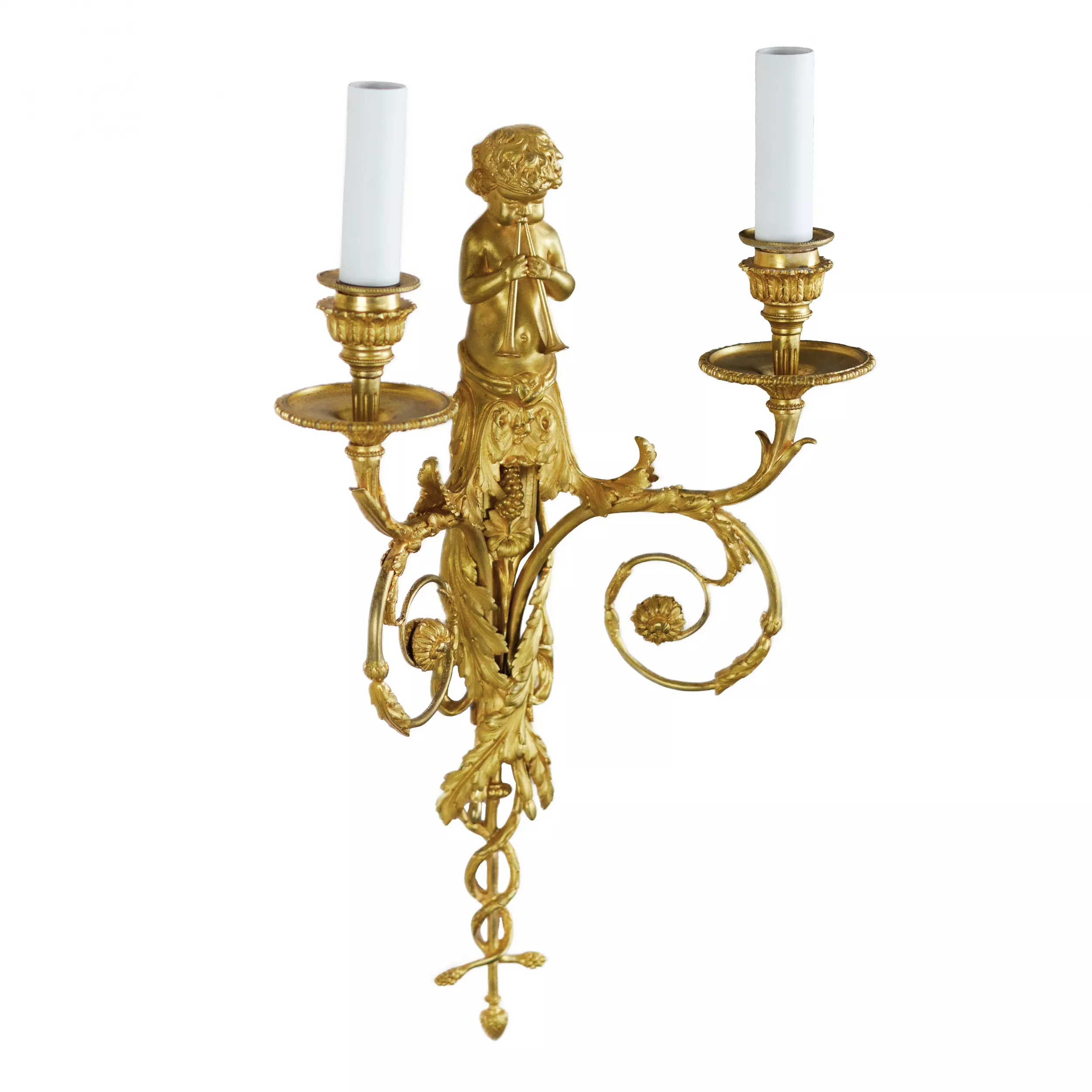
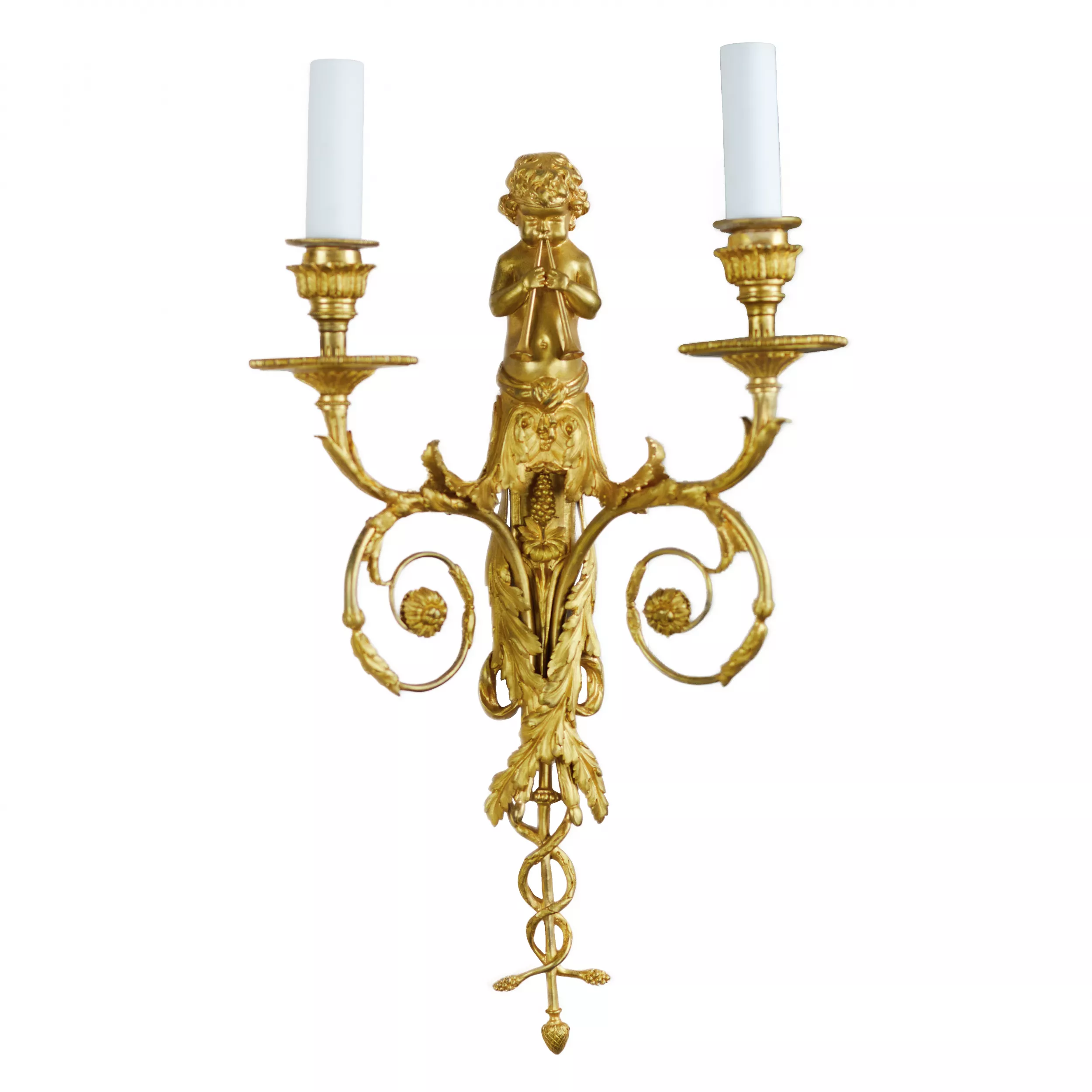
A pair of French wall appliques in finely cast, chased and gilt bronze, executed in the Louis XVI style after a model by Jean Hauré, originally designed in 1787 for the Château de Saint-Cloud. Each applique is fitted with two candle branches. The central stem is adorned with the figure of a putto playing a flute and continues into an elaborate composition of scrolling foliate ornament. Two volute-shaped branches issue from the central section and support candle nozzles above circular drip pans. The composition is richly embellished with acanthus leaves, rosettes, garlands and finely modelled spiral scrolls, while the lower section terminates in a decorative caduceus motif. The quality of the bronze casting, the refined hand chasing and the expressive modelling of the ornament are characteristic of accomplished French decorative bronze work produced during the Historicist period.
Dimensions: Height 42 cm. Width 26 cm.
Condition: Good.
The model for these wall appliques, designed by the French sculptor and decorator Jean Hauré in 1787 for the Château de Saint-Cloud, is regarded as one of the most recognisable compositions of the Louis XVI period in the field of French gilt-bronze decoration. Its artistic vocabulary reflects the mature phase of French Neoclassicism, in which references to Antiquity were combined with refined ornamental modelling and the technical virtuosity of Parisian bronziers. The figure of a putto playing a flute evokes harmony, music and the celebration of the arts, while the garlands, acanthus leaves, rosettes and scrolling branches derive from the decorative repertory favoured in royal interiors during the final decades of the eighteenth century.
During the second half of the nineteenth century, renewed interest in the decorative arts of the Ancien Régime encouraged leading French bronze foundries and ateliers to revisit celebrated eighteenth-century designs. Historicist interiors created under the Second Empire and the early Third Republic frequently incorporated finely executed reproductions and adaptations of Louis XVI models, intended for grand salons, libraries, music rooms and ceremonial apartments. Such works were valued not merely as functional lighting devices, but as sculptural elements capable of reinforcing the architectural rhythm and historical character of an interior.
The production of these pieces required specialist knowledge of bronze casting, assembly, chasing and gilding. Their refined surfaces, carefully articulated details and balanced silhouettes demonstrate the continuation of techniques associated with the finest French bronziers. Wall appliques after Hauré’s model are therefore appreciated both as decorative objects and as evidence of the nineteenth-century revival of eighteenth-century French court taste. Today, examples of this type are represented in important museum and private collections and remain highly regarded within the international market for French decorative arts.
Good condition, consistent with age. The gilding is well preserved. Minor traces of age and use are present, characteristic of objects dating from the second half of the nineteenth century.
The condition report is provided for informational purposes only.
It is not comprehensive and may not reflect all defects, restorations, alterations, or adaptations, as Antiqon does not perform professional conservation-level assessments. The information is based on a qualified, yet subjective, evaluation by our specialists.Before purchasing, we recommend consultation with an independent expert.Please also consult our Terms and conditions and Glossary A-Z, which contain important information on lot characteristics and sale conditions.