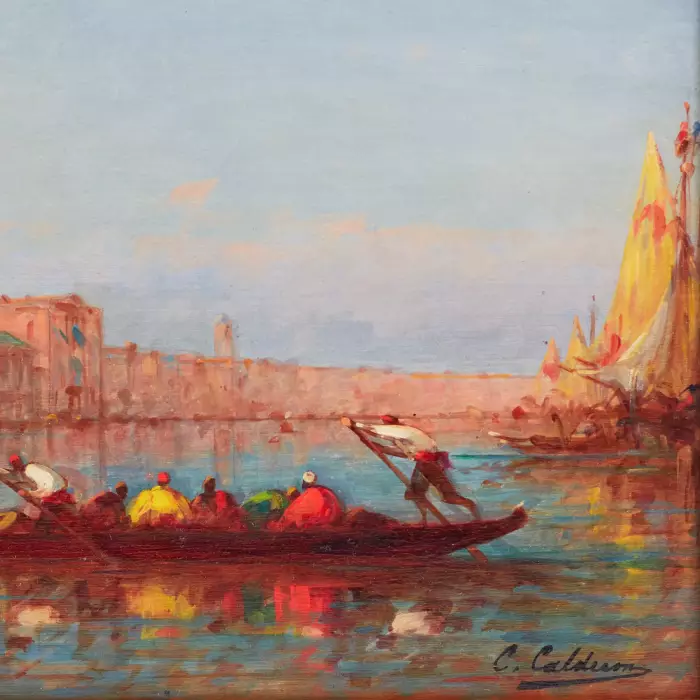
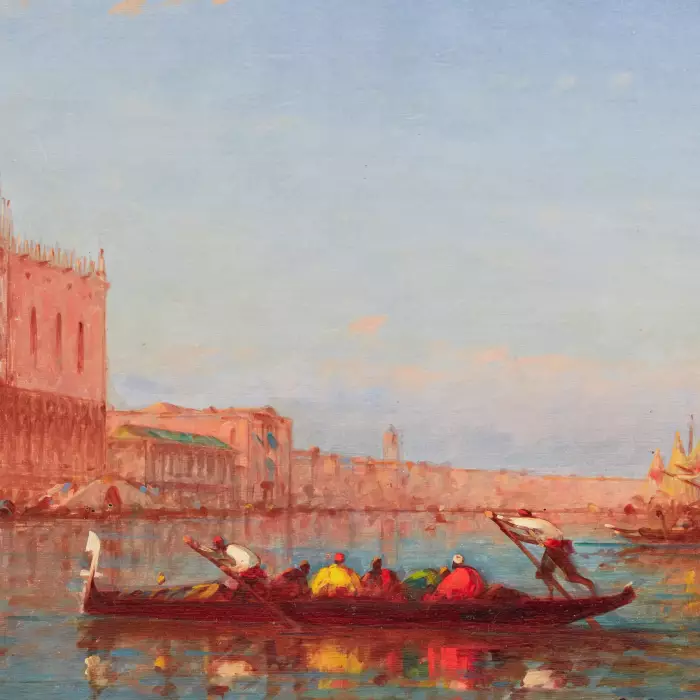
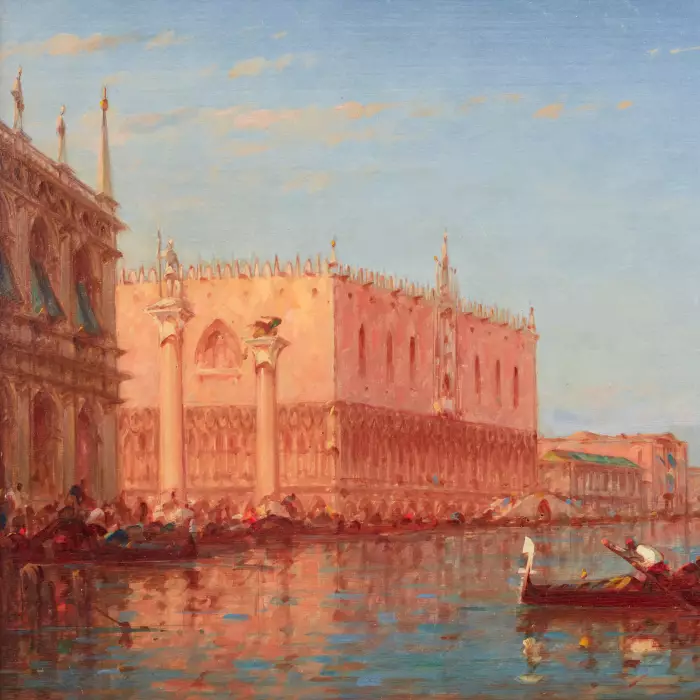
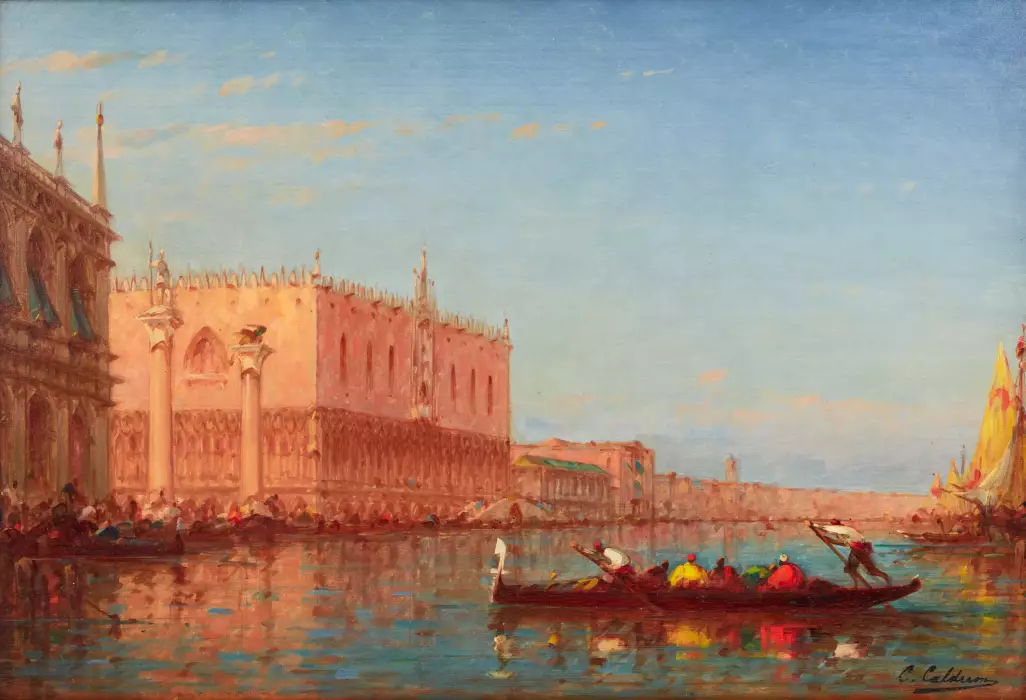
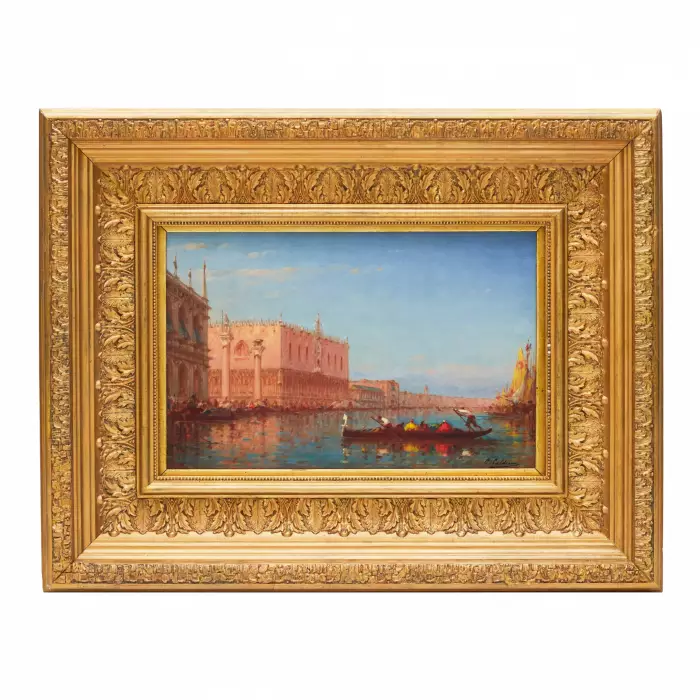
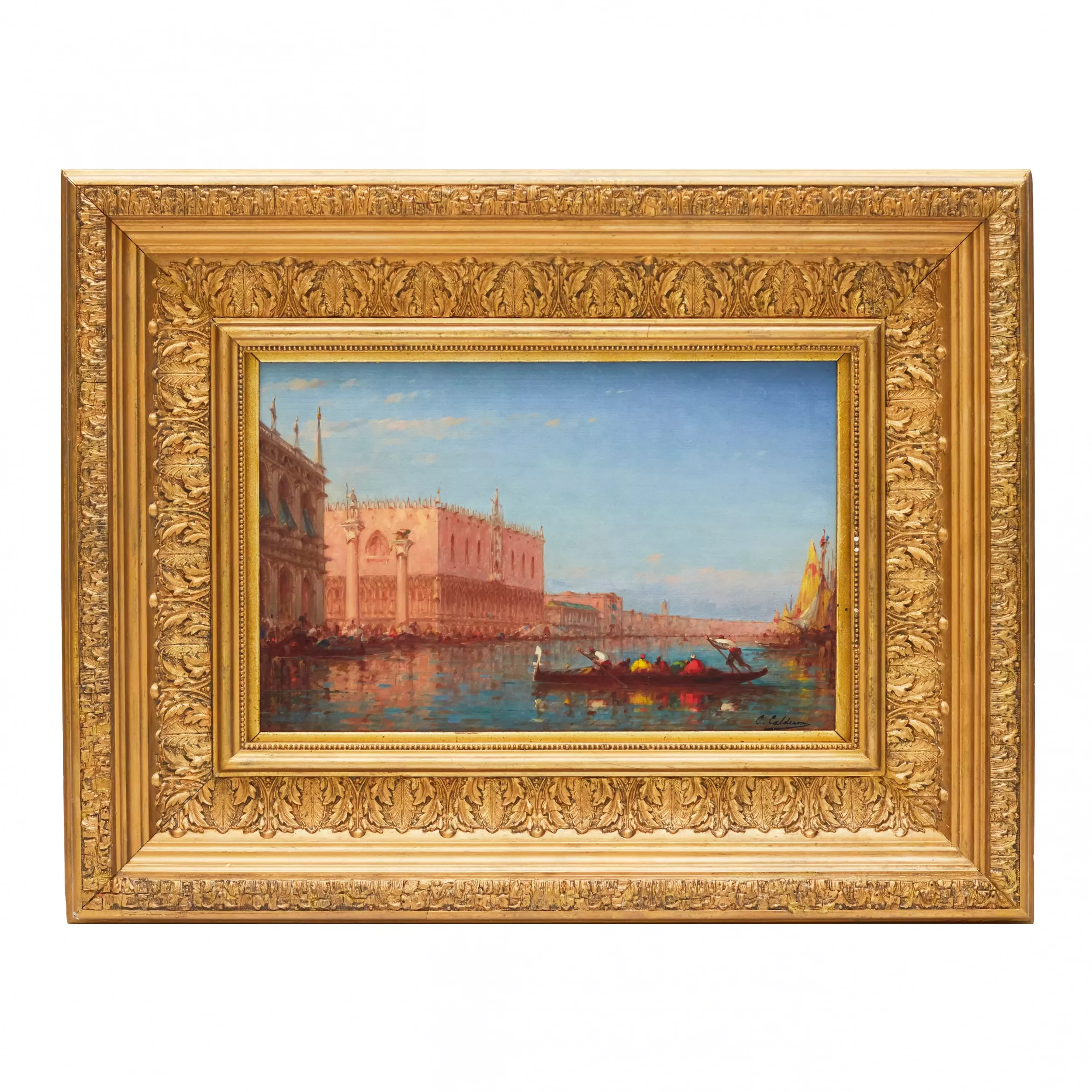
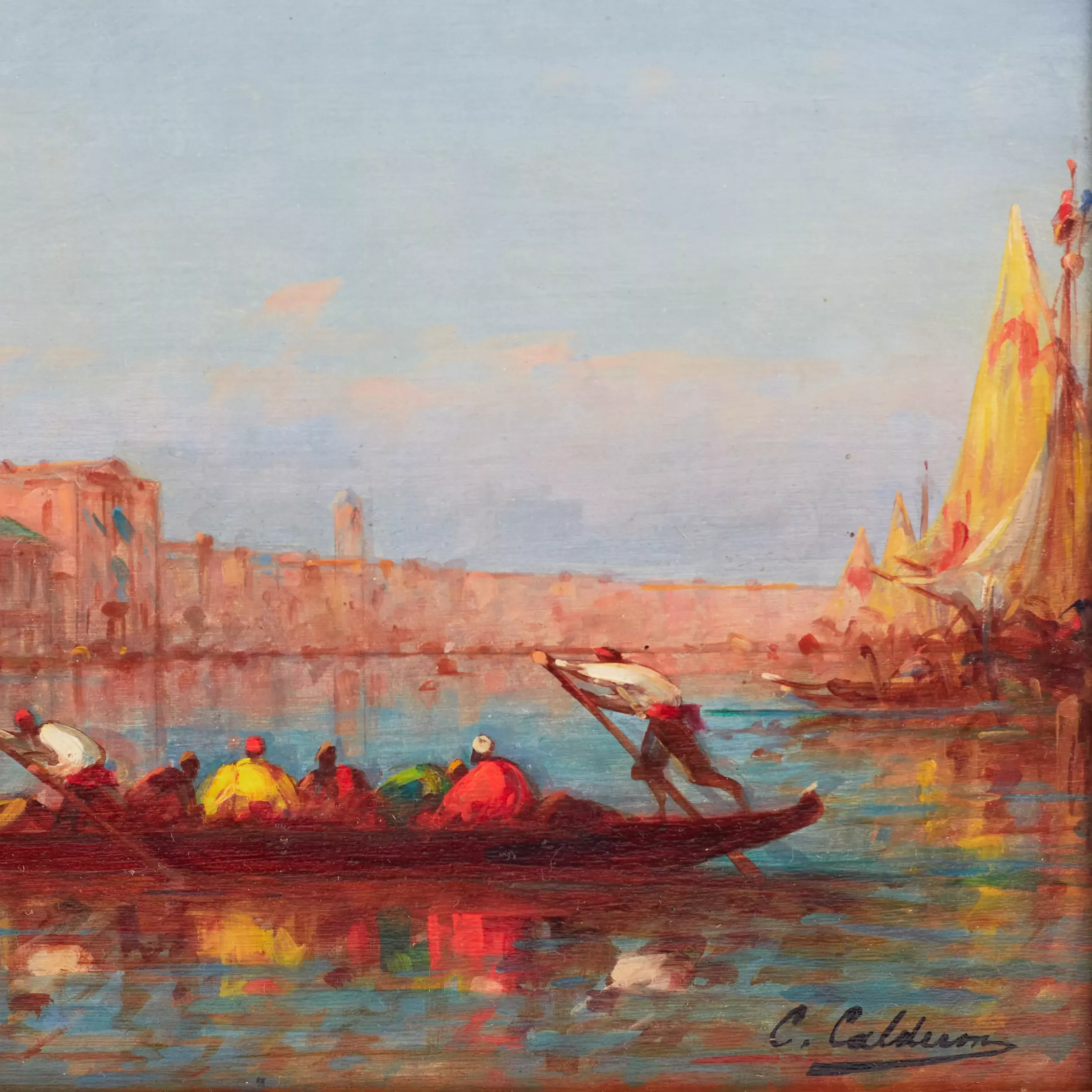
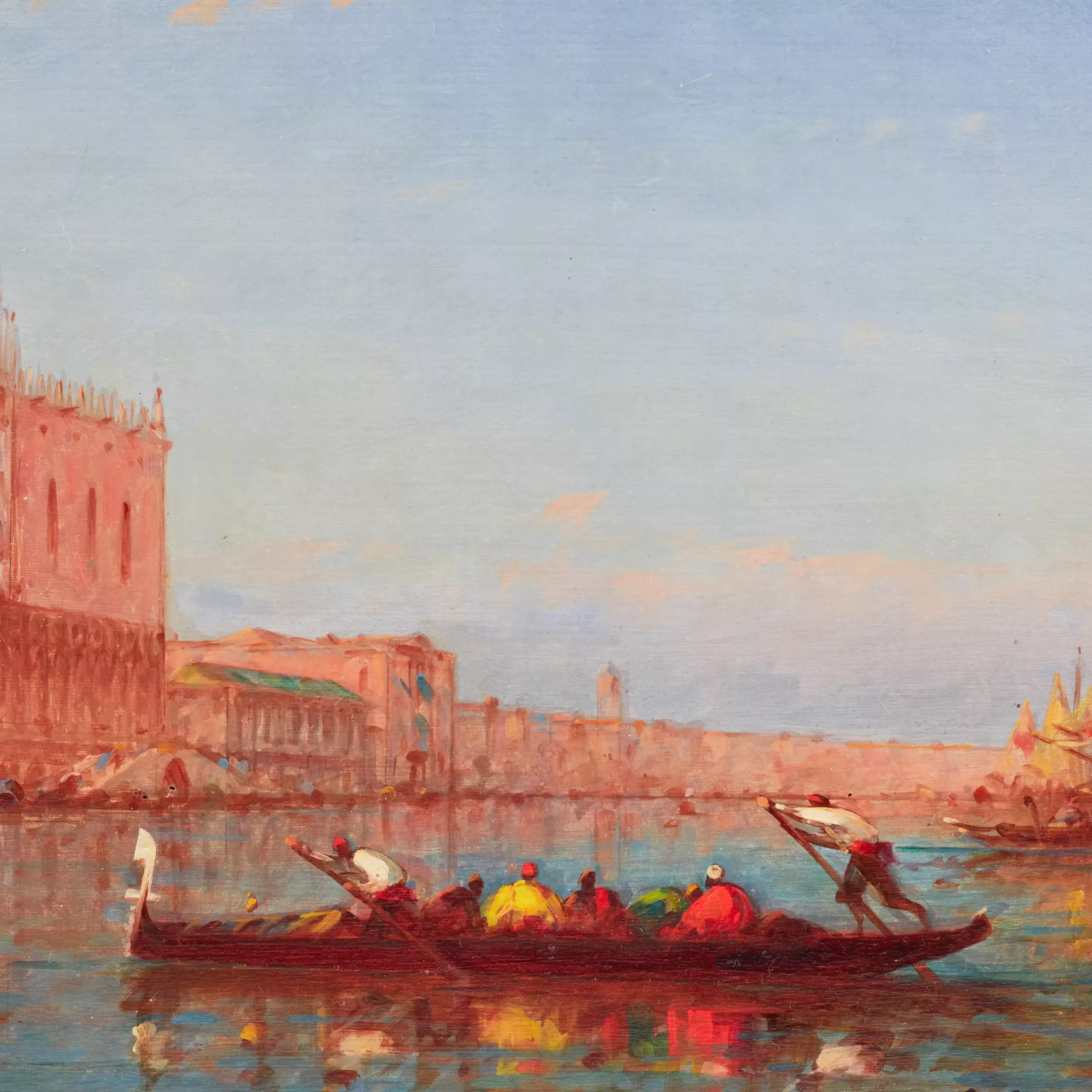
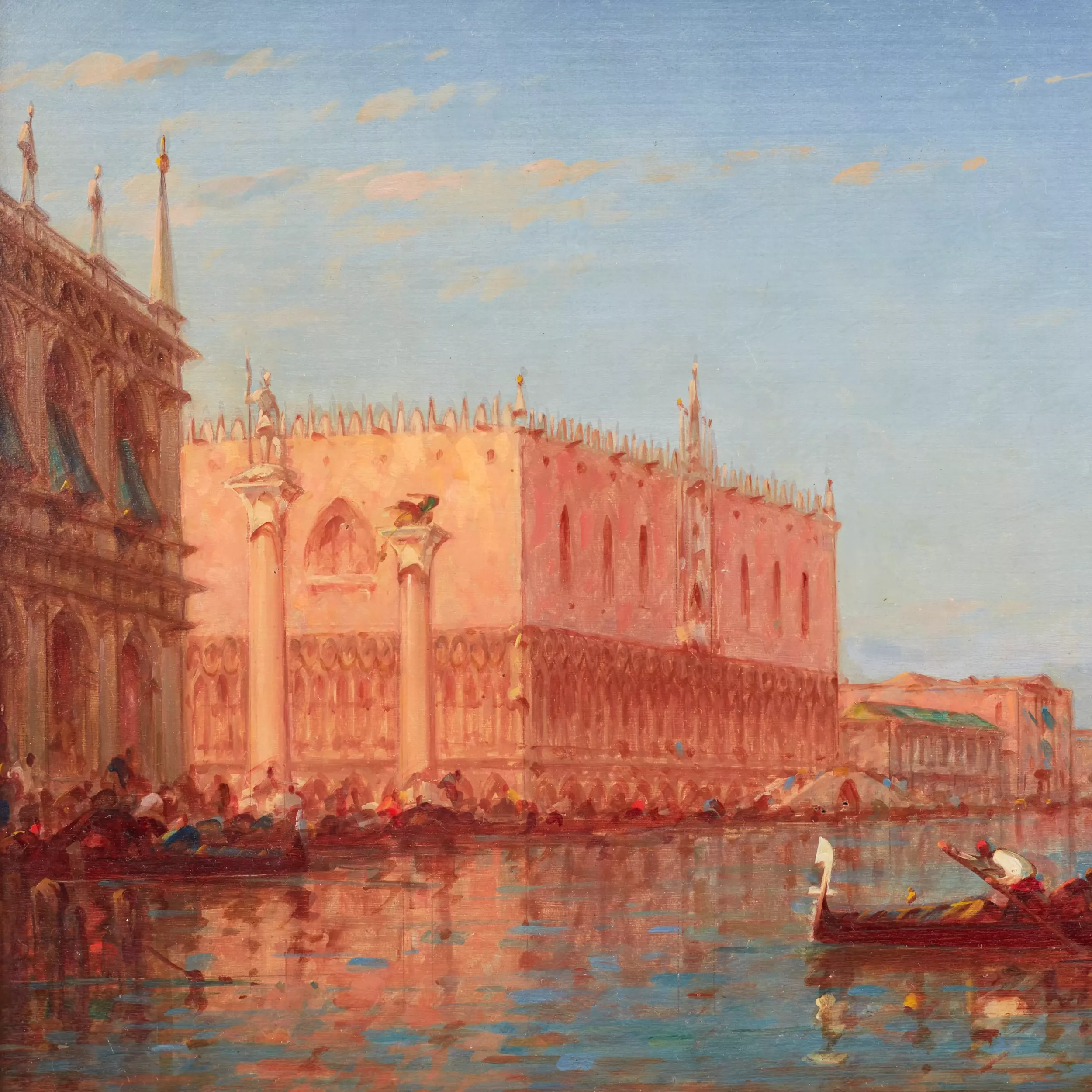
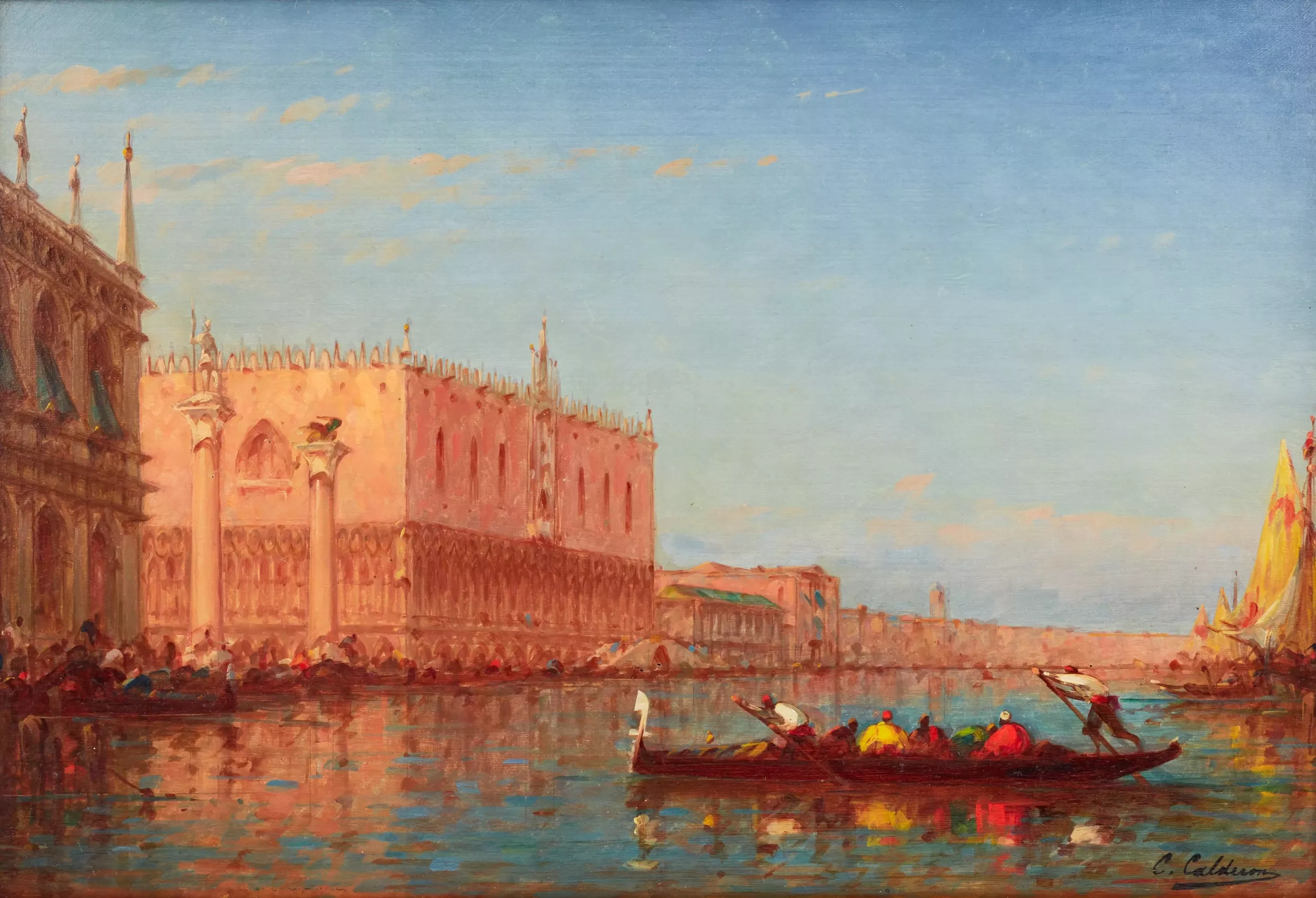
A refined painting by the French artist Charles-Clément Calderon (1870-1906), depicting one of the most iconic architectural ensembles of Venice - the Doge’s Palace and St Mark’s Square. The work continues the tradition of European veduta painting, combining academic precision in architectural representation with a subtle sensitivity to light, atmosphere and the unique character of the Venetian lagoon.
The composition unfolds as a panoramic view of the Piazzetta San Marco with its two celebrated columns: the column bearing the winged Lion of Saint Mark, the symbol of the Venetian Republic, and the column of Saint Theodore. In the background, the majestic façade of the Doge’s Palace rises prominently, rendered with careful attention to the architectural details of Venetian Gothic. A gondola with passengers dressed in vivid colours animates the foreground, bringing movement and a sense of everyday Venetian life to the scene.
The free painterly technique, delicate transitions of light and reflections on the water surface reveal the influence of late 19th-century plein-air painting, while preserving a realistic foundation and classical compositional harmony.
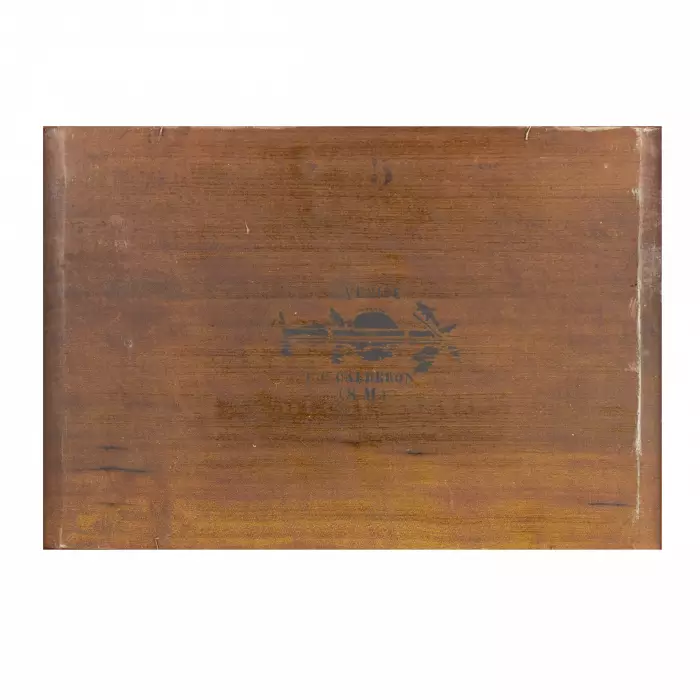
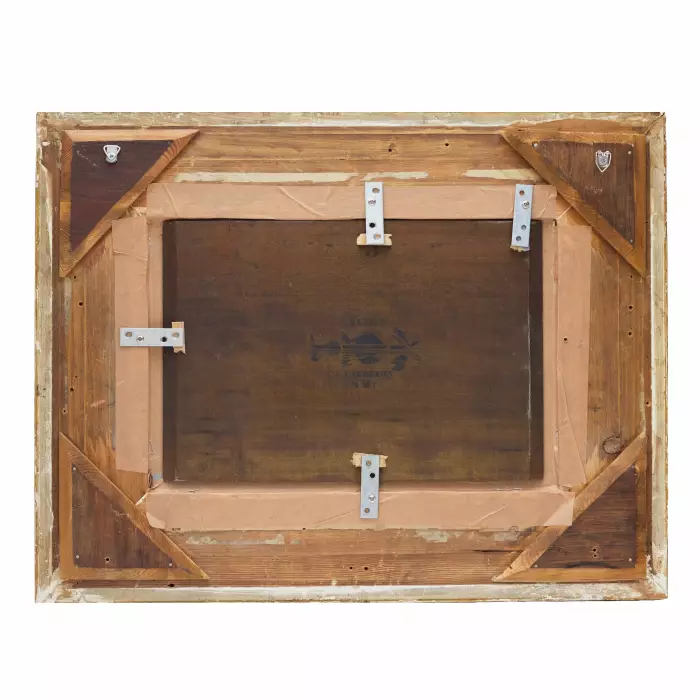
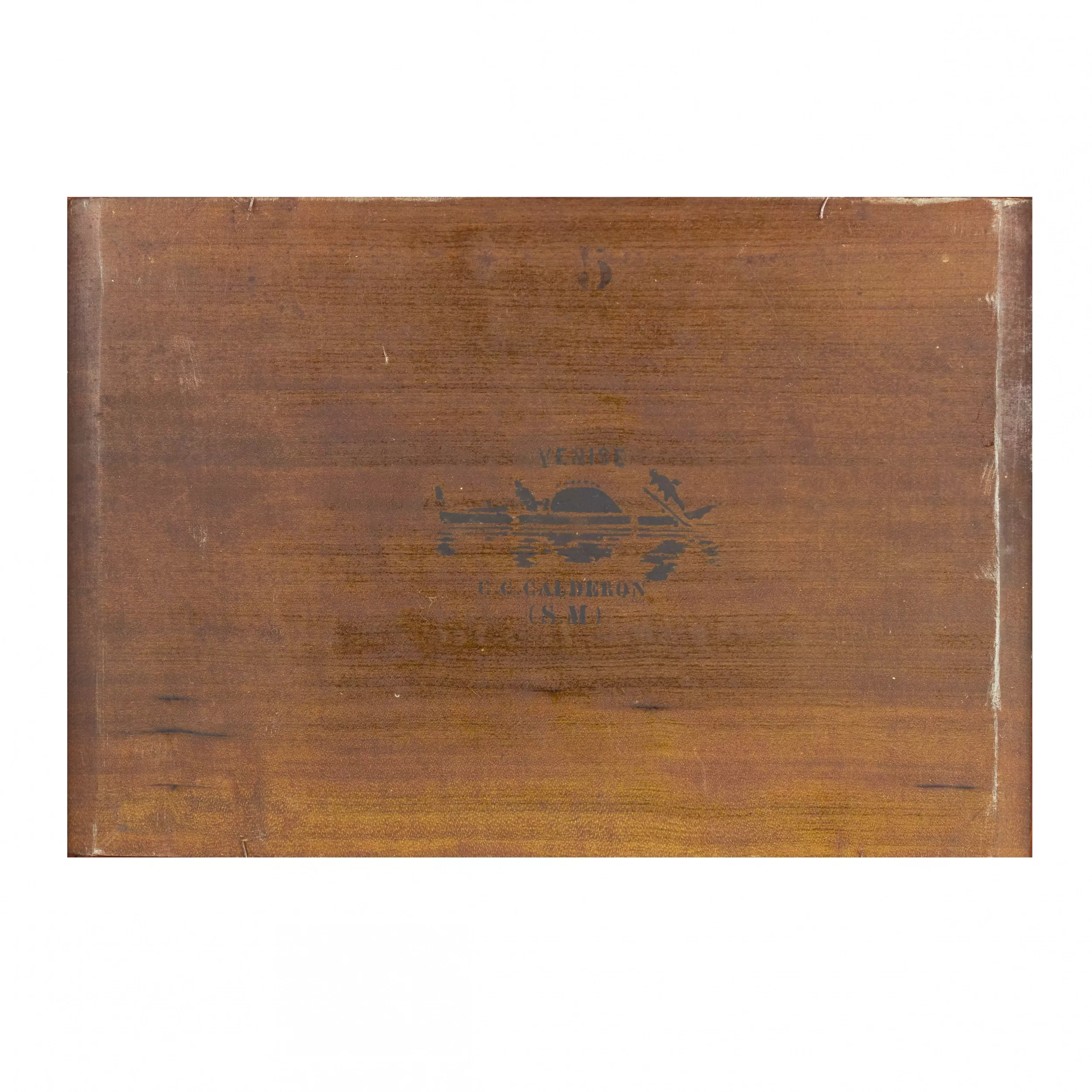
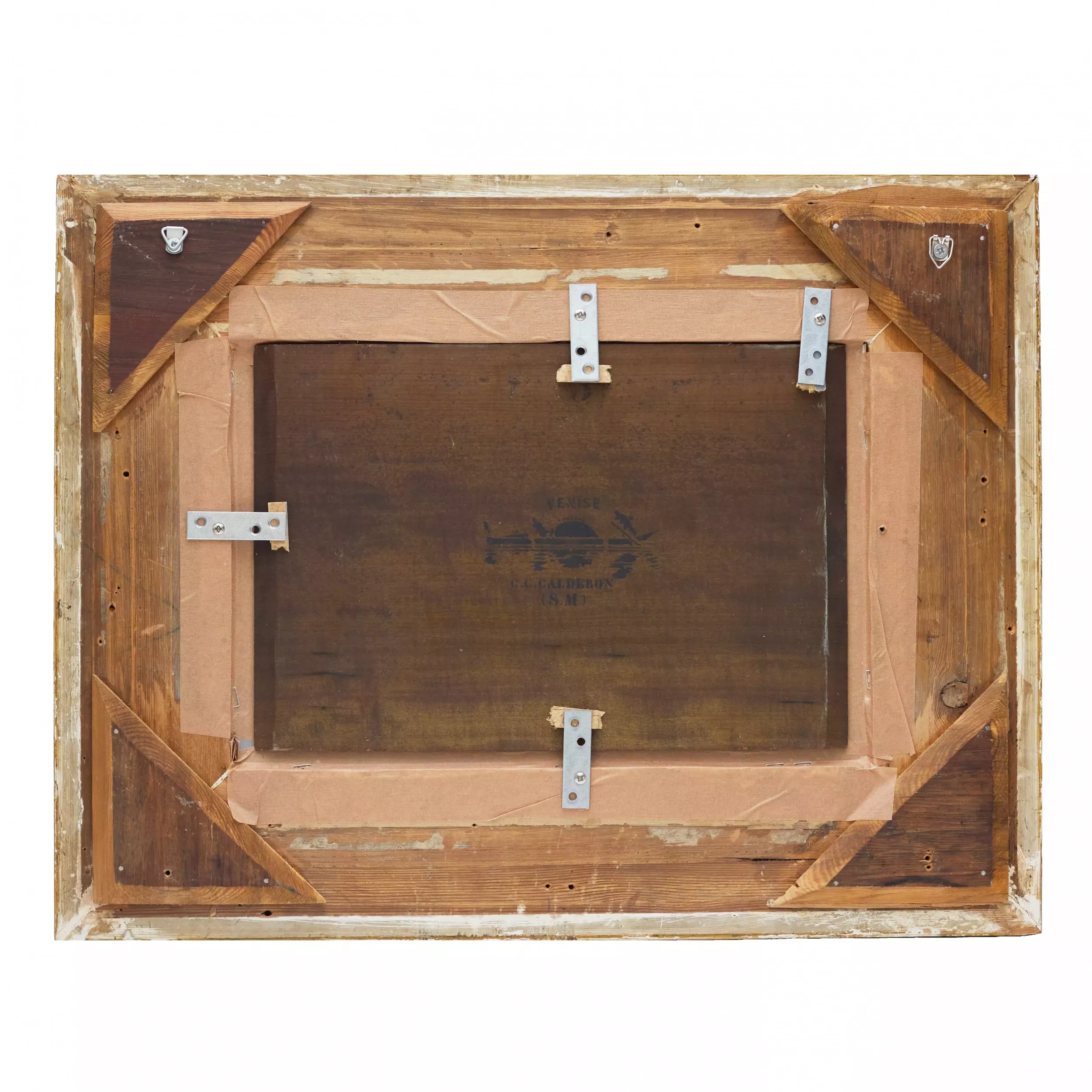
Marks: Artist’s signature “C. Calderon” lower right; reverse bearing the stamp “VENISE - C.C. CALDERON (S.M.)”.
Dimensions: 24 × 35 cm.
Medium: Oil on mahogany panel.
Frame dimensions: 45 × 57 cm.
Condition: Good collectible condition, with a light natural age-related patina. The original gilt frame shows minor signs of age consistent with the period of creation.
Provenance: Private European collection.
Period:
At the turn of 19th -20th century
Charles-Clément Calderon (1870-1906) belonged to a generation of French artists at the turn of the 19th and 20th centuries whose work developed at the intersection of academic tradition, realism and the new perception of light shaped by plein-air painting. His artistic practice reflects the fascination of European painters of this period with historic urban landscapes, architectural monuments and the preservation of cultural heritage.
Venice occupied a special place in 19th-century European art. Following the great masters of 18th-century veduta painting, such as Canaletto and Francesco Guardi, the image of the city on water experienced renewed interpretation among artists from France, England and Italy. For late 19th-century painters, Venice represented not only an architectural subject but also a symbol of historical memory, artistic heritage and a romantic vision of the past.
In “View of the Doge’s Palace and St Mark’s Square in Venice”, Calderon turns to one of the most important symbols of the Venetian Republic. The Doge’s Palace, once the political centre of Venice and an outstanding monument of Venetian Gothic architecture, becomes the principal architectural focus of the composition. The columns of the Piazzetta, crowned by the Lion of Saint Mark and Saint Theodore, emphasise the historical continuity and cultural identity of the city.
The artist preserves the documentary precision of architectural veduta while enriching the image with the painterly softness characteristic of European art at the turn of the century. Particular attention is given to the rendering of atmosphere: the play of sunlight on the water, aerial perspective, reflections and the harmonious relationship between human presence and architectural space.
The painting represents a fine example of European architectural landscape painting of the Belle Époque period, when artists sought to preserve the image of Europe’s great historic centres through a combination of academic skill, appreciation of cultural heritage and a renewed understanding of light and colour.
The work is in good collectible condition. The paint layer is stable, with the surface retaining its depth of colour and the artist’s original painterly qualities. Minor traces of age are consistent with the period and do not affect the overall visual integrity of the work.
The condition report is provided for informational purposes only.
It is not comprehensive and may not reflect all defects, restorations, alterations, or adaptations, as Antiqon does not perform professional conservation-level assessments. The information is based on a qualified, yet subjective, evaluation by our specialists.Before purchasing, we recommend consultation with an independent expert.Please also consult our Terms and conditions and Glossary A-Z, which contain important information on lot characteristics and sale conditions.