×
Create account and receive
15% DISCOUNT
your first acquisition
or
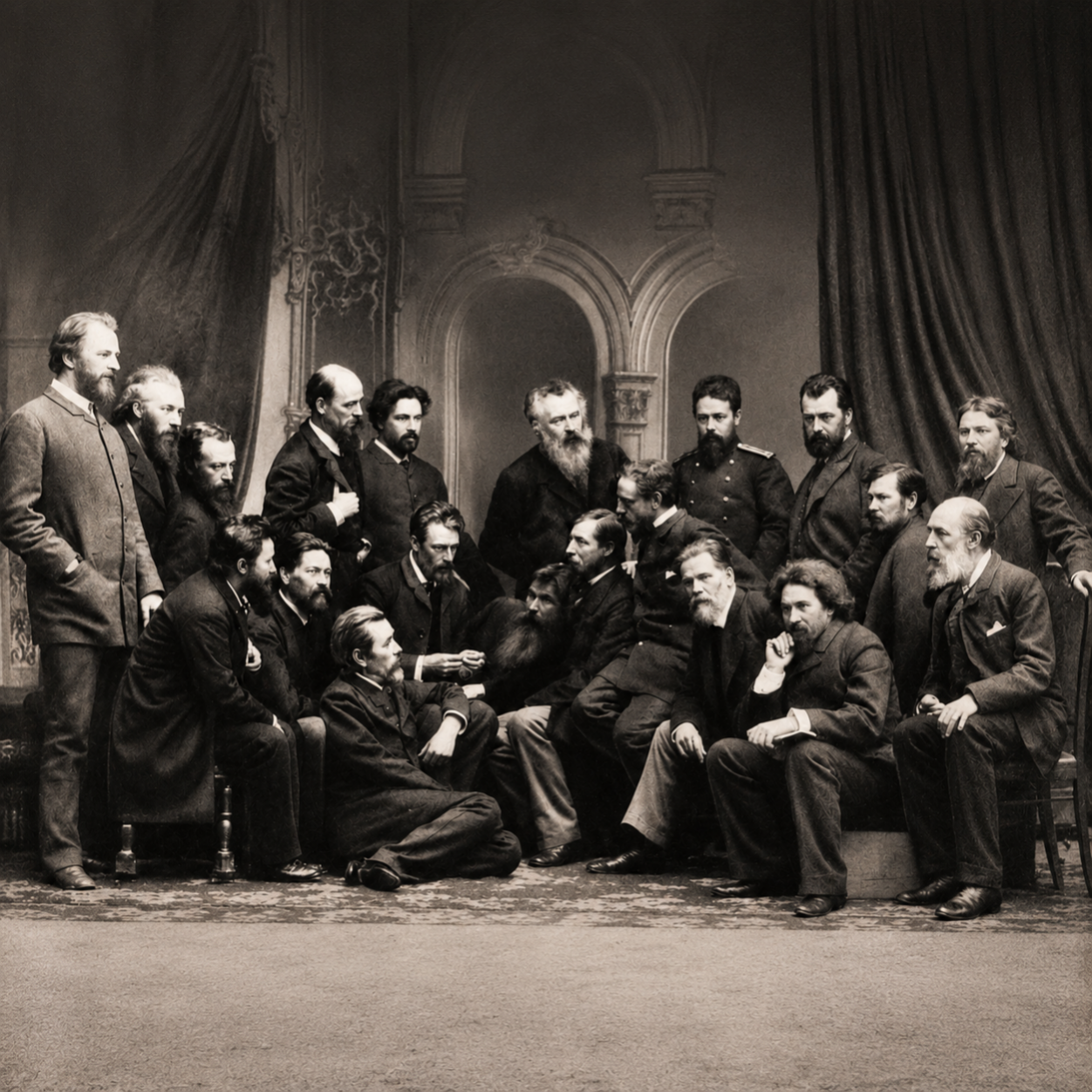
In the second half of the nineteenth century, Russia witnessed the emergence of an artistic movement that would profoundly transform the nation's cultural landscape. The Society for Travelling Art Exhibitions, widely known as the Peredvizhniki or The Wanderers, became a symbol of artistic freedom, realism, and a new understanding of the artist's role in society.
Founded in 1870, the Society arose in response to the conservative doctrines of the Imperial Academy of Arts. Following the celebrated "Revolt of the Fourteen," a group of young artists rejected academic conventions and embraced a new mission: to create art inspired by contemporary life, national history, and the human experience.
The Society's defining achievement was the organisation of travelling exhibitions, which brought works of art to audiences far beyond Saint Petersburg and Moscow for the first time. Over more than half a century, the Peredvizhniki organised forty-seven exhibitions, fundamentally reshaping the cultural life of the Russian Empire.
The movement established a new artistic tradition rooted in realism, psychological depth, and a strong sense of social responsibility. Their paintings explored the lives of ordinary people, the beauty of the Russian landscape, pivotal moments in national history, and the moral questions of their age.
Among the movement's most distinguished representatives were Ivan Kramskoi, Vasily Perov, Alexei Savrasov, Ivan Shishkin, Ilya Repin, Nikolai Ge, Vasily Surikov, Isaac Levitan, Vladimir and Konstantin Makovsky, Vasily Polenov, Arkhip Kuindzhi, and many other masters whose works now form the cornerstone of Russian artistic heritage.
A particularly noteworthy figure is Pavel Alexandrovich Bryllov (1840–1914), an Academician of Painting, participant in the Society's exhibitions, and nephew of the renowned Karl Bryllov. His monumental genre paintings devoted to the life of the Russian people became a compelling continuation of the traditions of Critical Realism and occupy an important place in the history of nineteenth-century Russian painting.
An indispensable role in the success of the Peredvizhniki was played by the eminent collector Pavel Mikhailovich Tretyakov, who consistently acquired the finest works exhibited by the Society for his gallery. Owing to his patronage, the legacy of the Peredvizhniki has been preserved within the foremost collection of Russian national art and has become an integral part of the world's cultural heritage.
Today, the art of the Peredvizhniki is recognised as one of the defining achievements of nineteenth-century European painting. Their works are held in the world's leading museums, remain highly sought after by collectors, and continue to inspire scholars, artists, and connoisseurs alike. For Maison ANTIQON, the legacy of the Peredvizhniki represents an essential chapter in Russian artistic heritage, reflecting exceptional technical mastery, profound humanism, and an enduring contribution to the history of European art.
We will only share latest what our month on the THE PEREDVIZHNIKI: A REVOLUTION IN RUSSIAN ART OF THE NINETEENTH CENTURY.