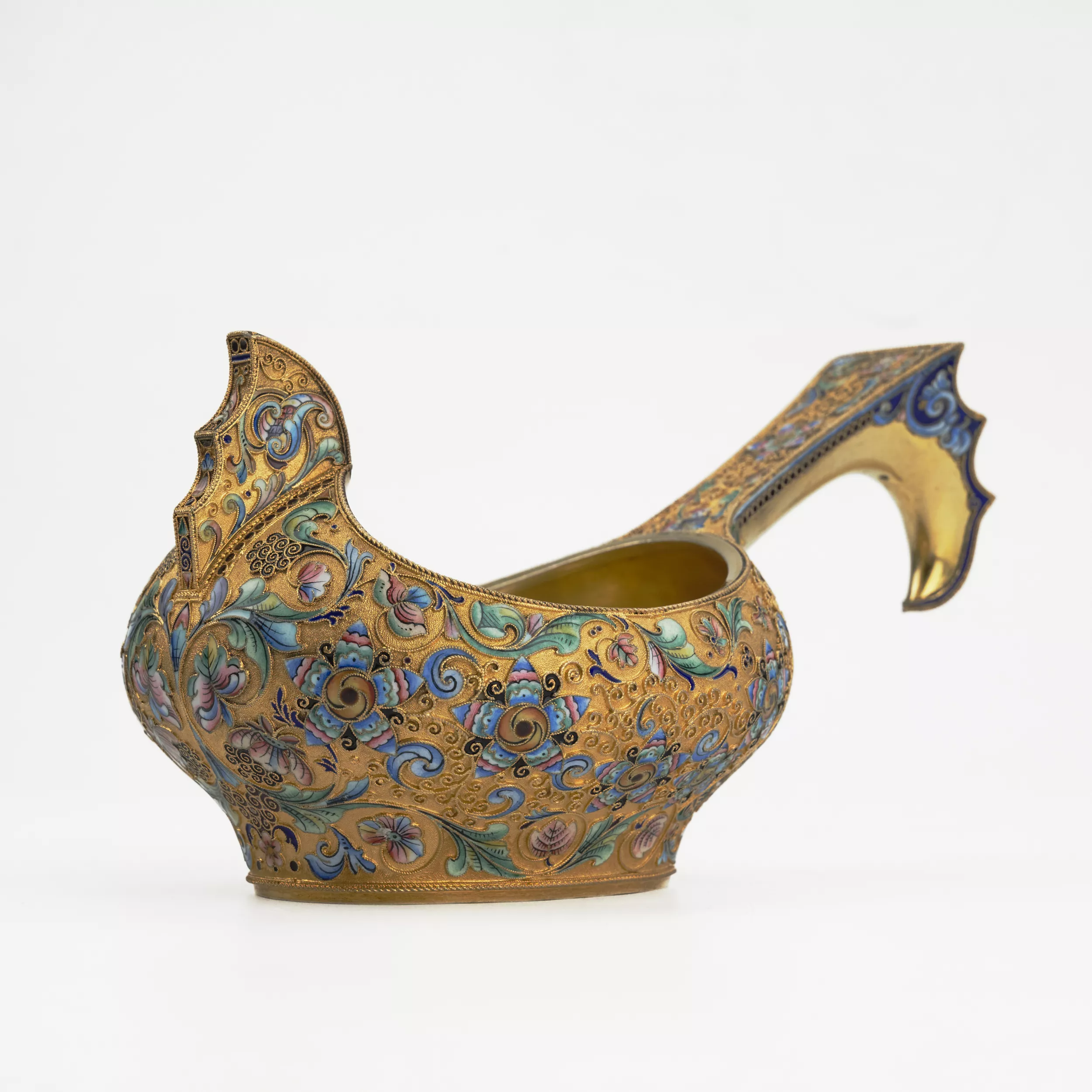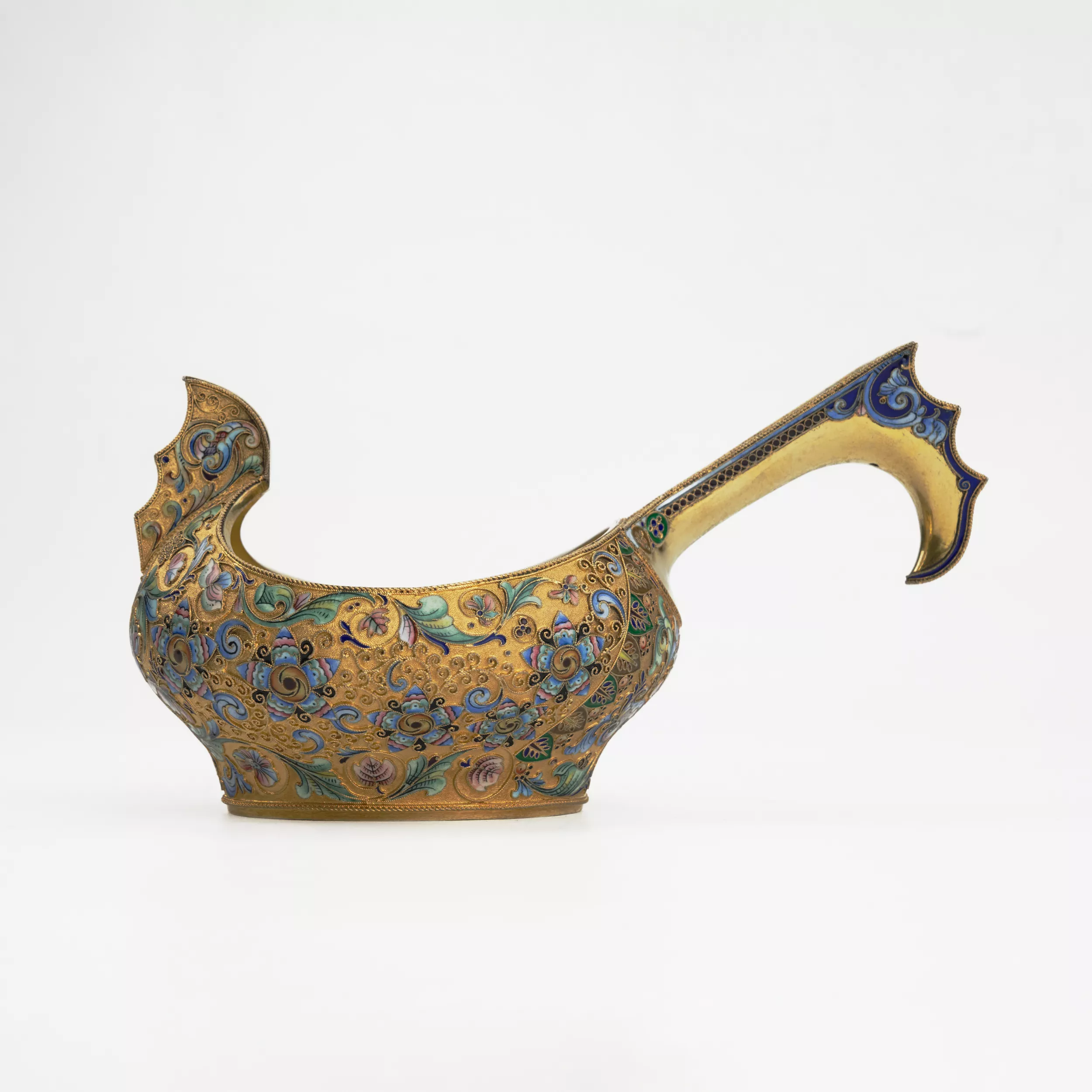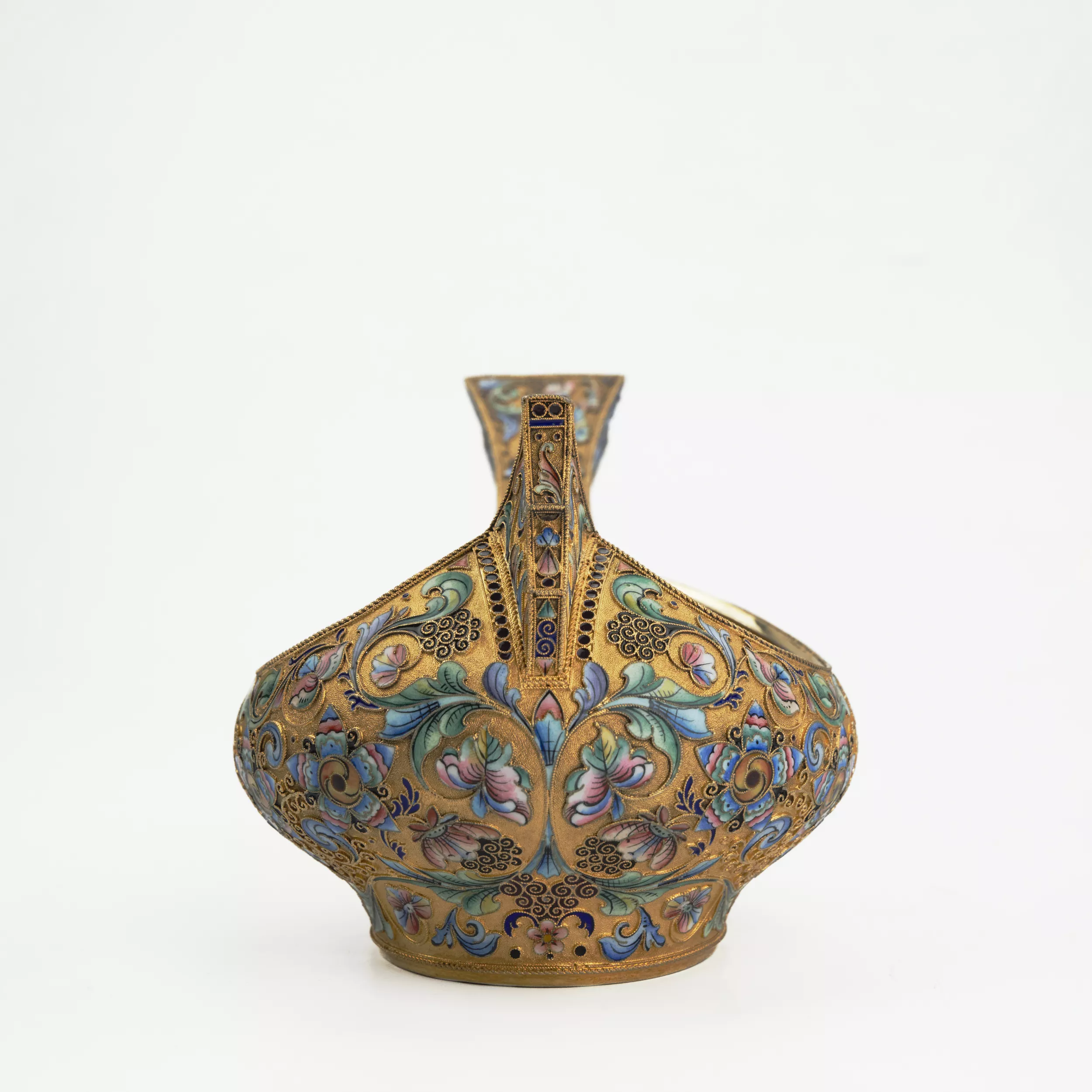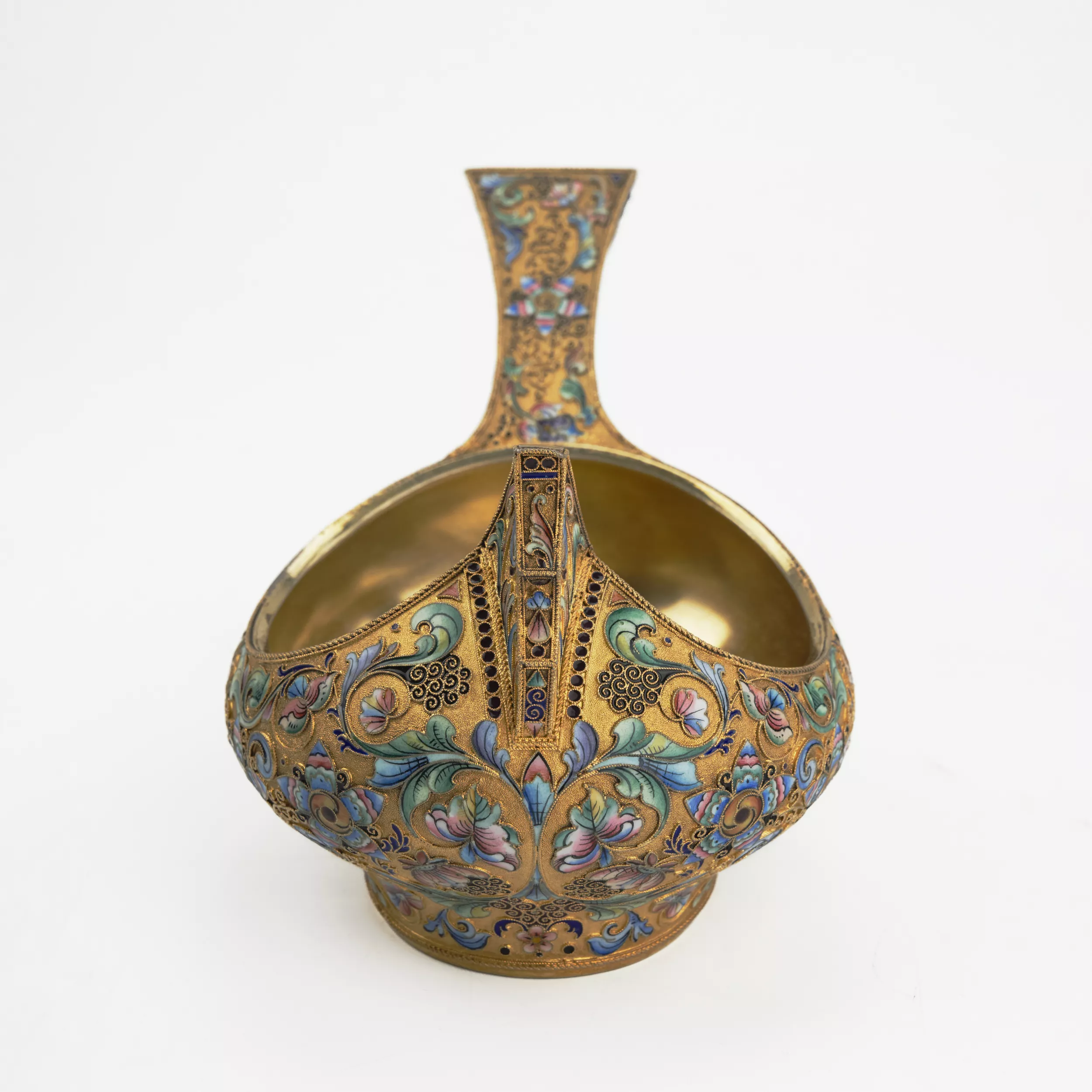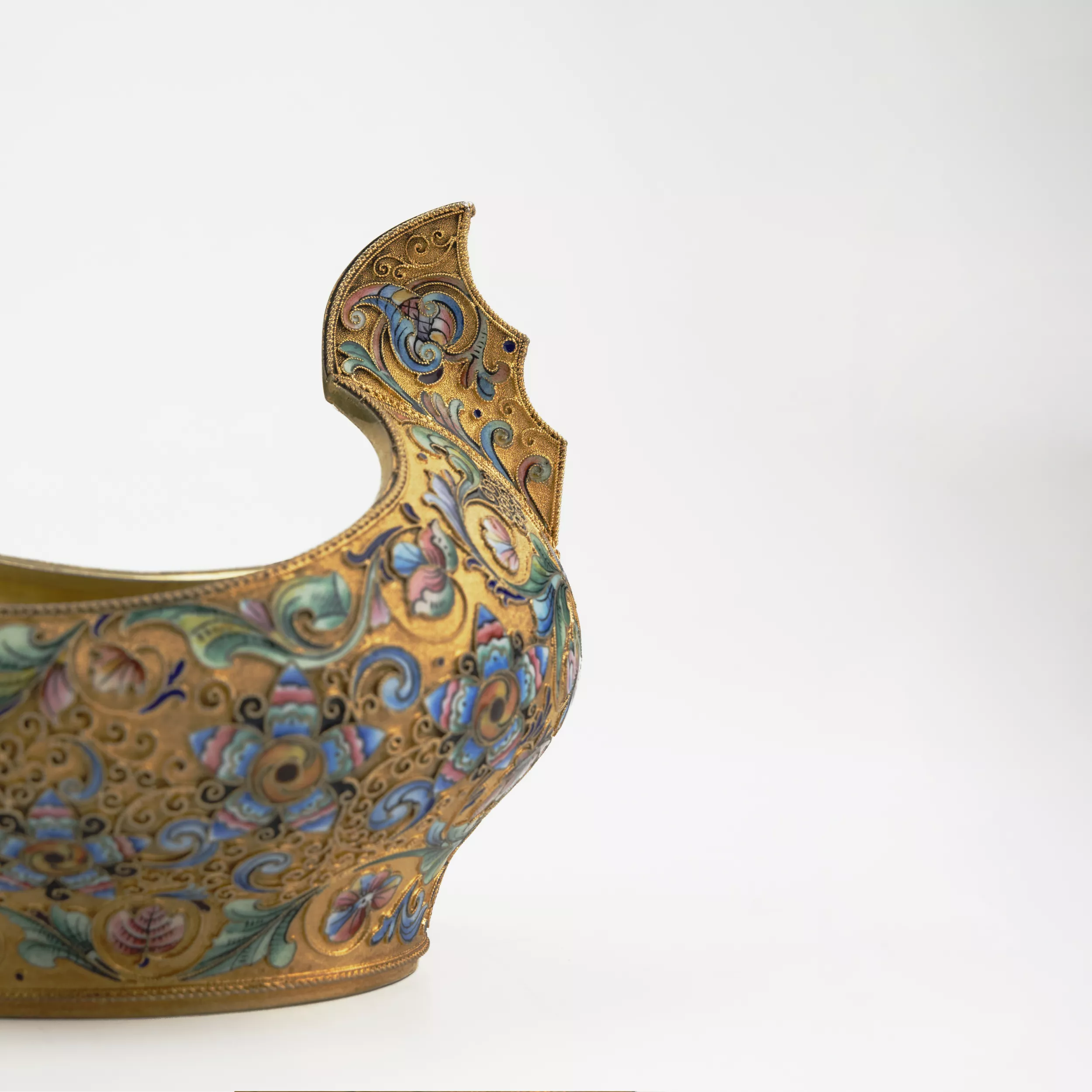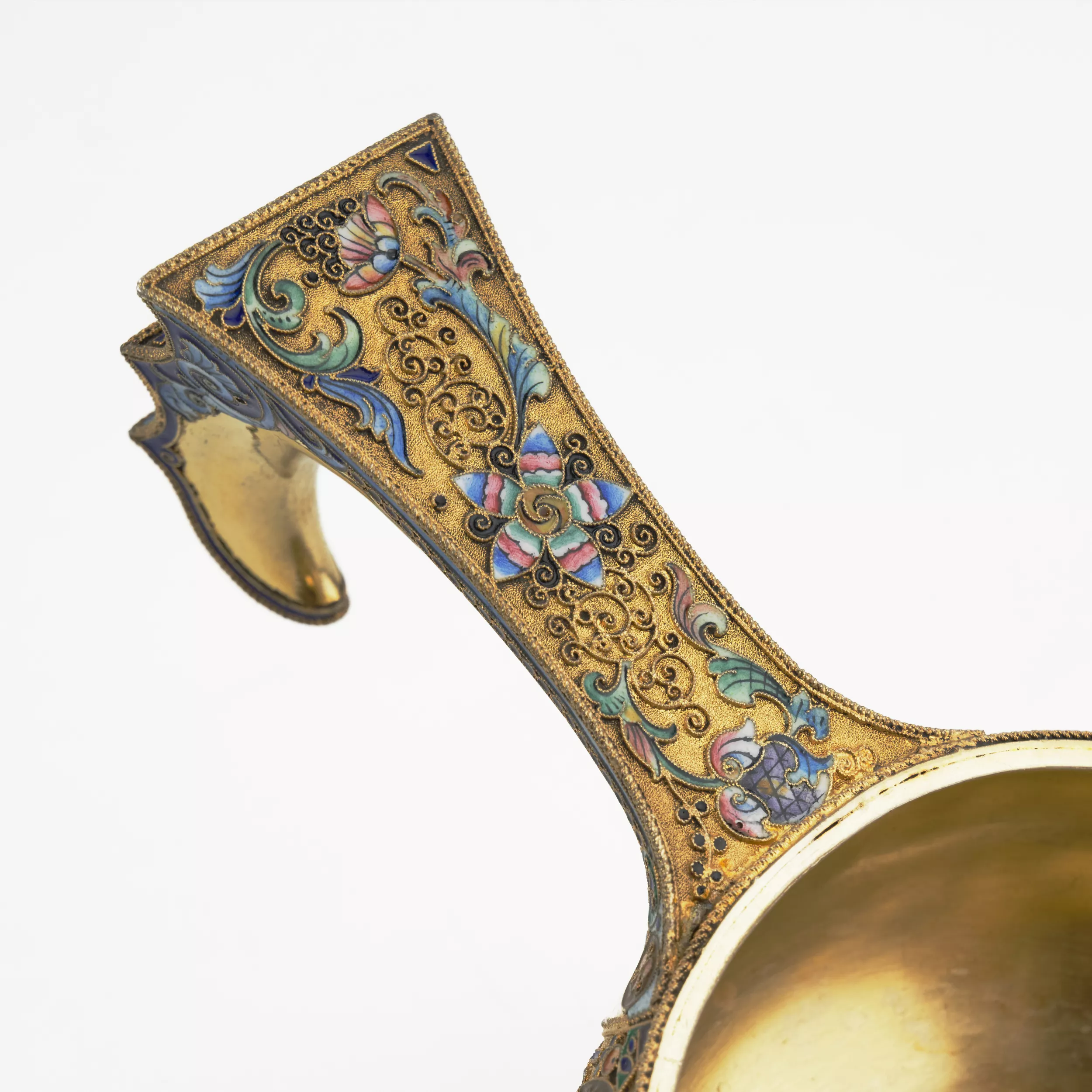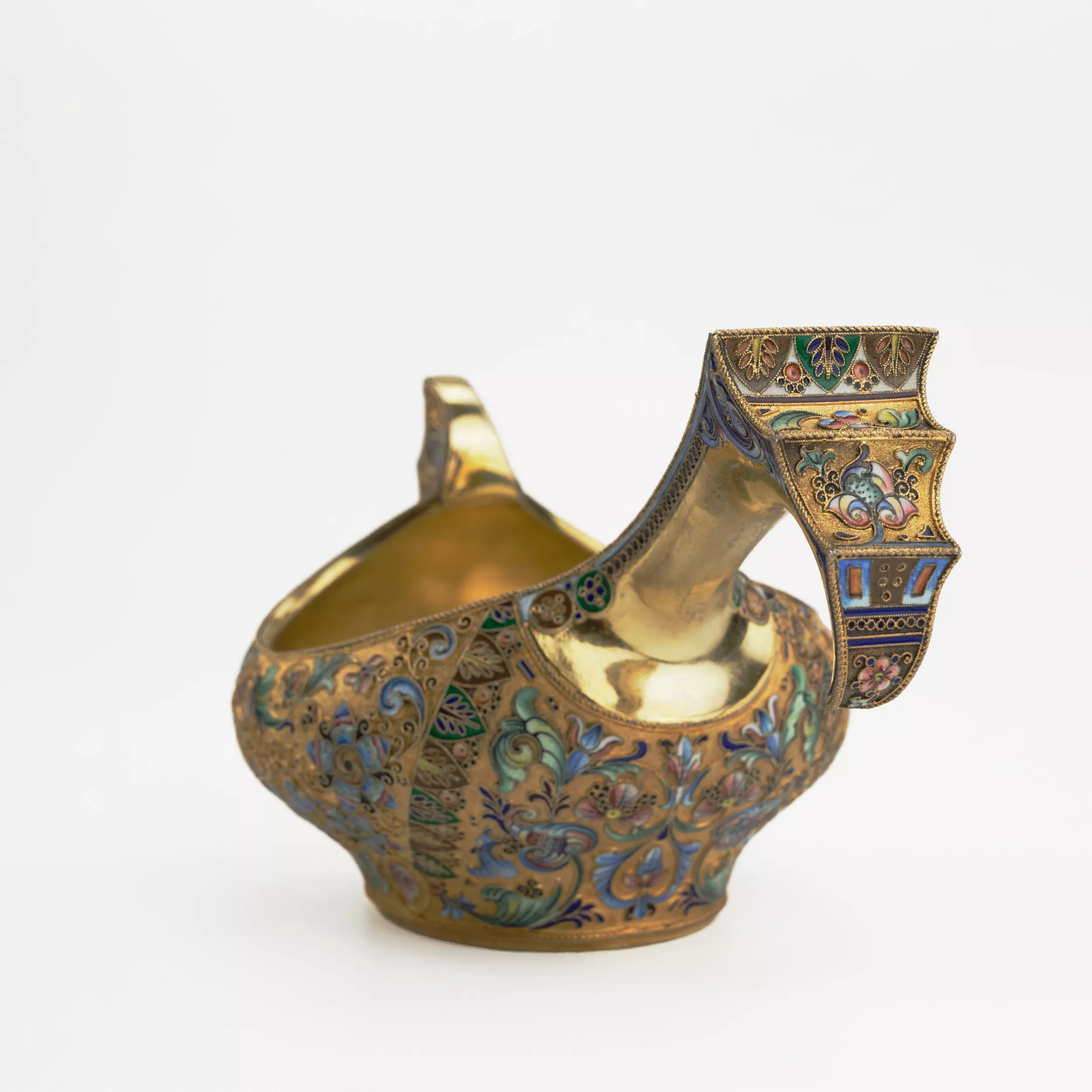


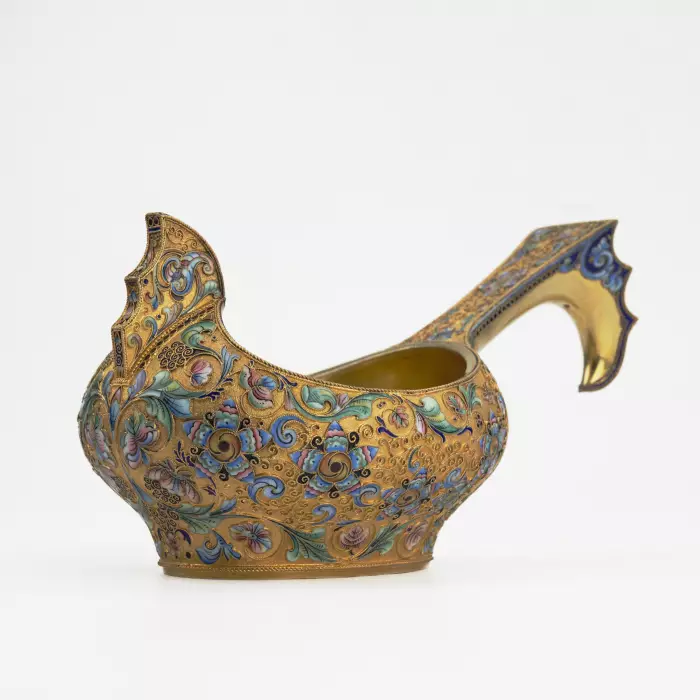
SILVER KOVSH WITH CLOISONNÉ ENAMEL IN THE NEO-RUSSIAN STYLE 11TH MOSCOW ARTEL, RUSSIA, CIRCA 1900-1908
Antiqon consultant will contact you within one business day after receiving your request.
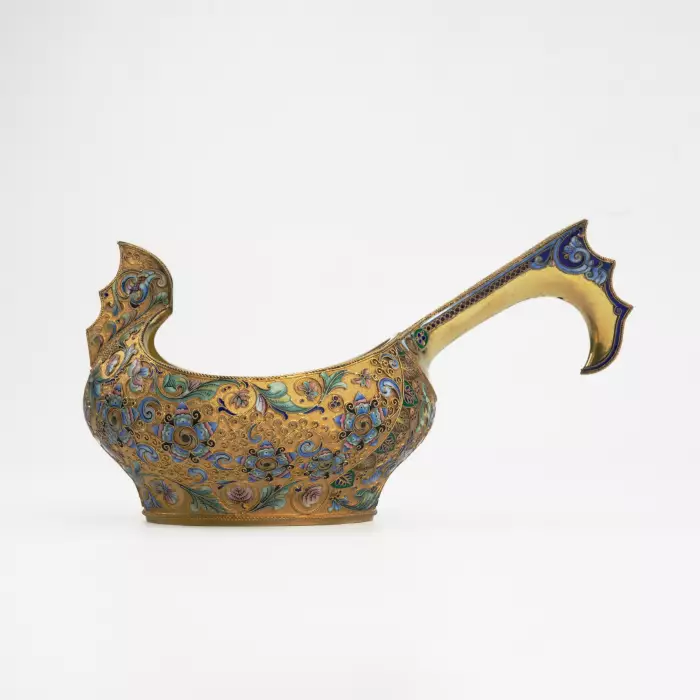
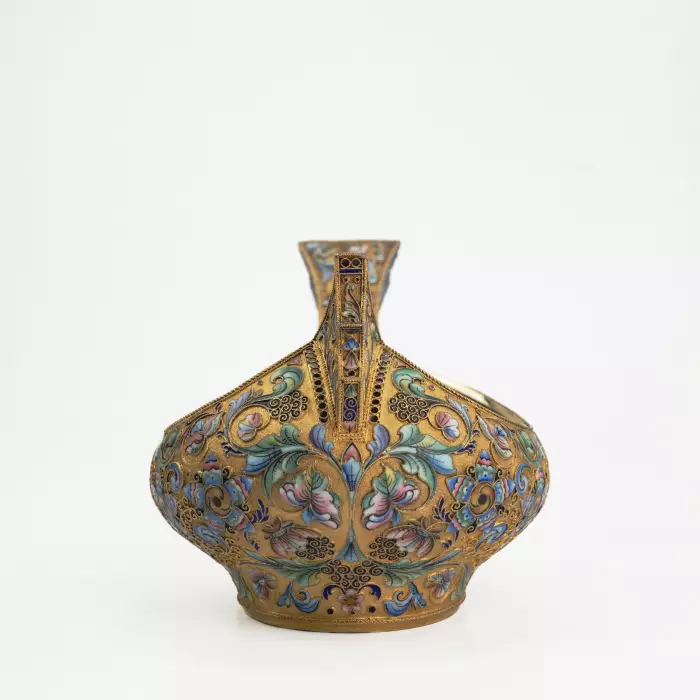
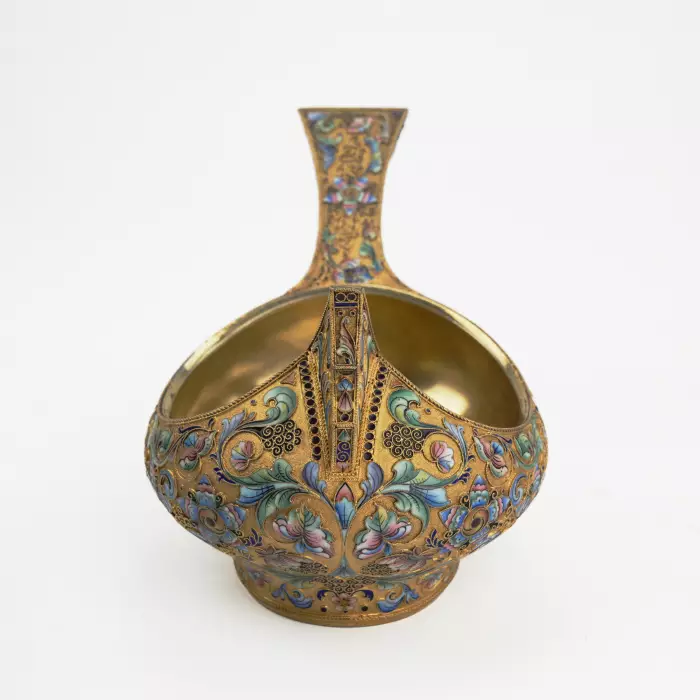
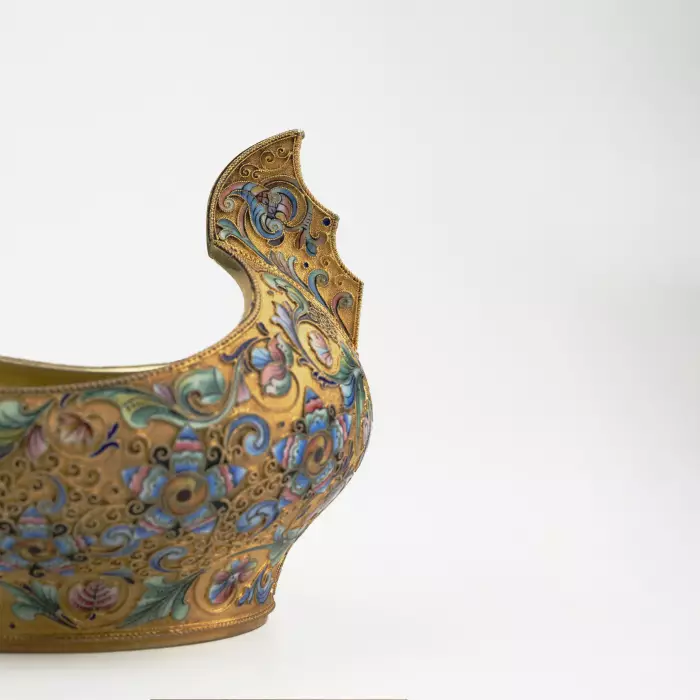
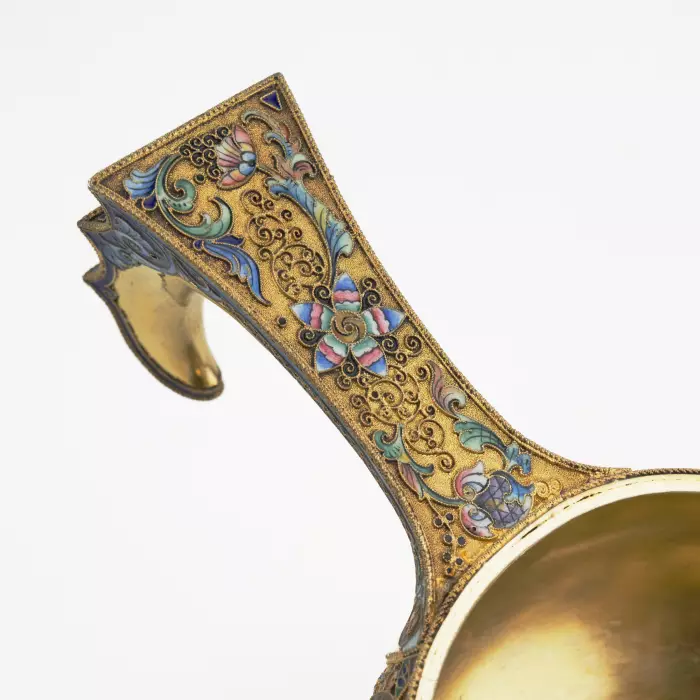
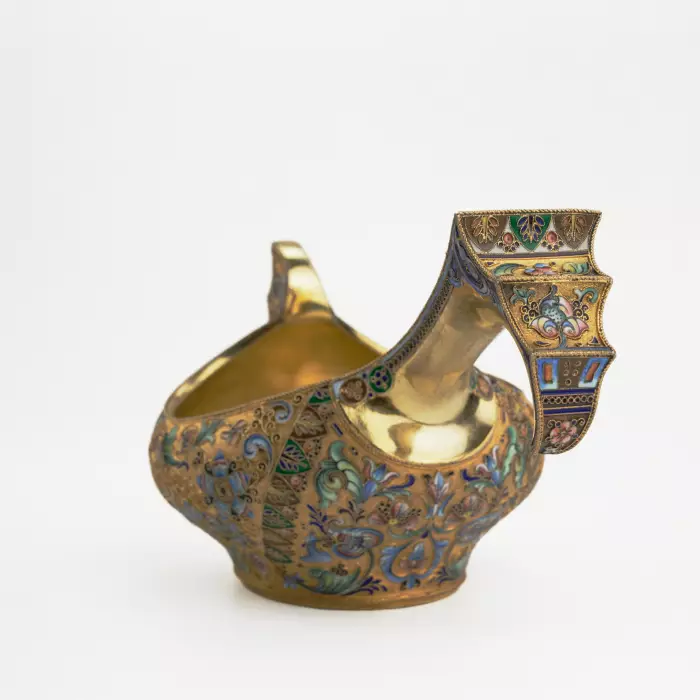
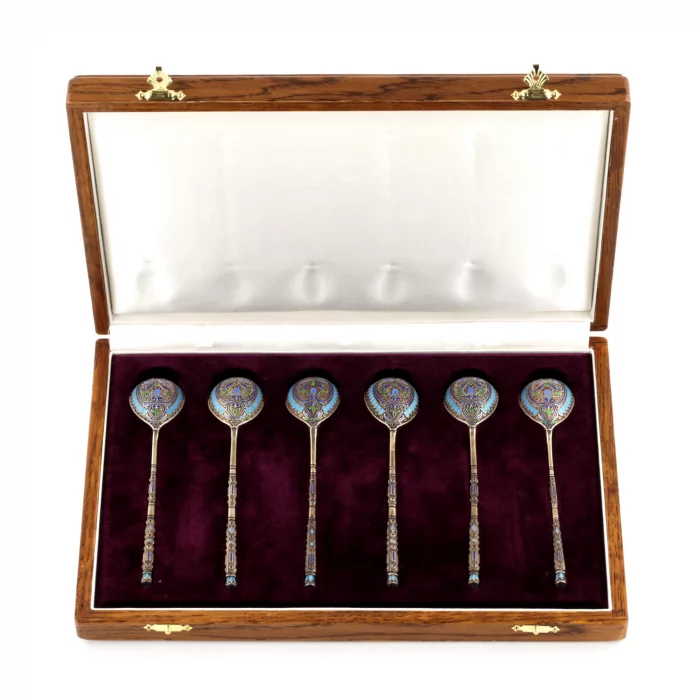
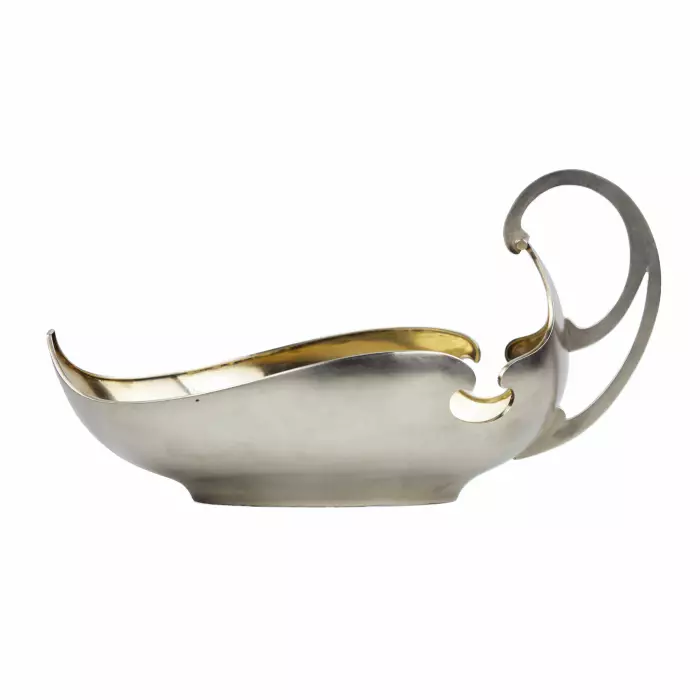
An outstanding silver kovsh of traditional Old Russian form, crafted by the 11th Moscow Artel around 1900. Rich cloisonné enamel decoration covers virtually the entire surface of the body and handle, forming an intricate ornamental composition of flowers, foliage, and scrolling vegetal motifs. The polychrome enamel, executed in a vibrant palette of blue, green, white, and pink tones against a gilded ground, reflects the exceptional skill of Moscow enamellers at the beginning of the twentieth century. The artistic conception draws inspiration from the masterpieces of seventeenth-century Russian silverwork and embodies the flourishing Neo-Russian style in the jewellery and decorative arts of pre-revolutionary Russia. The combination of a historic form, virtuoso cloisonné enamel technique, and a highly expressive decorative programme makes this kovsh a remarkable example of National Romanticism in the decorative arts of the Russian Empire.
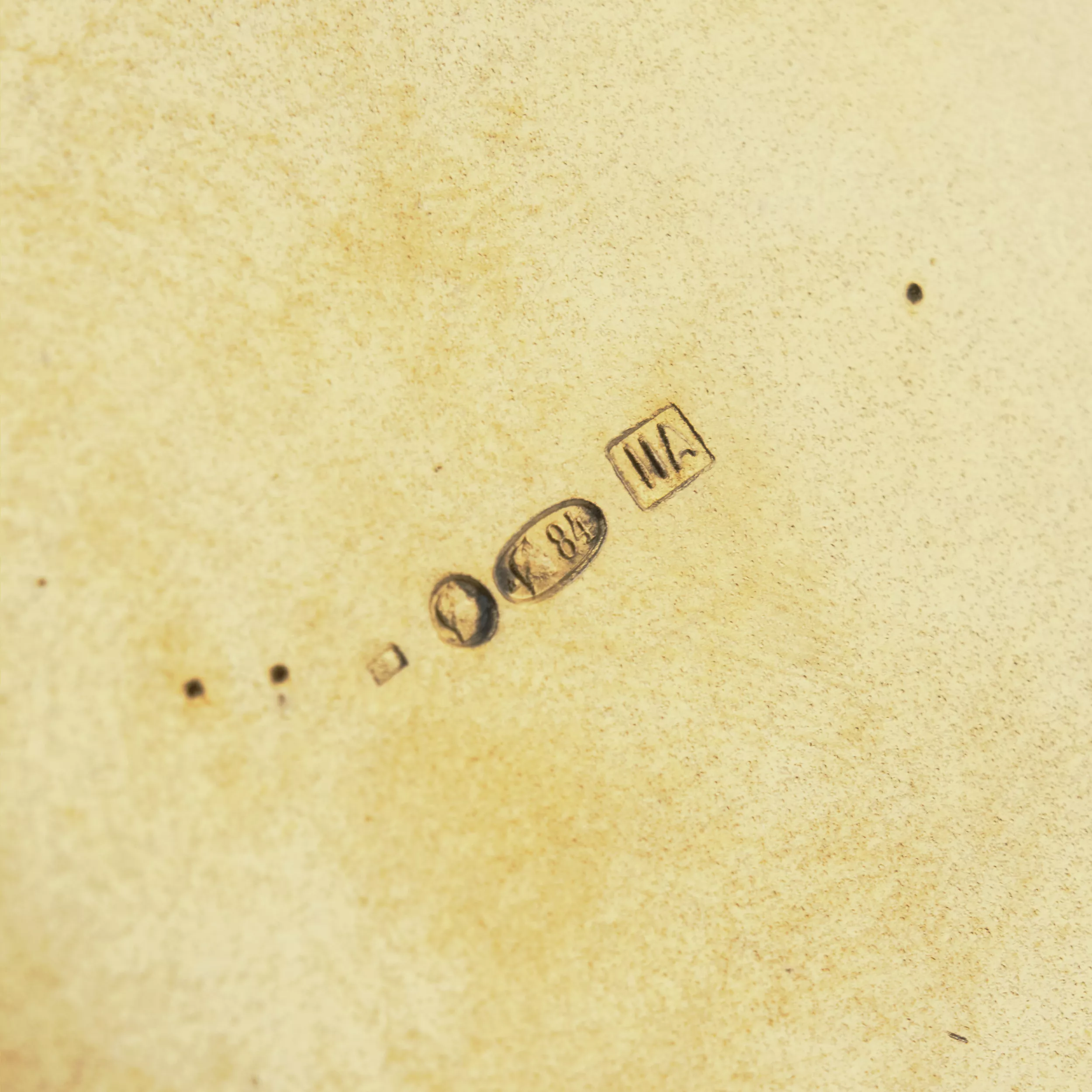
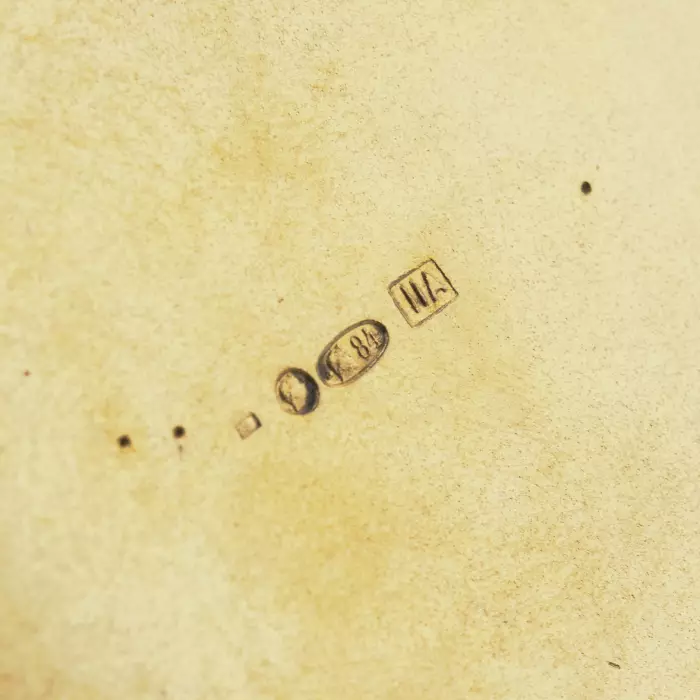
Marks: Makers mark 11A of the 11th Moscow Artel; Moscow District Assay Office mark depicting the female head in kokoshnik facing right with the Greek letter α (alpha); additional control mark with the kokoshnik head facing right; silver standard 84.
Dimensions: Height 11 cm. Length 19.5 cm.
Weight: 311.93 g.
Condition: Good. Minor traces of use consistent with age. No deformation of the body and no significant losses to the enamel decoration.
Provenance: Private European collection.
At the turn of the nineteenth and twentieth centuries, Moscow was the principal centre of artistic silver production and cloisonné enamel craftsmanship within the Russian Empire. It was here that a distinctive school of enamelling emerged, combining the artistic traditions of Old Russia with the aesthetic achievements of Historicism and Art Nouveau. A crucial role in the development of this movement was played by the numerous Moscow artels, where highly skilled silversmiths and enamellers worked collectively to create objects of exceptional artistic quality.
The 11th Moscow Artel was among the notable associations of craftsmen active in the early twentieth century and specialised in the production of silver objects in the Neo-Russian style. Workshops of this type worked under the influence of the great Russian firms of Pavel Ovchinnikov, Ivan Khlebnikov, and Feodor Rückert, while simultaneously developing their own artistic identity and maintaining a high standard of craftsmanship.
The form of the kovsh derives from traditional Russian drinking and ceremonial vessels of the sixteenth and seventeenth centuries. During the period of National Romanticism, these historic forms were revived and reinterpreted as symbols of Russias cultural heritage. The collections of the Moscow Kremlin Armoury, the State Historical Museum, and important private collections served as primary sources of inspiration for silversmiths seeking to revive the techniques and ornamental vocabulary of the past.
Cloisonné enamel represented one of the most technically demanding processes in Russian jewellery and decorative arts. Delicate silver wires were carefully shaped by hand to create the ornamental framework, after which each compartment was filled with coloured enamels and fired repeatedly at high temperatures. This painstaking process produced richly coloured and exceptionally durable decorative surfaces, characteristic of the finest works of Moscow enamelling workshops.
Today, silver kovshi with cloisonné enamel produced by Moscow workshops of the early twentieth century are among the most sought-after examples of Russian decorative art on the international art and antiques market. They are highly prized by collectors for their combination of historical authenticity, technical excellence, and outstanding artistic appeal.
The piece is in good collectors condition. The cloisonné enamel decoration is well preserved. Natural silver patina and minor traces of use consistent with age are present. There are no significant enamel losses or structural deformations.
The condition report is provided for informational purposes only.
It is not comprehensive and may not reflect all defects, restorations, alterations, or adaptations, as Antiqon does not perform professional conservation-level assessments. The information is based on a qualified, yet subjective, evaluation by our specialists.Before purchasing, we recommend consultation with an independent expert.Please also consult our Terms and conditions and Glossary A-Z, which contain important information on lot characteristics and sale conditions.