×
Create account and receive
15% DISCOUNT
your first acquisition
or
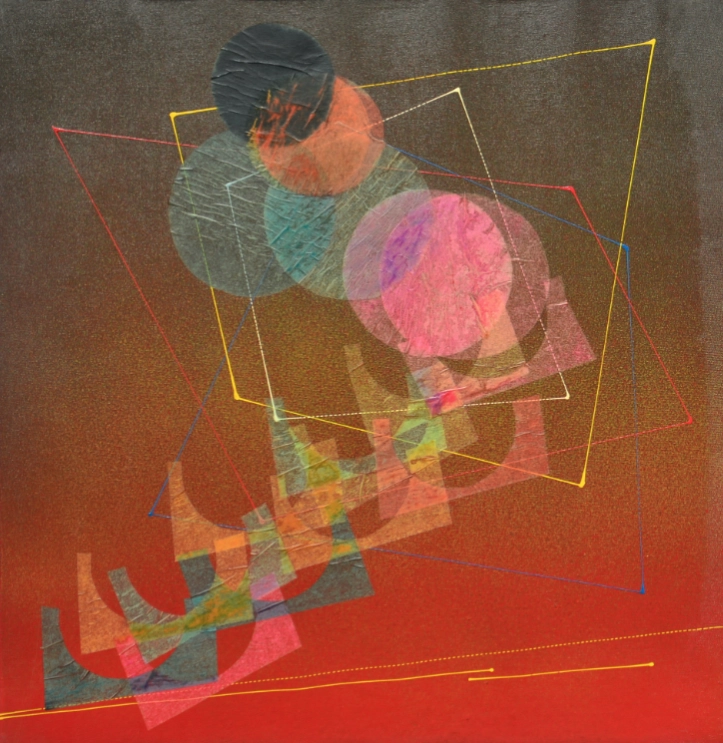
Raffaele Lattuada (born 1936, Milan) is an Italian painter and sculptor associated with abstract art of the second half of the 20th century. His work draws on the traditions of Italian spatial abstraction and explores colour, geometry and three-dimensional form. His artistic practice encompasses painting, mixed media and spatial compositions.
We will only share latest what our month on the RAFFAELE LATTUADA.
Raffaele Lattuada was born in Milan, Italy, in 1936. He received his artistic training at the Accademia di Belle Arti di Brera and the Scuola del Castello in Milan.
His artistic development took place within Milan's post-war art scene, where abstraction, Spatialism (Spazialismo) and Nuclear Art (Arte nucleare) were flourishing. These movements influenced the development of Lattuada's distinctive artistic language.
From the 1990s onwards, the artist maintained close ties with the historic region of Lunigiana, situated between Tuscany and Liguria, where he continued to develop his painting and sculptural compositions.
During the 1960s and 1970s, Lattuada developed his own approach to abstract painting, based on the interaction of geometric structures, planes of colour and spatial effects. Works exploring cosmic themes and concepts relating to the movement of matter occupied a particularly important place in his artistic practice.
Throughout the 1970s and 1980s, the artist made extensive use of mixed media, collage and multilayered compositions. His works were exhibited in art galleries in Italy and abroad.
Lattuada's artistic career is documented in monographic publications issued in 1976 and 1993. The monograph Lattuada (Severgnini Editore, 1993) includes a text by the Italian poet and art critic Roberto Sanesi.
In subsequent decades, the artist also turned towards three-dimensional compositions and metal sculpture.
Raffaele Lattuada's artistic style developed at the intersection of geometric abstraction, Spatialism and experimental painting.
His compositions are characterised by combinations of circular forms, overlapping planes, biomorphic elements and contrasting colour relationships. Cosmic themes are expressed through representations of imaginary galaxies, constellations, luminous structures and spatial sequences.
The artist worked in oils and employed mixed media, collage, metallic materials and spray-applied enamel paints. The use of varied textures enabled him to create effects of depth and visual movement.
Lattuada's sculptural experiments reveal an interest in metal structures, assemblage and the spatial relationships between individual elements.
Documented works by the artist include:
Proliferazione cosmica (1975) - mixed media and collage on canvas, 70 × 70 cm. A composition featuring geometric elements and contrasting planes of colour.
Matrice (1976) - spray-applied enamel paints on canvas mounted on panel, 51.5 × 51.5 × 10 cm.
Sequenza cosmica (1978) - an abstract composition exploring cosmic themes.
Sera (1980) - mixed media and collage on canvas, 55 × 55 cm.
A separate group comprises decorative sculptural objects presented under the name Lattuada in an illustrated booklet documenting the private collection of G. Di Pilato: Acquario Tropicale (2004), The Great Pink Cactus (2008), Cactus California (2009), Cactus spaziale (2009), as well as Jacovitti Cactus, Matite and Tubi.
These works are distinguished by their polychromy, geometric stylisation of natural forms and stylistic elements associated with Pop Art. Their direct attribution to Raffaele Lattuada (born 1936) requires further documentary confirmation.
Raffaele Lattuada's paintings are represented in private collections and documented in art catalogues published during the second half of the 20th century. The artist is also represented in the collection of MACLula, a museum of contemporary art in Sardinia.