×
Create account and receive
15% DISCOUNT
your first acquisition
or
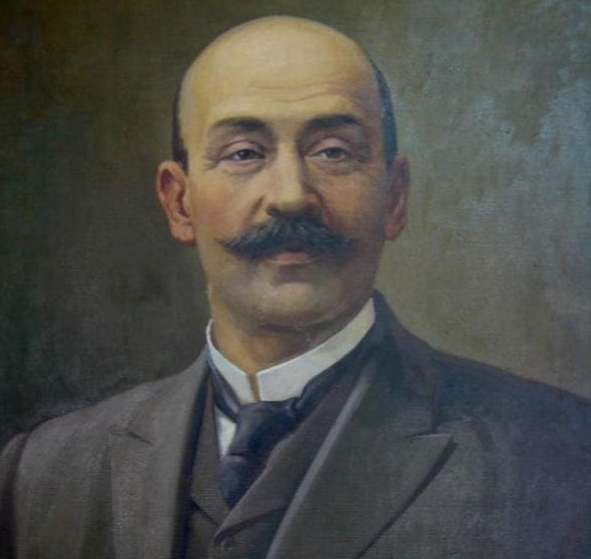
Franz Roubaud was a Russian painter of French origin and one of the most prominent masters of battle painting and Orientalism of the late 19th and early 20th centuries. An Academician of the Imperial Academy of Arts, he became renowned for his monumental historical panoramas and works devoted to the Caucasus, military history, and the cultures of Eastern peoples.
We will only share latest what our month on the FRANZ ROUBAUD.
Franz Alexeyevich Roubaud (Franz Roubaud) was born on 15 June 1856 in Odessa into a family of French origin. He received his first artistic training at the Odessa Drawing School, where he developed an early interest in genre scenes and animal painting.
In 1877, Roubaud continued his studies at the Munich Academy of Fine Arts under Carl Theodor von Piloty, Józef Brandt, and other representatives of the German academic tradition. The Munich school played an important role in shaping his artistic approach, characterised by precise draughtsmanship, attention to detail, and a scholarly treatment of historical subjects.
From the late 1880s, Roubaud worked extensively within the Russian Empire. In 1903, he was awarded the title of Academician of the Imperial Academy of Arts and was later invited to teach at the Higher Art School of the Academy in Saint Petersburg.
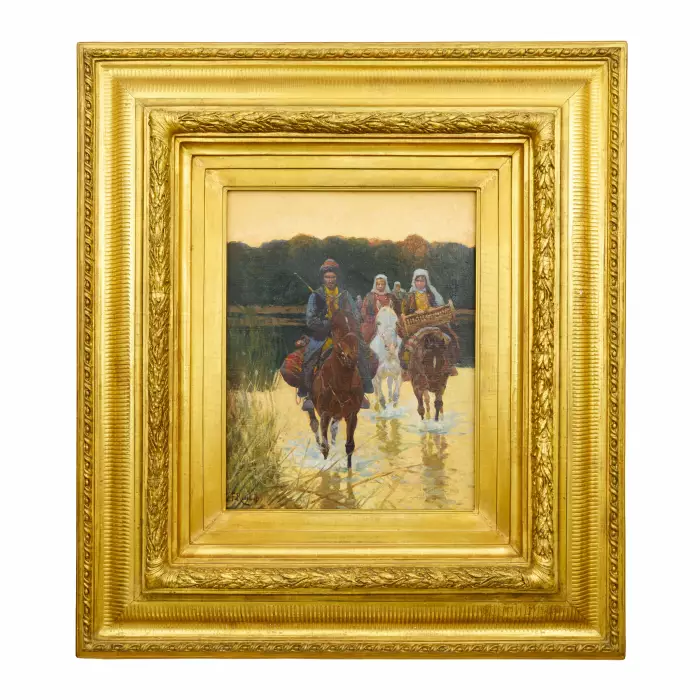
One of the defining stages of Franz Roubaud’s artistic career was his numerous journeys to the Caucasus and Central Asia. The artist studied the daily life, costumes, weapons, and traditions of the peoples of these regions, creating numerous genre compositions depicting horsemen, hunting scenes, and military subjects.
During the 1880s and 1890s, Roubaud gained recognition as a leading master of historical painting. Commissioned by Russian state institutions, he created several monumental works dedicated to the military history of the Russian Empire.
Among his most celebrated projects are the panorama The Storming of the Aul of Akhulgo (1890), devoted to the events of the Caucasian War; The Defence of Sevastopol (1904); and the monumental panorama The Battle of Borodino (1912), created for the centenary of the Patriotic War of 1812.
After 1913, the artist lived mainly in Germany, where he continued to create historical and Caucasian-themed compositions. Franz Roubaud died on 13 March 1928 in Munich.
Franz Roubaud is regarded as one of the most important representatives of Russian battle painting and Orientalism at the turn of the 20th century. His artistic legacy combines the traditions of European academic painting with a profound study of ethnographic material.
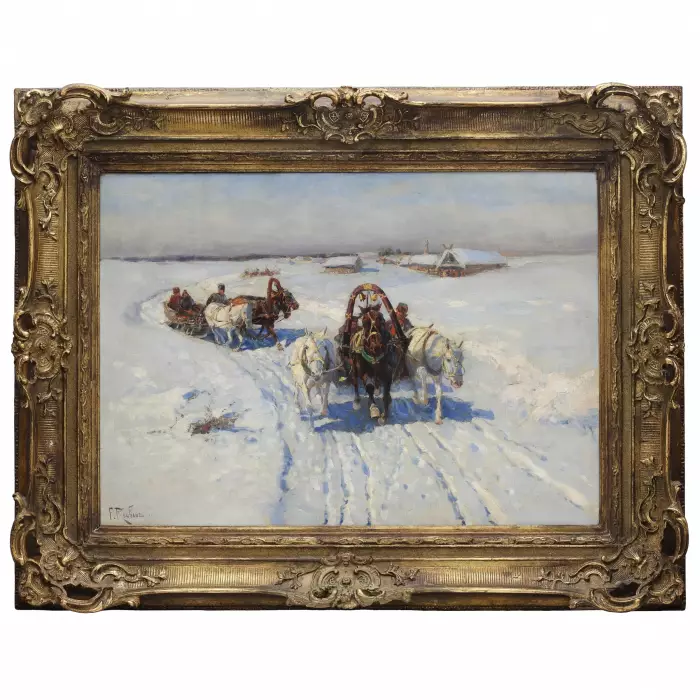
A special place in his oeuvre is occupied by Caucasian subjects: mountain landscapes, horsemen, military episodes, and scenes of everyday life. His works are distinguished by dynamic compositions, an accurate depiction of horses in motion, and meticulous attention to weapons, costumes, and historical details.
Roubaud’s paintings demonstrate exceptional mastery of oil painting techniques, complex multi-figure compositions, and a commitment to historical authenticity.
Franz Roubaud holds an important position in the history of Russian and European art as one of the creators of the largest historical panoramas of his era.
Among his most significant works are:
The Storming of the Aul of Akhulgo, 1890 - a monumental panorama dedicated to the Caucasian War.
The Defence of Sevastopol, 1904 - one of the major achievements of Russian battle painting.
The Battle of Borodino, 1912 - a historical panorama created to commemorate the centenary of the victory in the Patriotic War of 1812.
Works by Franz Roubaud are preserved in leading museum collections, including the State Russian Museum, the State Tretyakov Gallery, the Borodino Battle Panorama Museum, and other major public collections.
Roubaud’s artistic heritage remains highly valued by scholars and collectors due to its combination of academic mastery, historical significance, and unique representation of the cultural heritage of the Caucasus and the Russian Empire in the late 19th century.